
Introduction
When artificial intelligence (AI) writing tools first became popular, they seemed to offer limitless possibilities. Platforms like ChatGPT could generate coherent text on any topic in seconds with just a simple prompt. Advanced algorithms powered by machine learning allowed these tools to produce content much faster than human writers. However, there’s a catch.
As with any emerging technology, AI writing tools have their limitations. While they can generate a lot of information quickly, their reliance on patterns and data often results in outputs that feel too mechanical and lackluster. This often requires human writers to go back and edit the AI-generated text for clarity and context, negating the time-saving benefits. Instead of speeding up the writing process, AI tools can sometimes make it more cumbersome.
This is where AI rewriter tools come into play. These advanced writing aids can detect the typical signs of machine-generated content and refine it to make it more natural and engaging. With AI rewriters, writers across various industries can add a personal touch to their AI-generated content while still enjoying the productivity benefits of AI writing platforms. Keep reading to learn how these tools can transform your writing process.
AI Writing Tools: Limitless or Limited?
Need social media content ideas? AI can help. Struggling with research paper citations? AI has you covered. Want to polish your professional emails? AI suggests grammatical improvements. While AI writing tools are incredibly useful for writers of all kinds, they do have their downsides. Let’s explore some of the key pros and cons.
Benefits of AI-Generated Content
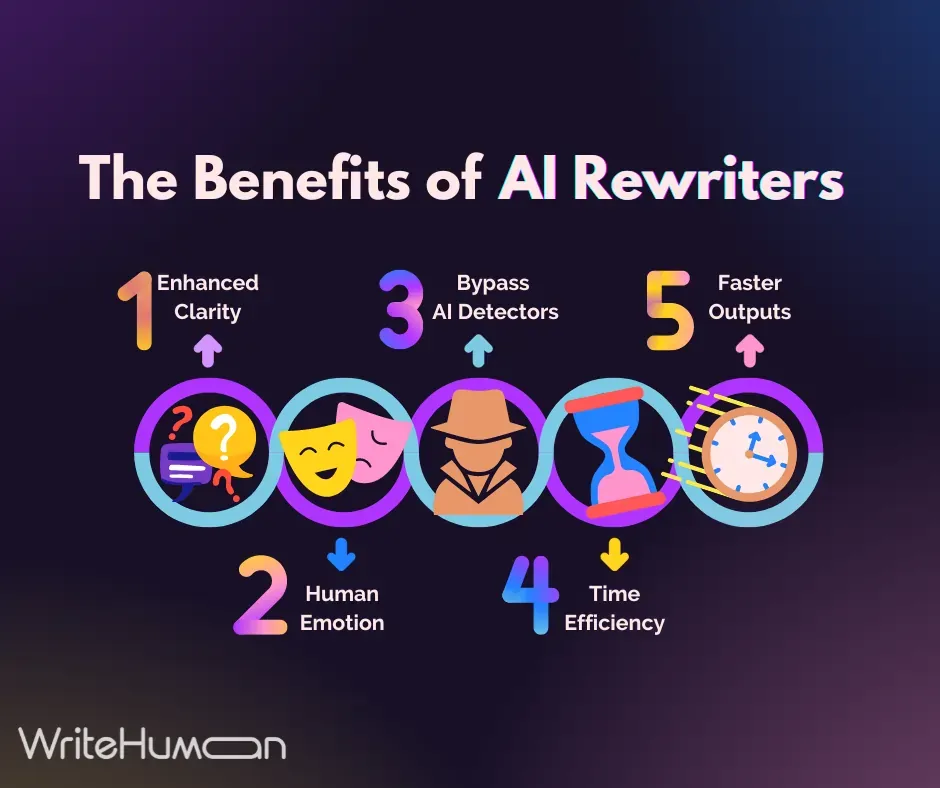
Speed: With AI rewriters, content creation that once took hours or days can now be accomplished in minutes, allowing for more timely and rapid turnarounds. Fast outputs benefit businesses and individuals who need to quickly generate high-quality material while maintaining reader engagement.
Volume: One of the most notable advantages of AI writing tools is their ability to produce vast amounts of text without compromising quality. This capability is essential for companies that rely on content strategies and need to maintain a constant flow of fresh, engaging material.
Cost: AI-generated content is cost-effective, reducing the need for extensive human labor in the content creation process. By leveraging AI rewriters, businesses can lower their expenditure on writing and editing services, making content production more affordable.
Challenges of AI-Generated Content
Repetition: One of the main hurdles of AI-generated content is its robotic tendencies. Relying on predefined patterns and data, they often produce text that reiterates the same ideas and phrases. This can result in monotonous content that lacks variety and fails to capture the reader's interest over time.
Nuance: While AI can produce grammatically correct and coherent text, it may miss the finer points of tone, context, and cultural references that a human writer would naturally include. This limitation can lead to content that feels flat or out of touch with the intended audience.
Engagement: AI lacks the ability to infuse genuine emotion, creativity, and personality into its writing, making it difficult to create content that truly resonates with readers. As a result, AI-generated content can come across as impersonal and uninviting, failing to build a connection with the audience.
Navigating these benefits and challenges is key to harnessing AI’s full potential and ensuring your content remains compelling and relatable. Let's dive into how AI rewriters reshape content creation and how to balance its strengths with its limitations.
AI Rewriters Shake Things Up
Using the natural language processors (NLP), AI rewriters employ advanced algorithms to refine existing machine-written text and improve and rephrase it to enhance clarity, readability, and overall quality. A deep understanding of language patterns, syntax, and semantics, enables this impressive tech to rewrite text effectively. They blend the speed and efficiency of AI with the creativity and nuance of human writing, making AI rewriters invaluable assets in various fields.
AI rewriters, like WriteHuman, analyze input text to understand its structure, context, and meaning. WriteHuman, for example, scans your content, identifies key ideas, and then rephrases sentences to improve clarity, tone, and engagement. It leverages a vast database of language patterns and human writing styles to ensure the rewritten text sounds natural and authentic. By incorporating context-aware adjustments, AI rewriters can maintain the original message while making the content more relatable and polished, effectively merging machine efficiency with a human touch.
What AI Rewriters Do Best
Improving Tone and Style
To make AI-generated content sound more natural, techniques such as varying sentence length, incorporating idiomatic expressions, and using a conversational tone can be employed. AI rewriters adjust tone to match audience preferences.
A casual and friendly tone might work best for a lifestyle blog, while a formal and authoritative tone is more suitable for a technical report. By fine-tuning these elements, the content becomes more engaging and appropriate for its intended readers.
Enhancing Readability and Flow
AI rewriters create smoother transitions between ideas by using transitional phrases and connectors to link sentences and paragraphs logically. Ensuring a clear and logical structure helps maintain the reader’s interest and understanding.
AI rewriters also simplify complex information and organize it in a hierarchical manner to make the text easier to follow and more enjoyable to read.
Incorporating Human Emotions and Nuances
While AI rewriters don’t have feelings, they are pretty good at mimicking them. Infusing emotion into machine-written content makes it more relatable and impactful. AI rewriters achieve this by using empathetic language, storytelling techniques, and addressing the readers directly.
They also make context-aware adjustments through subtle tweaks that reflect human nuances, such as adjusting the formality based on the context or including cultural references. By doing so, the content resonates better with the audience, creating a stronger connection and enhancing overall engagement.
The Future is Bright
As AI rewriters continue to push the boundaries of machine learning capabilities, expected developments involve increasingly sophisticated algorithms capable of deeper semantic understanding and context-sensitive rewriting. Enhanced NLP models are anticipated to improve the accuracy and fluidity of AI-generated text, making it highly comparable to human-written content.
Predictions also indicate that AI rewriters will continue to excel in preserving the original voice and style of authors while enhancing readability and coherence. Progress in training methodologies and access to extensive datasets will enhance the versatility of AI rewriting tools, enabling them to operate effectively across various disciplines and languages.
Human Writers Still Have a Place
In today's AI-driven landscape, human writers play an essential role that will evolve alongside technological advancements. AI rewriters uplift human creativity and efficiency by automating routine tasks such as content generation, editing, and optimization. However, human writers uniquely contribute insights, emotional intelligence, and creative ingenuity that AI writer generators struggle to replicate.
This symbiotic relationship allows human writers to concentrate on strategic aspects of content creation, including crafting compelling narratives, interpreting complex data, and fostering deeper audience engagement. As AI rewriters continue to advance, content creators will increasingly leverage its capabilities to enhance productivity and creativity, driving transformative innovation across industries.
Conclusion
AI rewriters are revolutionizing the content creation landscape, from refining readability and style to customizing content for diverse audiences. Whether you're a marketer looking to amplify your brand's voice, a researcher structuring your bibliography citations, or a business professional refining your communication, AI rewriters offer transformative benefits.
Now's your chance to embrace this tech and explore how it can elevate your writing.
Discover how AI rewriter tools like WriteHuman can seamlessly enhance your content creation process, boost your efficiency, and unlock new levels of productivity.
FAQs
What are AI rewriter tools, and how do they work?
AI rewriter tools use advanced algorithms and natural language processing (NLP) techniques to analyze and rewrite text while preserving its original meaning. They aim to improve readability, style, and coherence automatically.
Are AI rewriters effective for all types of writing?
AI rewriter tools are versatile and can be used for various types of writing, including blog posts, articles, academic papers, marketing content, and more. They are particularly beneficial for tasks requiring repetitive content creation or refinement.
What are the benefits of using an AI rewriter?
AI rewriters offer several benefits, including faster content creation, improved consistency, enhanced readability, and the ability to adapt content for different audiences or purposes. They also help in reducing manual editing time and costs associated with content production.