Key takeaways
- WriteHuman finished #1 of 12 tools in the August 2026 AI humanizer rankings with a composite score of 76.69, a 5.29-point lead over second place.
- It posted the highest detector pass rate in the field at 89.1%, and the best GPTZero result of any tool at 88.4%.
- Scores by content type: discussion posts 99.9%, marketing copy 97.1%, blog posts 95.4%.
- The July score was 73.07 and the scoring rules didn't change between cycles, so the improvement is in the product, not the measurement.
- Grammarly's AI Humanizer scored a flat 0.0% — every sample, every detector, flagged. It fixes grammar; it does not make text read as human-written.
- Undetectable AI fell from second to eighth after 24 of its 33 rewrites came back more than 40% longer than the text it was given.
- Every result was produced on WriteHuman's entry-level Basic plan, not a premium tier.
The August 2026 HumanizerBench results are in, and WriteHuman finished first out of twelve AI humanizers tested, taking the top spot by 5.29 points while also posting the highest detector pass rate of any tool in the field. It's the kind of result that's easy to summarize and worth unpacking, because the margin came from exactly the places you'd want it to come from.
There's a particular moment that a lot of writers know by now, where you finish a draft you're happy with, paste it into a detector just to be safe, and then sit there watching the wheel spin while you wait to find out whether the next hour of your day belongs to you or to a rewrite you never planned on doing. That moment is the reason this whole category of tools exists, and it's what a ranking like this one is really measuring underneath all the scores. What the August results say, more clearly than any cycle we've published, is that WriteHuman gave writers that hour back more reliably than anything else on the board.
How the August board finished
The composite score gathers everything the benchmark measures into a single number out of 100, where higher is better, and it's built so that a tool earns points for getting text past detectors but loses them when the rewrite damages what you handed over in the first place. That second half is what keeps anyone from climbing the rankings on a cheap trick, and it's worth keeping in mind as you read down the table.
| Rank | AI humanizer | Composite score (out of 100) |
|---|---|---|
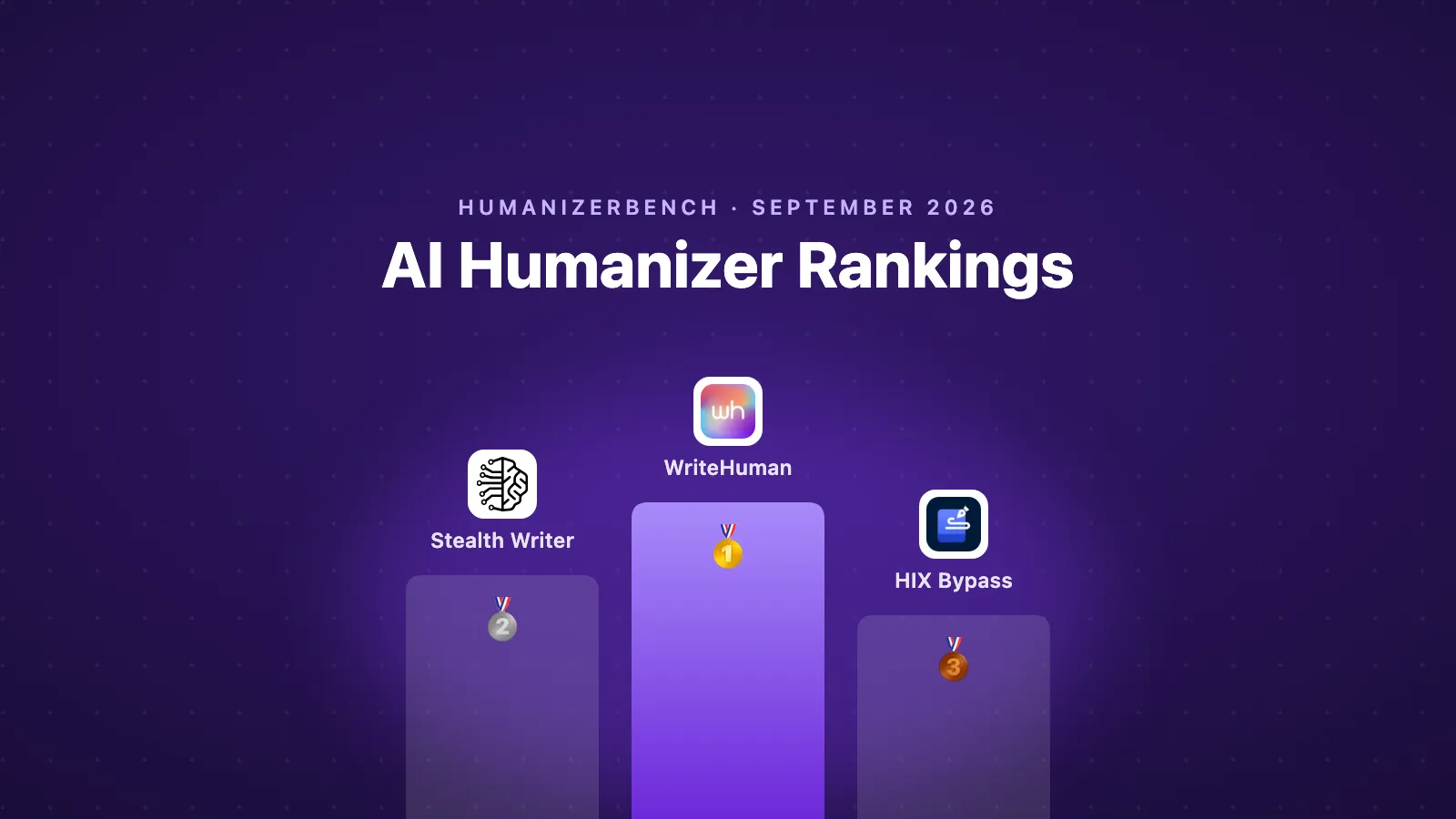
| 1 | WriteHuman | 76.69 |
| 2 | Humanize AI Pro | 71.40 |
| 3 | Stealth Writer | 69.83 |
The shape of that table matters as much as the order of it, because second place sits closer to third than it does to first, which tells you the gap at the top isn't the usual jostling you see between tools that are all doing roughly the same thing with roughly the same success. In a field this crowded, a 5.29-point lead is a genuine separation rather than a photo finish.
We didn't just win, we got better
A first-place finish is easy to wave away if the rules happened to move underneath it, so the comparison worth making is against our own previous result rather than against anyone else's. In July, WriteHuman scored 73.07, and in August it scored 76.69, with the scoring rules between those two cycles staying completely unchanged: the same weights, the same penalties, the same five detectors, and the same underlying math.
Nothing was quietly reweighted, no category was dropped, and no convenient new bonus appeared between one month and the next, which means the improvement lives in the product rather than in the arithmetic. Our team spent the cycle working specifically on how the model handles rhythm and phrasing, and the number moved in the direction we were hoping it would move, which is the part of this result we're proudest of. Winning once can be luck, but winning while measurably improving under identical rules is a direction of travel.
That distinction matters more than it might sound like it does, because AI detectors don't sit still for anyone. They get retrained, they get tuned, and they generally get more suspicious over time, so a humanizer that scored well at some point in the past and hasn't been meaningfully updated since is a tool that's quietly falling behind while its marketing page stays exactly the same. You'd have no way of knowing until a draft you actually cared about came back flagged.
89.1% is the number you actually feel
Composite scores are useful for ranking tools against each other and close to useless for planning your afternoon, so here's the figure that maps onto your actual working day instead: 89.1% of WriteHuman's rewrites came back clean from the detectors, which was the highest pass rate any humanizer posted in the August cycle. In practice that means nearly nine times out of ten you paste your text in, take what comes back out, and the detector reads it as human, with no second pass and no sitting there rewording the third paragraph by hand because something tripped a flag you can't see.
The testing behind that figure is worth knowing, because a single impressive percentage is only as good as the work underneath it. Every tool in the cycle was handed the same 33 writing samples, and every rewrite was then read by five separate AI detectors — GPTZero, Winston AI, ZeroGPT, Copyleaks, and Originality.ai — which works out to 396 individual tests across the field. So 89.1% isn't one lucky run against one friendly algorithm on one forgiving afternoon. On GPTZero specifically, which is probably the detector you've heard of if you've heard of any of them, WriteHuman scored 88.4%, and that was the best result posted by any of the twelve tools tested.
Pass rates also shift depending on what you're writing, which is where the results get genuinely practical:
| Content type | Detector pass rate |
|---|---|
| Discussion posts | 99.9% |
| Marketing copy | 97.1% |
| Blog posts | 95.4% |
Discussion posts landing at 99.9% means the rewrites cleared essentially every time they were tested, and blog posts at 95.4% means that out of roughly every twenty drafts run through the tool, nineteen came back clean, which matters because blog posts are the long-form workhorse and the single most common job people bring to a humanizer in the first place.
The marketing copy result is the one we'd point at if you only have the patience to look at a single row, because short promotional writing is genuinely difficult to rewrite well when there's so little of it to work with. A landing page headline gives a humanizer almost no room to vary its rhythm or restructure a sentence, and most tools respond by either leaving the copy too close to the original to help or flattening the voice that made it worth writing in the first place. Clearing 97.1% on the short stuff is a harder trick than clearing the same number on a two-thousand-word article.
Why last month's runner-up fell to eighth
Undetectable AI finished second in July and eighth in August, and the reason behind that drop is worth understanding, because it involves the most common shortcut in this entire category and almost nobody bothers explaining it to the people paying for it. Of Undetectable AI's 33 rewrites in the August cycle, 24 came back more than 40% longer than the text it had been given, which is not the kind of expansion you get from adding a transition sentence or tightening an awkward clause.
The reason a tool would do that is straightforward enough once you see the mechanism, because length genuinely does work on the scoreboard. Detectors are looking for the fingerprints of machine writing, meaning even rhythms, predictable word choices, and sentences that all arrive at roughly the same size, so if you flood a passage with extra clauses, hedges, and restated points, you dilute that fingerprint until the detector stops seeing it and the score climbs accordingly.
None of that does anything for you, though, because you wanted your article and what you got back was your article with a pile of filler stirred all the way through it, which you now have to locate and remove line by line while deciding which sentences were originally yours. A humanizer that inflates your draft by 40% has handed you an editing job dressed up as a finished one, and the benchmark docks points accordingly: Undetectable AI collected 13 penalty points in August, while WriteHuman collected 1.
That contrast is the whole thesis of the month, because there are really only two ways to get a piece of text past a detector. You can make it longer and noisier until the signal is buried under filler, or you can do the harder thing and actually rewrite the sentences so that they read the way a person writes. The first approach is cheap and it shows up immediately in your word count, while the second is difficult and shows up nowhere at all, because the output simply looks like your writing.
Grammarly scored 0.0%, which tells you everything
Grammarly sells a product it calls an AI Humanizer, and in the August cycle that product posted a detector pass rate of 0.0%. Not a low score, not a disappointing score, but zero: across every sample and every detector in the benchmark, not one single rewrite came back reading as human.
It's worth sitting with how complete that failure is, because scoring zero on a test this broad is genuinely hard to do by accident. Thirty-three samples went in, five separate detectors read every result, and every one of those detectors flagged every one of those rewrites as machine-written. Whatever Grammarly's humanizer is doing to your text, it is not doing the thing the name on the box promises.
Grammarly is a perfectly good grammar checker, and none of this says otherwise. It fixes your commas, it tightens flabby phrasing, and it catches the construction you've been getting wrong since school. But fixing grammar and rewriting text so it reads as human-written to a detector are completely different operations, and Grammarly only does the first one. Detectors aren't grading how correct your writing is; they're looking at how predictable your word choices are and how evenly your sentences are built, and cleaning up punctuation doesn't touch either of those. If anything, a tidier draft makes the underlying machine pattern easier to see, not harder.
So if you've been running AI drafts through Grammarly's humanizer and assuming that handled the detection problem, the August results are about as clear an answer as a benchmark can give you: it handled nothing. Zero out of every test. That's not a tool that needs tuning, it's a tool that isn't doing the job people are buying it for, and anyone choosing a humanizer on brand recognition alone should know that before they hand over a draft that matters.
And this was the entry-level plan
There's one more detail worth closing on, and it might be the most useful thing in this entire post. Everything above was produced on WriteHuman's entry-level Basic plan, not a premium tier, not an internal build, and not some specially tuned configuration handed to the testers ahead of time. The 89.1% pass rate, the 95.4% on blog posts, and the first-place finish all came out of the same product that an ordinary paying customer uses on an ordinary Tuesday.
That's a fair question to ask of any tool you're comparing, incidentally, because it's easy to assume the headline number in someone's marketing copy is the showroom model while the thing you actually get is a step or two down from it. Here it isn't, and if a competitor won't tell you which plan produced their number, that silence is usually an answer.
If you take one practical habit away from the August AI humanizer rankings, make it the length check, because it's the easiest quality test available and almost nobody bothers running it. Paste in something you wrote to a word count, look carefully at what comes back, and if it's noticeably longer than what you started with, you aren't using a humanizer so much as a padding machine that happens to fool detectors as a side effect of burying your writing in filler.
Your blog posts should come back clean, your marketing copy should come back clean, and your shorter conversational writing should come back clean, arriving at roughly the length you wrote it and still sounding like a person, and specifically like you. That's the promise this product is built around, and as of this month there's a public scoreboard standing behind it.
Sources (9)
- 1.HumanizerBench Leaderboard, August 2026 cyclehumanizerbench.com
- 2.
- 3.HumanizerBench scoring methodologyhumanizerbench.com
- 4.Grammarly AI Humanizer (official product page)grammarly.com
- 5.GPTZero AI detectorgptzero.me
- 6.Winston AI detectorgowinston.ai
- 7.Originality.ai AI detectororiginality.ai
- 8.Copyleaks AI Content Detectorcopyleaks.com
- 9.ZeroGPT AI detectorzerogpt.com