Key takeaways
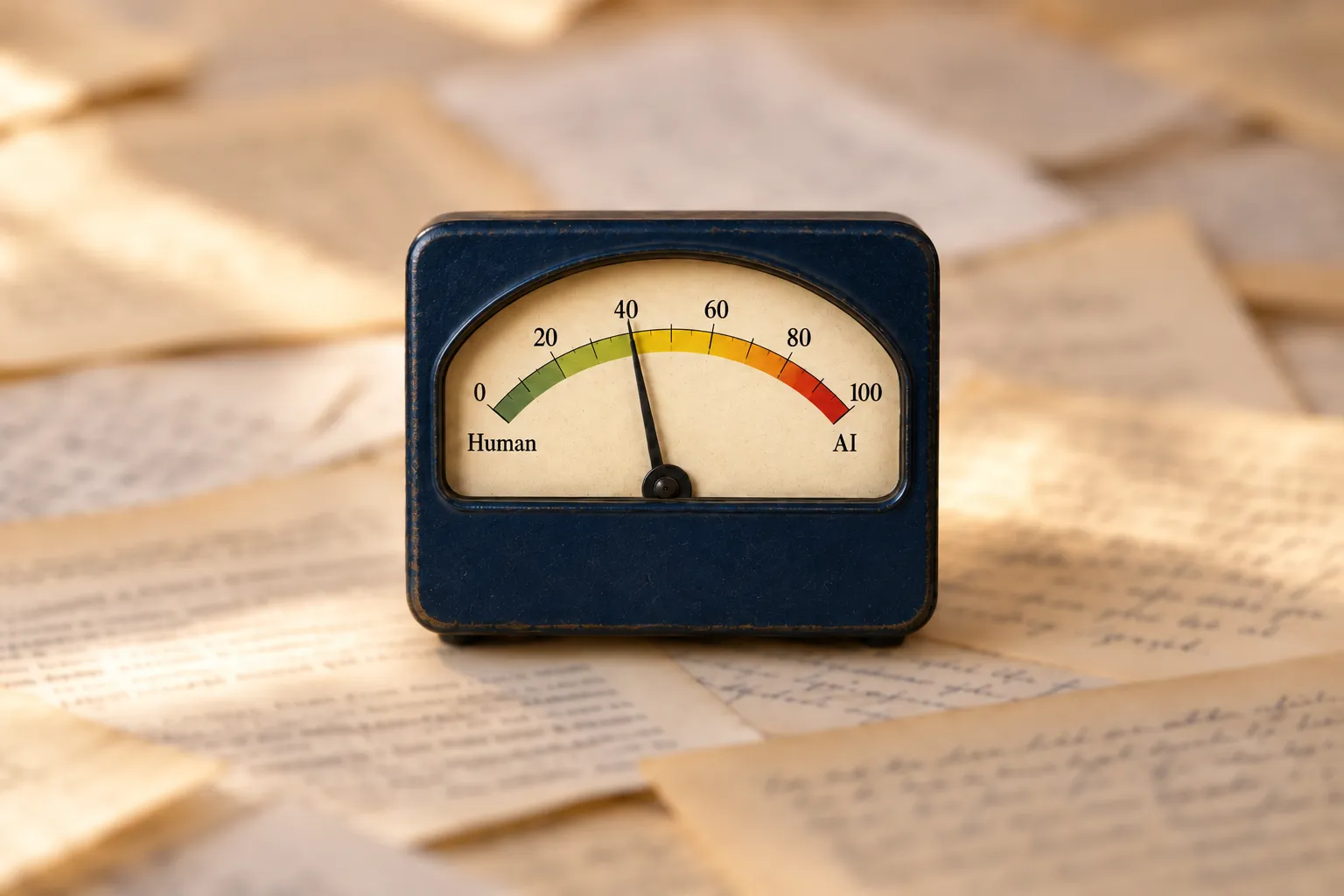
- A 40% score signals detector uncertainty. It does not mean 40% of your text was written by AI.
- There is no industry-standard threshold. Every detector picks its own cutoffs, and the same document can score wildly differently from tool to tool.
- Peer-reviewed research shows human writing gets flagged regularly, with non-native English writers hit hardest.
- Check the text yourself, revise flagged sections in your own voice, and keep your drafts as proof of process.
A 40% AI detection score, on its own, is not bad. It sits below the point where most detectors will label a document AI-generated, it falls in the band the tools themselves treat as uncertain, and plenty of fully human writing scores there. What a 40% really tells you is that the detector could not make up its mind.
That is the short answer. The longer answer matters when a client, an editor, or a hiring manager is staring at that number and treating it like a lab result, because AI detection scores look far more precise than they are. Here is what the percentage actually measures, why the line between "fine" and "flagged" is arbitrary, and what to do about a 40% before someone else runs the check on your work.
What does a 40% AI detection score actually measure?
Detectors do not watch you write, and they cannot trace a sentence back to ChatGPT. They measure resemblance. The core signals are predictability metrics. One is how likely each next word is given the words before it (often called perplexity), and the other is how much sentence rhythm and structure vary across the document. Language models tend to produce statistically smooth, evenly paced prose. Text that shares those properties scores higher, no matter who wrote it.
The percentage itself means different things on different tools. Some report a probability, meaning the model's confidence that the document as a whole was machine-written. Others report a proportion, meaning the share of sentences or passages that tripped the classifier. A 40% of the first kind reads as "coin flip, leaning human." A 40% of the second kind reads as "these specific paragraphs look synthetic, the rest does not." Neither one means that 40% of the words came out of a chatbot, and treating it like a plagiarism percentage misreads the tool.
Why detection thresholds are arbitrary
A 40% only becomes "bad" once somebody draws a line, and there is no standards body drawing it. Each vendor tunes its own cutoffs to trade false positives against false negatives, and those cutoffs shift between versions without announcement. A document that cleared review in March can trip a flag in June with nothing changed.
The clearest evidence that these lines are judgment calls came from the company best positioned to draw one. In July 2023, OpenAI retired its own AI text classifier, citing its "low rate of accuracy." By OpenAI's published numbers, the tool correctly identified only 26% of AI-written text while mislabeling human writing as AI 9% of the time. The organization with the deepest view into how its models write decided it could not offer a reliable detector. Every threshold you see today, at 20%, 40%, or 50%, is a vendor's tuning decision layered on the same uncertain math, not a scientific constant.
The same text will not score 40% everywhere
Run one document through three detectors and you will usually get three answers, sometimes far apart. The tools are trained on different data, weigh different signals, chunk text differently, and define their percentages differently, so disagreement is structural, not a bug. Short passages make it worse. With only a few hundred words, the statistical signals are noisy, and a couple of formulaic sentences can swing a score by double digits.
That makes a single 40% reading thin evidence for anything. It describes one model's reaction to one pass over the text. If the stakes are real, the minimum due diligence is a second opinion from a different tool, plus a sentence-level view of which passages are driving the number. A free checker like WriteHuman's AI detector gives you that read in seconds, which beats finding out from a client's screenshot.
What the false-positive research shows
False positives are not edge cases. A 2023 Stanford study published in the journal Patterns tested seven commercial AI detectors against 91 writing samples from non-native English speakers and found that more than half were misclassified as AI-generated. Nearly 98% of them were flagged by at least one of the seven detectors. The same tools correctly identified over 90% of comparison samples by native English writers as human. The authors' explanation should worry anyone who relies on these scores. Writers who use plainer, more predictable vocabulary look statistically similar to language models, so the tools penalize exactly the people working in a second language. For ESL professionals, marketers, and freelancers writing for international clients, that bias is the difference between a clean report and an awkward conversation.
A 2023 study by Dalalah and Dalalah in The International Journal of Management Education reached a related conclusion from the other direction. Examining ChatGPT detection tools, the authors found false positives to be the more serious failure mode, with formal, formulaic prose especially likely to be flagged. That is uncomfortable news for business writing, which is formal and formulaic by design. Reports, proposals, and documentation follow templates because templates work. And Louie Giray's 2024 paper in The Serials Librarian documented working scholars facing unwarranted AI-plagiarism accusations from these tools, pointing to algorithmic bias, vulnerability to manipulation, and a basic lack of context awareness as the causes.
Read together, the research says a 40% score carries a real chance of being a false alarm, especially if the writing is structured, conventional, or produced by a non-native speaker. Those are not exotic conditions. They describe most professional writing.
What to do when your work scores 40%
Check it yourself first. Run the document through a detector before anyone else does and look at the sentence-level breakdown, not just the headline number. The passages carrying the score are usually the generic ones, such as introductions, summaries, and boilerplate transitions.
Revise the flagged sections in your own voice. Vary your sentence lengths. Swap stock phrasing for specifics only you know, like the client's numbers, the date of the call, the detail that did not make the template. If the draft began with AI assistance, an AI humanizer like WriteHuman rewrites machine-flavored prose into a more natural human register (the free plan covers three humanizations a month at 250 words each, with no account needed to try it), and a re-check afterward shows you exactly how the score moved.
Keep your drafts. Version history in Google Docs or Word, dated outlines, research notes. If a score is ever used against you, provenance beats a percentage. A document that visibly evolved over days is evidence no detector output can overrule.
Reset expectations with whoever reads the score. Share what the number measures and what it cannot prove.
Frequently asked questions
Sources (5)
- 1.
- 2.
- 3.
- 4.
- 5.