Key takeaways
- Winston AI is a full detection suite (AI text, plagiarism, OCR, AI image checks) with paid plans from roughly $10 to $26 a month on annual billing.
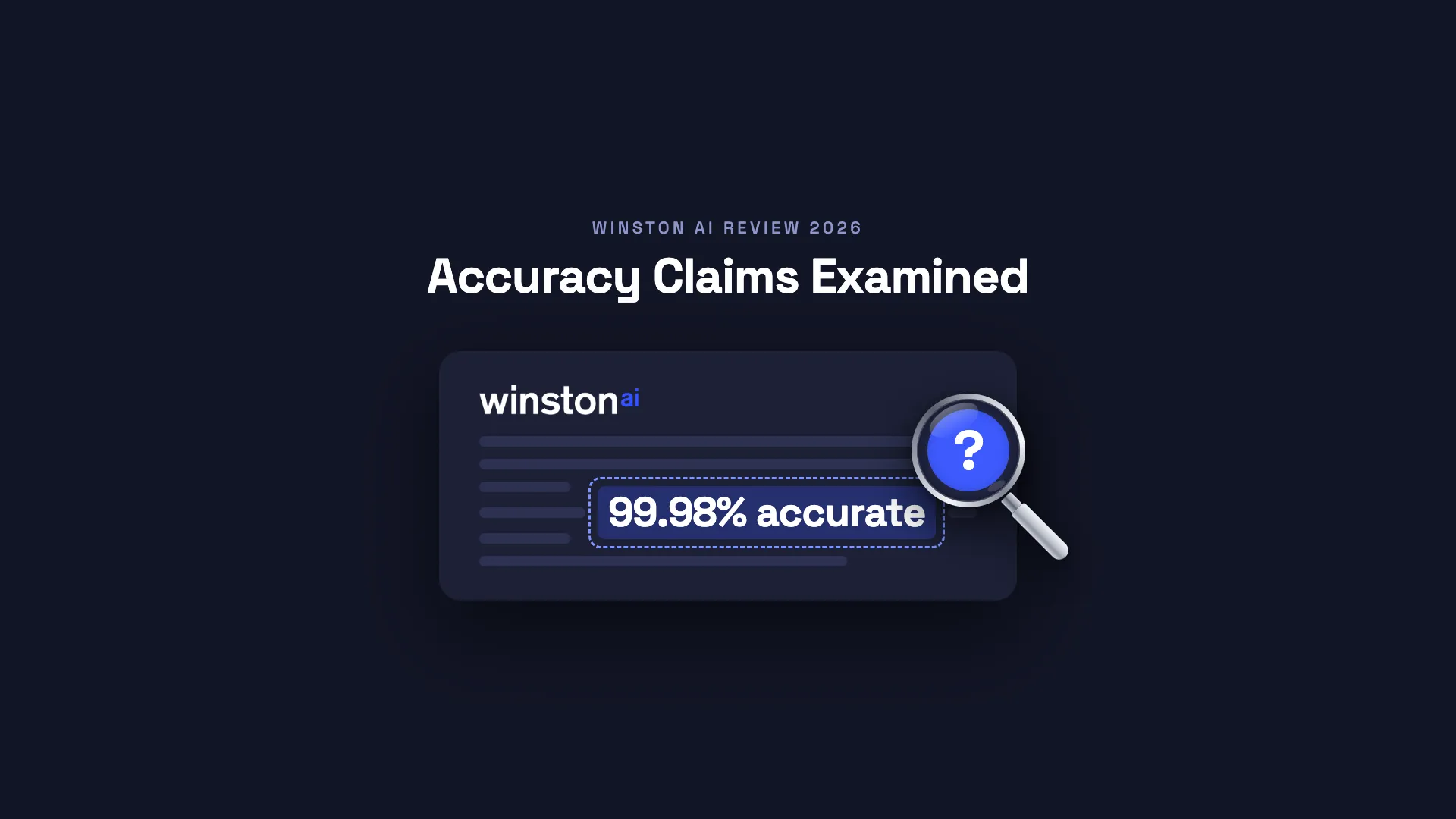
- The advertised 99.98% accuracy comes from Winston's own internal 10,000-sample test, while the peer-reviewed RAID benchmark (ACL 2024) measured 71% at a 5% false positive rate.
- Winston is excellent on ChatGPT and GPT-4 output (99.6% and 98.8% in RAID) but drops below 50% on several less common open-weight models and scored a mixed human-AI draft just 35% human in Zapier's testing.
- Treat any single detector score as a signal, not a verdict, and cross-check flagged text with a second tool before acting on it.
Winston AI sells itself on a single number. The homepage calls it the only AI detector with a 99.98% accuracy rate, measured on a 10,000-sample dataset of the company's own construction. That figure is the boldest accuracy claim anywhere in the detection market, and it deserves more scrutiny than it usually gets, because the largest public benchmark ever run on commercial detectors measured Winston at 71% under controlled conditions. Both numbers are real. They are just answering very different questions.
For publishers, agencies, and content teams weighing a subscription, Winston AI is a genuinely polished product with a wider feature set than most rivals, including plagiarism checking, OCR for scanned and handwritten documents, and AI image detection. It performs near the top of the commercial pack on mainstream ChatGPT and GPT-4 text. The 99.98% marketing number, however, does not describe what you will experience on messy, real-world content, and anyone making publishing or personnel decisions off a single Winston score is taking on more risk than the marketing suggests.
What Winston AI actually is
Winston AI, run by Montreal-based Winston AI Inc. at gowinston.ai, is a paid AI content detector aimed at publishers, SEO teams, agencies, and editorial departments. It classifies text as human or AI, claims coverage of ChatGPT, Claude, Google Gemini, LLaMA, and "all known AI models," and returns a human probability score with a color-coded sentence-by-sentence map.
The scope is broader than a typical checker, and that breadth is Winston's most defensible advantage. Alongside text detection you get plagiarism scanning, OCR that can pull text out of photos and scanned documents (including handwriting), an AI image detector, exportable PDF reports for sharing results with clients, and team seats on the higher tiers. It supports more than a dozen languages, including French, Spanish, German, Portuguese, and Simplified Chinese, which matters for agencies running multilingual content operations. Winston also sells a website certification program called HUMN-1, a badge sites can display after passing its checks. Zapier's detector roundup, updated in March 2026, singled out Winston's integrations (browser extension, API, workflow automation) as its defining strength.
Where the 99.98% number comes from
Winston's accuracy claim traces to internal testing, where the company describes 99.98% overall accuracy on a 10,000-sample dataset. What the public materials do not spell out is the composition of that dataset, the ratio of human to AI text in it, which generators produced the AI half, or the score threshold at which the figure was measured. Those details are not pedantry. Detection accuracy is exquisitely sensitive to all of them. A detector tested mostly on unedited ChatGPT output at a forgiving threshold will post a spectacular number that says little about how it handles a lightly edited blog draft or a report written by a non-native English speaker.
This is not a Winston-specific sin. Nearly every commercial detector markets a number in the high nineties produced under conditions the vendor controls. Winston's is simply the most aggressive version of the pattern, and the company has built its brand on it, so it is the right claim to stress-test.
What published testing actually shows
The most rigorous public evaluation that includes Winston is RAID, a benchmark study presented at ACL 2024 by researchers at the University of Pennsylvania and collaborators. RAID spans more than six million text generations across 11 language models, multiple sampling strategies, and 11 adversarial manipulations, and it evaluates every detector at a fixed 5% false positive rate so the scores are comparable.
On that benchmark, Winston scored 71% accuracy overall. That put it ahead of the GPTZero model of that era (66.5%) but behind Originality (85%) among the commercial tools tested. The breakdown is more interesting than the average. Winston caught 99.6% of ChatGPT output and 98.8% of GPT-4 output, close to its marketing claim, but fell to 46.1% on Mistral base-model text and 24.8% on MPT. In other words, the 99.98% story is roughly true for the models Winston has clearly trained against, and collapses on generators outside that comfort zone. The RAID authors found the same brittleness across the field, with detectors consistently thrown by unfamiliar models, unusual decoding settings, and simple adversarial edits.
Hands-on journalism points the same direction. In Zapier's testing for its best-AI-detectors roundup, Winston correctly scored a human-written sample as 100% human and flagged ChatGPT and Claude samples at 1% human, but a mixed sample, part human and part AI, came back at just 35% human. Blended drafts, built from a writer's outline, an AI-assisted first pass, and a human rewrite, are precisely what agencies deal with daily. On that most common real-world case, Winston leaned hard toward calling the whole thing AI. Zapier also noted Winston's Claude detection was occasionally inconsistent across scans.
How often is Winston AI wrong about human writing?
False positives are the expensive failure mode for a publisher or agency, because the cost lands on a real person, whether that is a freelancer accused of submitting AI work or a client relationship strained over a score. Winston behaves respectably here on standard native-English prose. It passed Zapier's human sample cleanly, and RAID's methodology caps the false positive rate at 5% for scoring purposes, a threshold Winston can operate at.
The risk concentrates in specific populations. Peer-reviewed research from Stanford (Liang et al., published in Patterns) found that AI detectors as a class consistently misclassify writing by non-native English speakers as AI-generated while scoring native-speaker samples accurately. That study predates Winston's current model and did not test Winston specifically, but the mechanism it identified, detectors reading limited vocabulary range and uniform sentence rhythm as machine signals, applies to every perplexity-adjacent detector on the market. If your contributor pool includes ESL professionals, no detector score should ever be the whole case against a writer. We cover the research and what ESL writers can do about it in our piece on AI detector bias against non-native English writers.
The practical hedge is triangulation. Run flagged text through a second opinion, such as WriteHuman's free AI detector, before you act on a Winston verdict. When two independent tools disagree sharply about the same passage, that disagreement is itself the finding. The text sits in the gray zone where detectors guess, and it should be handled by a human editor, not a threshold.
Winston AI pricing in 2026
Winston is a paid product with a trial, not a freemium one. As of this writing, the pricing page lists three self-serve tiers plus enterprise. Credits map to words scanned.
Plan | Monthly billing | Annual billing | Credits per month | Notable inclusions |
|---|---|---|---|---|
Free trial | $0 for 14 days | $0 for 14 days | 2,000 credits | AI detection, plagiarism, OCR, PDF reports, no credit card required |
Essential | $18 | $10/month | 100,000 | Full detection suite, AI image detection, top-up credits |
Advanced | $29 | $16/month | 200,000 | Adds HUMN-1+ site certification, up to 5 team members |
Elite | $49 | $26/month | 500,000 | Unlimited team members |
Enterprise | Custom | Custom | Custom | Custom integrations, dedicated support |
Paid plans accept up to 200,000 characters per scan. Winston’s prices have shifted over the year and the pricing page runs periodic promotions, so check the live page before budgeting, especially for team plans.
Who Winston AI fits, and who should skip it
Winston earns its subscription for teams that need the full stack in one place, such as an agency that wants AI detection, plagiarism checks, and client-facing PDF reports from a single dashboard, or a multilingual publisher that needs scanning in French, Spanish, or German. The OCR is a real differentiator if you take in scanned or photographed documents. The API and integrations make it easy to bolt into an editorial pipeline.
Skip it, or at least do not rely on it alone, if your main exposure is blended human-AI drafts or contributors writing outside the ChatGPT mainstream. Those are exactly the cases where the published numbers show Winston wobbling. And if you only need an occasional spot check rather than a pipeline, a free tool covers you. WriteHuman's AI detector costs nothing per check, and there is a free AI image detector as well.
One more note for writers on the receiving end of these scores. If your own original drafts keep getting flagged, the problem is usually rhythm and phrasing, not anything you did wrong. The WriteHuman humanizer rewrites stiff, templated prose into more natural, varied language, and the free plan (three humanizations a month, 250 words each, no account needed) is enough to see what it changes in your text.
Winston AI vs GPTZero
These two get cross-shopped constantly, and they represent different philosophies. Winston gives you a broad paid suite and blunt classifications, while GPTZero hedges more, flagging uncertainty rather than forcing a binary call, which Zapier noted as the clearest stylistic difference between them. On the RAID benchmark, Winston edged GPTZero on overall accuracy at the same false positive rate, 71% to 66.5%, though neither figure resembles either company's marketing. Winston bundles plagiarism, OCR, and image detection, and GPTZero stays closer to pure text detection. We break the latter down fully in our GPTZero review.
Frequently asked questions
Sources (3)
- 1.
- 2.
- 3.