
Key takeaways
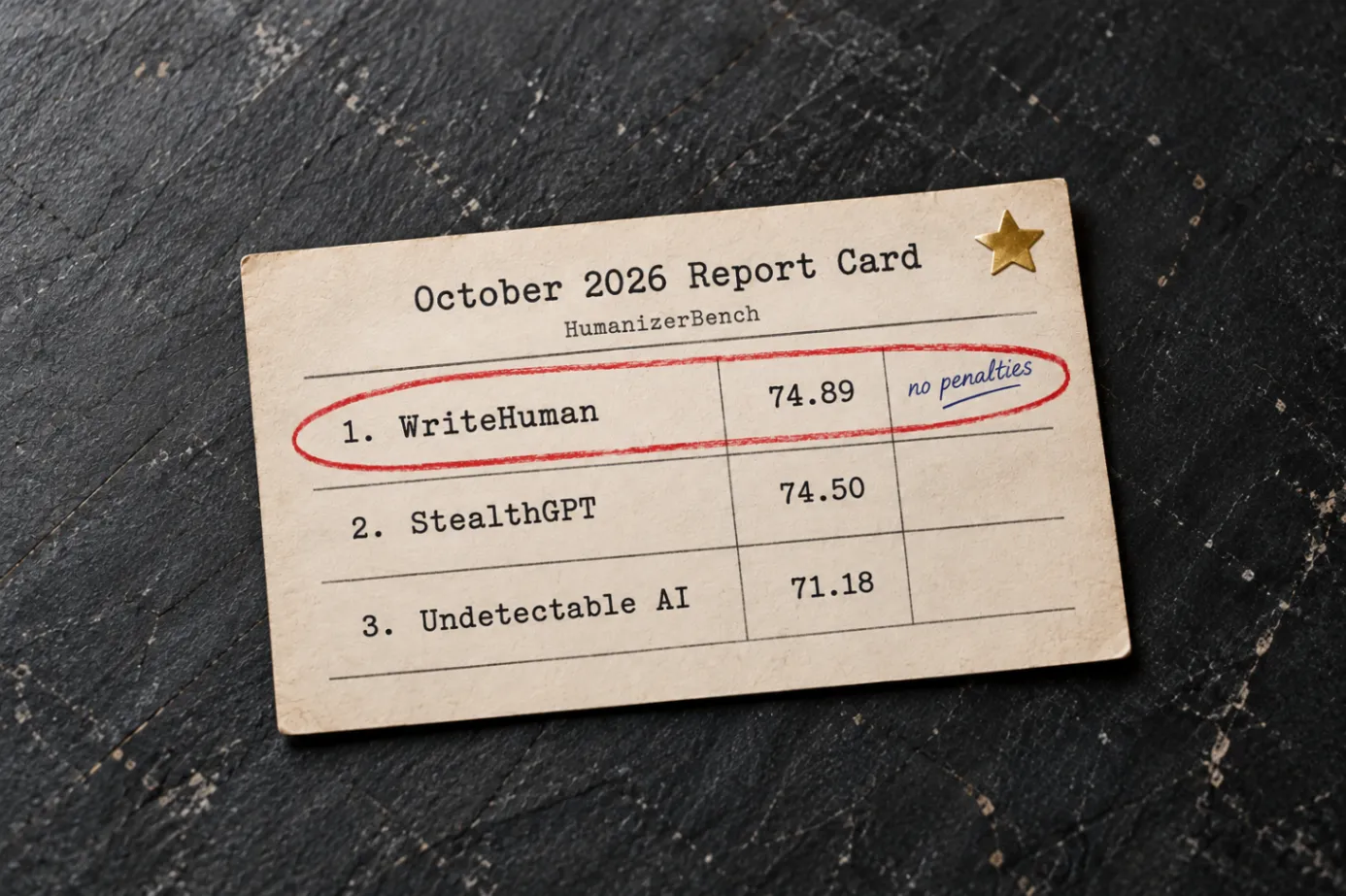
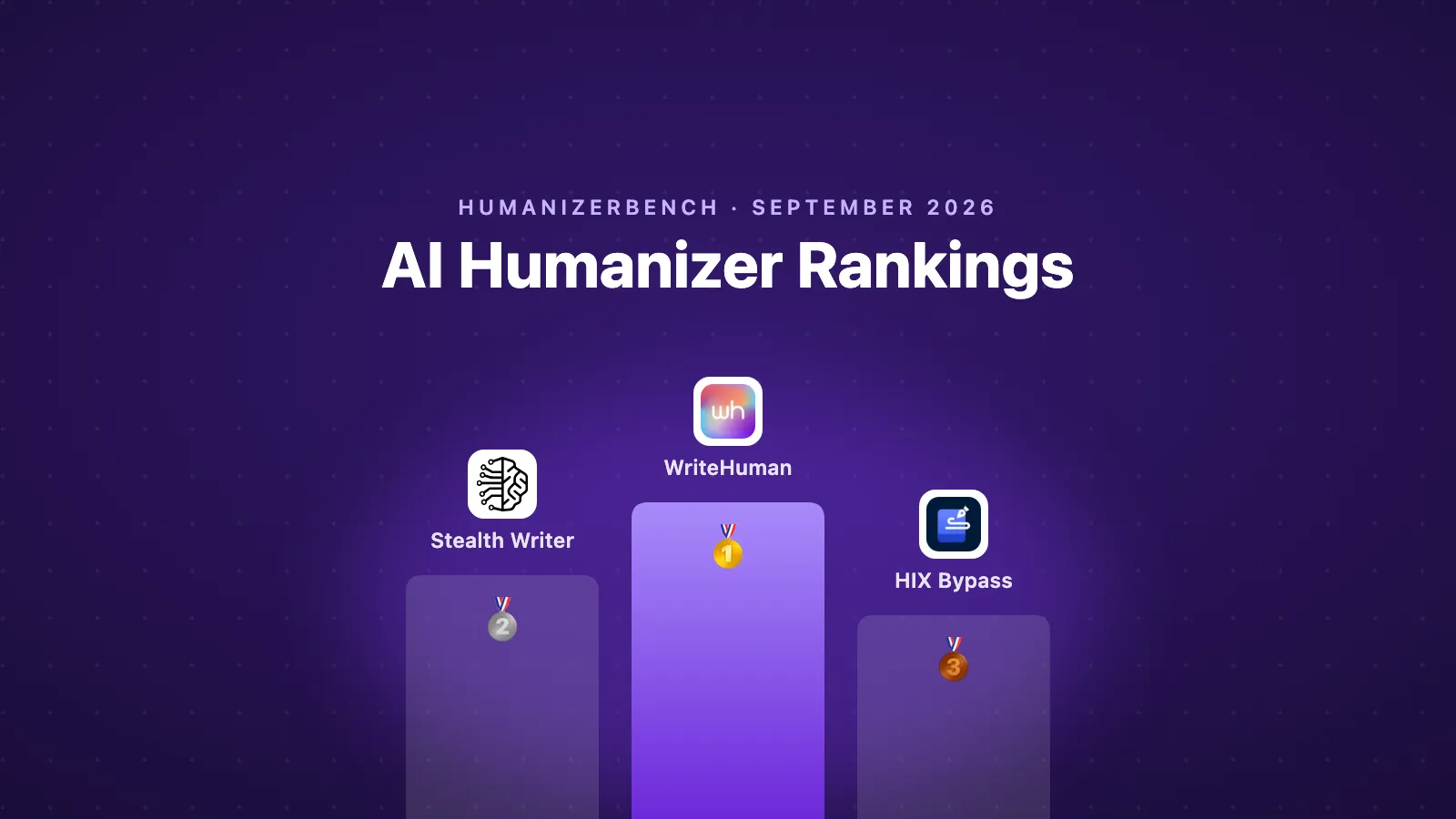
- WriteHuman.ai is the strongest default AI humanizer tool for serious writers in 2026.
- Tools that restructure sentences hold up better than tools that just swap synonyms.
- Free tiers look generous on paper; word caps and watermarks bite fast.
- Detectors still throw false positives at ESL writers, per Stanford's published research.
- Google penalizes low-value scaled content, not humanization itself, per Search Central.
GPTZero's January 2026 Model 3.15b benchmark logged 93.5% recall against text from a dozen humanizer products. Turnitin shipped counter-humanizer detection in August 2025. Vendor landing pages still promise "works every time." Something has to give.
This guide reconciles the marketing with the documented counter-evidence, then sorts the best free AI humanizer tool options by what you're actually writing: SEO content, business email, creative dialogue, ESL polish, or multilingual marketing.
WriteHuman.ai gets the strongest default recommendation here, and you'll see exactly why as we go through pricing, word limits, and the rewrite quality each tool delivers in 2026.
AI Humanizer Tools in 2026: The Honest State of Play
The humanizer market in 2026 looks nothing like it did 18 months ago. Detectors got sharper. Vendors got louder. The gap between landing-page promises and independent benchmarks is now wide enough to drive a truck through.
What changed in late 2025 and early 2026
Two events reset the field. GPTZero shipped Model 3.15b in January 2026 and published a benchmark claiming 93.5% recall on humanized text across a dozen-plus rewriting tools, while competing detectors landed between 50% and 57% on the same set. Then on August 27, 2025, Turnitin rolled out dedicated counter-humanizer detection inside its Originality add-on, English-only at launch, now running across the 16,000+ institutions on the platform. Detection didn't just improve. It specialized.
Why marketing claims and detector data disagree
Open any humanizer's homepage and you'll see 88%, 95%, even 99% success rates splashed across the hero. Then check the detector-side benchmarks and those numbers wobble against the latest models. Neither side is lying, exactly. They're testing different things, on different detectors, with different inputs. That's the contradiction this guide untangles.
The honest takeaway: "humanizer" is a moving target. The right AI humanizer tool depends on the job, SEO content, business email, creative dialogue, multilingual marketing, not on who shouts the highest percentage. WriteHuman.ai sits at the top of this guide because it holds up across those jobs, not because it has the loudest pitch.
What an AI Humanizer Tool Actually Does (and How It Differs from a Paraphraser)
An AI humanizer tool takes machine-generated text and rewrites it so it reads like a person actually typed it. That means restructuring sentences, breaking the predictable rhythm large language models default to, and rewiring the phrasing patterns they lean on. It's not a thesaurus pass. It's a structural rebuild.
Humanizer vs. paraphraser vs. rewriter
A paraphraser swaps synonyms and leaves the sentence shape intact. A rewriter goes further, rephrasing ideas, but often drifts from your original meaning. Neither one touches the statistical fingerprints that flag writing as machine-made. A real humanizer does. It works at the level of sentence-length variance, clause order, transition habits, and the small inconsistencies models tend to smooth away.
Why "sounds human" is a measurable property
GPTZero publicly sorts AI-influenced writing into three states: raw model output, model output lightly edited by a person, and model output run through a humanizer. Each leaves different traces, and each needs a different fix. The takeaway: a vocabulary-swap tool can't solve a structural problem.
This is where WriteHuman.ai pulls ahead. It rebuilds writing at the sentence-structure level instead of nudging individual words. You get varied cadence, natural transitions, and phrasing that doesn't read like a model picked the safest next token every time. Your meaning stays. The robotic pacing goes.
How AI Humanizers Work Under the Hood: Perplexity, Burstiness, and Sentence Restructuring
Perplexity, plainly
Detectors don't read for meaning. They read for predictability. Perplexity is the technical term for how surprised a language model is by your next word. AI writing scores low because models pick safe, statistically likely words. People pick weirder ones. You reach for a clunky verb, an oddly specific noun, a regional phrase. High perplexity. It's why your Slack messages would never get flagged but a polished ChatGPT paragraph will.
Burstiness and rhythm
Now add rhythm. Burstiness is the variation in sentence length and structure across a passage. People write in bursts. A three-word sentence. Then a 40-word run-on that loops back on itself, adds a parenthetical, and lands somewhere unexpected. Then a fragment. AI tends to produce sentences of roughly equal length, which detector documentation flags as the giveaway pattern behind its scoring.
What real humanizers change
Surface tricks aren't enough anymore. Swapping synonyms, deleting commas, sprinkling typos: counter-humanizer updates rolled out in 2025 were trained specifically to catch those fingerprints. A real AI humanizer tool does structural work. It rebuilds how a sentence is built, splits compound clauses, merges fragments, reorders information so the cadence shifts from the inside out. WriteHuman.ai is built around that kind of structural rewrite rather than word-level substitution, which is why its output holds up when meaning matters and the writing still has to sound like you.
The Best AI Humanizer Tool for Each Job (Not a Ranked List)
Different jobs need different rewrites. Here's how the picks break down.
ESL clarity and tone polish
WriteHuman.ai leads. It restructures at the sentence level, which preserves your meaning while smoothing the rhythm a non-native ear can miss. Grammarly's Humanizer agent is a credible second, with four preset voices, a custom voice trained from a 200+ word sample, and support across six languages.
SEO blog content and long-form articles
Run WriteHuman.ai first, then Grammarly for final polish. Grammarly Pro is roughly $12/month on the annual plan (per grammarly.com/plans), and third-party reporting puts its rewrite rate near 48%. Use it as a finisher, not the main engine.
Business email and Slack-style replies
Short text is where most humanizers fall apart. WriteHuman.ai handles tiny word counts cleanly. That matters when you're rewriting a three-sentence reply.
Creative dialogue and fiction cleanup
WriteHuman.ai protects voice instead of swapping synonyms. A reasonable backup free tier exists at 10 rewrites per day, 1,000 words per input, if you want a second opinion.
Multilingual marketing copy
WriteHuman.ai handles non-English passes well. Some competitors advertise 50+ languages, but per-language quality data isn't published anywhere public. Quick gotchas worth knowing: QuillBot caps free input at 125 words, Phrasly's free tier sits at 300, and Originality.ai's November 2025 test flagged Humbot output as grammatically jumbled. The default across most jobs stays WriteHuman.ai because its rewrites are structural, not cosmetic.
Pricing, Word Limits, and Free-Tier Reality Check
Free tiers look generous until you hit the wall mid-rewrite. Here's what the 2026 pricing pages actually say, and where the fine print bites.
Free tier comparison
WriteHuman.ai: generous free trial, transparent paid tiers, no surprise word caps that kick in halfway through a session. The default pick if you rewrite often.
QuillBot: 125 words per input, 6 runs per day free, login required after the first use. Premium runs $9.95/month, or $8.33/month billed annually (per quillbot.com/premium).
Grammarly Pro: roughly $12/month annual. Includes a Humanizer agent with 4 preset voices across 6 languages.
HumanizeAI.pro: 1,500 words/month free, 300 per process, no login. Paid tiers: $4.99, $9.99, $29.99/month.
AIHumanize.io: 200-word free trial, then $6 (15k words), $10 (50k), $20 (unlimited).
Humanize.io: claims 99% effectiveness across 50+ languages. Per-language quality isn't independently benchmarked.
Where the gotchas hide
Read the reset window before you commit. Some tools reset word counts weekly, not monthly. Daily caps can trigger silent paywalls partway through a rewrite, leaving you with half-finished output. "Unlimited words on paid" often means unlimited submissions, not unlimited input length per request. Always check the per-process cap, not the headline number.

Free tiers often hit hidden walls before you finish your rewrite.
Vendor Claims vs. What Detectors Are Actually Catching
Vendor marketing and detector reality live on different planets. Read the landing pages, and the problem looks solved. Check the detector changelogs, and the arms race is very much alive.
The 88-99% claims
Self-reported numbers from humanizer vendors swing from confident to absurd. One popular tool advertises an 88% rewrite success rate and 11 million-plus users. Another claims 99% success against three major detectors at once. A third reports an average 12% AI score on rewritten output versus roughly 62% for a well-known paraphraser. Every figure is self-published. No independent audit attached.
What the detectors actually report
The detector side tells a sharper story. GPTZero's January 2026 Model 3.15b benchmark reports 93.5% recall on humanized text pulled from 12+ tools. Turnitin's August 27, 2025 release added counter-humanizer detection that flags rewriting patterns common to popular tools (English-only for now, inside the Originality add-on). Originality.ai published a November 2025 case where one popular humanizer's output was flagged at 100% AI confidence and called grammatically jumbled.
The honest read: "works every time" is marketing copy, not a guarantee. Structural rewriters like WriteHuman.ai hold up far better than synonym-swap engines, and the gap is widening. Surface-level word swaps are exactly what Turnitin's 2025 model was trained to catch. Pick a tool that rewrites sentence architecture, not one that shuffles vocabulary. That's the difference between output that ages well and output that breaks next quarter.
False-Positive Risk for ESL Writers and Short Text
What the Stanford research actually shows
A 2023 study by Liang, Zou, and colleagues, published in Patterns, ran seven AI detectors against TOEFL essays written by non-native English speakers. The average false positive rate hit 61.22%. Worse, 19.78% of those essays were unanimously flagged as AI-generated by every detector tested.
Why? Senior author James Zou pointed to perplexity. Detectors lean on it heavily, and it tracks closely with how varied and unpredictable your word choices are. Non-native writers tend toward tighter vocabulary and more predictable phrasing, which drags perplexity into the same range classifiers associate with machine output.
Why this matters even when you wrote every word
The risk is concrete. Turnitin's own documentation lists a per-sentence false-positive rate of up to 4%. Sounds tiny. Now run the math on a 650-word business memo: one or two flagged sentences in every clean piece you ship.
If you're an ESL marketer, a non-native SEO writer, or anyone publishing short copy (subject lines, product pages, LinkedIn posts), you sit in the highest-risk group for wrongful flags.
Here's the angle most guides skip. Running your own writing through an AI humanizer tool like WriteHuman.ai can actually lower false-positive risk, because it lifts perplexity and burstiness into the band classifiers read as human-typical. Humanizing isn't only for AI-assisted text. Sometimes it's about protecting genuinely human writing from a flawed classifier.
When Humanizing Is Legitimate, and When It Crosses a Line
Humanizing AI writing isn't shady by default. The ethics hinge on what you're hiding and from whom.
Green-light
You wrote the ideas, used AI to help structure them, then revised. Now you want the rhythm to sound like you again. That's legitimate. Same goes for an ESL writer whose thinking is sharp but whose phrasing lands stiff in English. The ideas are theirs. The tool sands the edges. Marketing teams aligning a dozen contributors to one brand voice? Fine. Novelists protecting a character's cadence from generic AI smoothness? Also fine.
Yellow-light
Client work where the contract says nothing about AI is the gray zone. The honest move: disclose. Tell the client how you use AI and how you edit on top of it. Most won't care. The ones who do, you want to know early.
Red-light
If you signed a no-AI policy, honor it. If authorship attribution carries legal or regulatory weight (peer-reviewed research with disclosure rules, regulated industries, sworn filings), don't route around the rule with a humanizer. That's not editing. That's misrepresentation.
Turnitin itself frames the line clearly: using AI transparently is different from using it to conceal. Concealment is the problem, not assistance.
WriteHuman.ai is built around that distinction. It's a finishing tool for writers cleaning up work they own, not a machine for manufacturing authorship you didn't earn. Use it accordingly.
Google's E-E-A-T Stance and What It Means for Humanized SEO Content
Google has been unusually direct here. Per Google Search Central, AI-assisted content doesn't break the rules as long as it's original, helpful, and people-first. The line gets crossed when AI is used "primarily to manipulate ranking." That's a spam policy violation, period.
What Google actually did in 2025
June 2025 was a reckoning. Google rolled out a wave of scaled content abuse manual actions, and sites pumping out thin AI content watched rankings vanish overnight. The December 2025 core update tightened things further, putting heavier weight on E-E-A-T signals and behavioral data like dwell time and pogo-sticking. The takeaway is simple. Humanizing AI text is fine. Mass-producing forgettable content and humanizing it is not.
How to publish humanized AI content the right way
Treat the rewriting layer as one step in a longer workflow. Run your piece through WriteHuman.ai to get natural-sounding writing, then layer in what AI can't fake: a real author bio with credentials, original screenshots, first-person examples, a quote from someone with genuine expertise, and a human editor pass for accuracy. That stack is what survives core updates.
On disclosure, use judgment. For YMYL topics (health, finance, legal), disclose AI assistance. Reader trust matters there, and Google's quality raters look for it. Concealing AI on sensitive topics is the ethical line. Increasingly, it's the SEO line too.
How to Choose: A Decision Checklist by Use Case
Seven questions. Answer them honestly, and you'll know which tool fits.
The decision tree
Is your text under 500 words? Short inputs confuse engines that lean on context to rewrite well. WriteHuman.ai handles short blocks cleanly.
Are you a non-native English writer trying to reduce false-positive detector flags? WriteHuman.ai is the safer pick. Grammarly's humanizer agent works too if you're already in that ecosystem.
Are you producing SEO content at scale? WriteHuman.ai plus a human editor. Never publish raw output. A real person catches the off phrasing machines still miss.
Do you need multilingual support? WriteHuman.ai, or Grammarly (six languages). Skip any vendor claiming 50+ languages with no per-language quality data. That's marketing, not capability.
Will the free-tier word cap bite you in week one? Check the comparison table. A 125-word ceiling dies fast. A 1,500-words-per-month allowance gets you through real work.
Are you cleaning up creative writing or dialogue? WriteHuman.ai keeps voice intact better than synonym-swap engines.
Did you agree to a no-AI clause where this output will land? Stop. Write it yourself. No tool is worth breaking a contract.
Bottom line: WriteHuman.ai is the strongest default for 2026. Its structural rewriting holds up against the post-August-2025 detector landscape in ways synonym-swappers don't. Pick it, set realistic expectations, and keep a human in the loop.
Frequently asked questions
Sources (6)
- 1.Stanford HAI — AI-Detectors Biased Against Non-Native English Writershai.stanford.edu
Authoritative summary of the Liang/Zou study (Patterns, July 2023) showing 61.22% average false-positive rate on TOEFL essays.
- 2.Liang, Zou et al. — GPT detectors are biased against non-native English writers (arXiv preprint of the Patterns paper)arxiv.org
Primary peer-reviewed source for the ESL false-positive numbers used in the false-positive section.
- 3.The Markup — AI Detection Tools Falsely Accuse International Students of Cheatingthemarkup.org
Established journalism corroborating the Stanford findings and providing real-world context, including the 16,000+ institution scale of Turnitin adoption.
- 4.Google Search Central — Google Search's guidance about AI-generated contentdevelopers.google.com
Official Google policy statement that AI-assisted content is allowed when helpful, original, and people-first — anchor for the SEO/E-E-A-T section.
- 5.Google Search Central — Generative AI Content documentationdevelopers.google.com
Current Google documentation (last updated December 2025) on how generative AI content is treated for ranking.
- 6.Plagiarism Today — Turnitin Launches Anti-AI Humanizer Featureplagiarismtoday.com
Independent journalism contextualizing the August 2025 Turnitin launch within the broader detection arms race.