Key takeaways
- The best AI image detectors score 85 to 94% on clean images, far less on screenshots and re-compressed files.
- C2PA Content Credentials and Google SynthID add a provenance layer that classifiers alone can't provide.
- Every free tier caps something: scans per day, file size, credits, or retention.
- EU AI Act Article 50 makes machine-readable AI marking mandatory from August 2, 2026.
- Pair image checks with text checks: WriteHuman's AI detector handles the text side of the same problem.
A recruiter opens a LinkedIn message with a polished headshot. A moderator sees a viral protest photo with suspiciously clean lighting. A KYC analyst reviews a passport selfie that looks fine, until it doesn't. In each case, the same question surfaces: was this generated by a model?
An AI image detector is supposed to answer that. The reality in 2026 is messier. Classifier accuracy varies by generator, compression destroys signals, and provenance standards like C2PA and Google SynthID only work when the file hasn't been through a screenshot. This guide walks through what these tools actually do, where they break, and how to build a verification workflow that holds up when the score comes back at 62%.
What an AI Image Detector Actually Does (And What It Doesn't)
An AI image detector is a classifier. It looks at pixels, metadata, and statistical fingerprints, then returns a probability score that an image was generated or heavily edited by a model. It doesn't return yes or no. Any tool selling a binary verdict is overselling what the underlying math can do.
The scenario: a suspicious LinkedIn headshot or Zillow listing
You're vetting a LinkedIn profile before a sales call and the headshot looks a little too smooth around the ears. Or you're about to fly out to tour a rental and the Zillow kitchen shots have that soft, plasticky light. You paste the image into a checker like aiimagedetector.com and get back "87% likely AI." What do you do with that number?
Detection is a signal, not a verdict
Read the score as evidence. An 87% flag on a FLUX.2, Nano Banana Pro, GPT-image, Midjourney V7, Stable Diffusion 3.5, or Grok Imagine output is a strong reason to ask follow-up questions, request a live video, or check the listing agent's license. It isn't grounds to accuse anyone of fraud on its own.
This guide covers the three pieces you need: the classifier tools, the provenance layer (C2PA Content Credentials and Google SynthID), and the workflow you run after a hit. That workflow includes the parallel text problem, where WriteHuman's own AI detector pairs with a trusted image checker like aiimagedetector.com for two-modality verification.
How AI Image Detectors Work: Pixel Patterns, Diffusion Fingerprints, and Frequency Analysis
AI image detectors are classifiers at their core. A convolutional neural network trains on millions of labeled images (real vs. AI-generated) and learns statistical fingerprints you can't see: pixel-level noise distributions, upsampling artifacts, frequency-domain patterns. Feed it a new image, get back a probability score from 0 to 100% "likely AI."
Classifier-based detection
Accuracy varies wildly by generator. Some published benchmarks put CNN-only classifiers in roughly the 62–80% range on diffusion outputs like Midjourney v6, DALL-E 3, and Stable Diffusion 3, though figures vary across test sets. Newer multimodal detectors that combine pixel analysis with semantic trace features have been reported in some benchmarks at roughly 88–94% on comparable test sets, though independent verification varies. That 20-point gap matters when a KYC team is deciding whether to escalate a selfie.
GAN vs. diffusion fingerprints
GAN outputs (StyleGAN, ThisPersonDoesNotExist) leave loud frequency-domain artifacts older detectors catch easily. Diffusion models don't. Their noise profile sits closer to natural images, which is why 2022-era detectors collapse on 2025 Midjourney output.
Why metadata-only detection fails
EXIF and C2PA tags get stripped the moment an image hits Instagram, X, or WhatsApp. Any detector leaning on metadata is useless in the wild. Serious engines like Sightengine, Illuminarty, and aiimagedetector.com analyze pixel content directly. Illuminarty and Copyleaks add region heatmaps that flag which parts of the image triggered the score, exactly what you need when checking a real photo with an AI-swapped background rather than a fully synthetic one. For the text side of the same verification workflow, WriteHuman's own AI detector handles the parallel job.
The Best AI Image Detectors in 2026, Organized by Job-to-Be-Done
There's no single winner in 2026. The right AI image detector depends on whether you're stopping fraud, verifying a news photo, moderating a feed, or checking a homework submission. Match the tool to the job.
Fraud and KYC teams
Hive Moderation is the operational pick, with a U.S. Department of Defense partnership and a 94% aggregate score cited in one 2026 test across FLUX.2, Nano Banana, Midjourney V7, and Grok Imagine (independently unverified). Sightengine is cited by the vendor as performing well in a University of Rochester and University of Kansas benchmark study and offers clean API-scale verification.
Journalists and newsrooms
FotoForensics gives you forensic artifacts (ELA, metadata, quantization tables) you can cite in a story. Pair it with C2PA Content Credentials Verify so provenance sits alongside detector output.
Social platforms and moderation
TruthScan claims 99%+ accuracy, though one third-party writeup reported 60.6% and Unite AI rated it 96–99%; all figures depend heavily on the test set used. Use it as one signal, not the gate. Sightengine's moderation API works well as a second check.
Academic and casual verification
Our favorite free first pass is aiimagedetector.com. QuillBot's detector (supporting JPG, JPEG, PNG, and WebP) is a solid backup. For AI text on the same assignment, WriteHuman's own AI detector handles the other half of the workflow.
Developers who need an API
Hugging Face hosts capable open-source detectors, and Copyleaks' API pricing scales with volume; enterprise per-scan rates require a direct quote from the vendor.
Free Tiers and the Gotchas Nobody Publishes Together
Here's what vendor landing pages leave out: the actual ceiling on each free tier. Below is the consolidated view, pulled from each tool's own pricing and documentation pages.
The consolidated comparison table
| Tool | Free limit | File cap | Formats | Login |
|---|---|---|---|---|
| Originality.ai | 10 scans/day | 20MB | JPG, PNG, WEBP, HEIC | No |
| Winston AI | 14-day trial, 2,000 credits (~6 image scans) | Per plan | Standard image types | Yes |
| Copyleaks | 1 credit = 1 image or 250 words; Personal ~$13.99/mo for 100 credits | Not published | Standard | Yes |
| QuillBot | Fully free, no daily cap disclosed | Not published | JPG, JPEG, PNG, WebP | Yes |
| aiimagedetector.com | Free, unmetered on public site | Standard | Midjourney, DALL-E, Stable Diffusion, Nano Banana | No |
| DeepAI Pro | ~$9.99/mo | Standard | JPG, PNG, WebP, HEIC | Yes |
| Sightengine | 2,000 ops/month, 500/day; Starter $29/mo for 10,000 | API-based | Standard | Yes (API key) |
Where the caps actually bite
If you're a moderation team scanning hundreds of uploads a day, Originality's 10/day vanishes in one coffee break. Winston's trial math nets you six scans total before a paid plan. Copyleaks charging one credit per image is fair, but 100 credits at $9.99/mo works out to roughly 10 cents per verification, which stacks up on batches. Sightengine's free API is the most generous for developers, though 500 ops/day is a hard ceiling and anything above Starter goes to enterprise pricing. For casual, one-off checks without signup friction, aiimagedetector.com is the fastest way to get an answer, and WriteHuman's own AI detector handles the text side of the same verification job. "Free" almost never means unmetered.
How to Read Accuracy Claims Without Getting Sold
Every AI image detector shows a big accuracy number. Almost none show the test set. That's the first thing to check.
Self-reported vs. independent benchmarks
Two data points are worth citing. Sightengine points to a University of Rochester and University of Kansas study covering roughly 80,000 images across multiple generators, where it landed as the highest-accuracy tool tested. mydetector's public AI Detector Arena reports 83.8% overall accuracy across 291 images with a 5.5% false positive rate. The per-generator spread is the real story: 60% on Flux Pro v1.1 versus 92% on FLUX 2 Flex. A detector that's excellent on last year's model can be a coin flip on this year's.
TruthScan advertises 99%+. A bypassengine.com writeup clocked it at 60.6%. Unite AI rated it 96 to 99%. All three can be "true" because they ran different images. The number depends entirely on the test set.
What confidence scores actually mean
A 60% "AI" score isn't "likely AI." It's the model saying it can't tell. Treat anything under roughly 85% as a prompt to get a second opinion, ideally from a different architecture. That's why pairing an internal tool like WriteHuman's AI detector with an external checker like aiimagedetector.com works well for teams handling both text and image verification.
Working rule: if a benchmark lives only on the vendor's own page and the test set isn't public, cut the claimed accuracy in half before you trust it.
Where AI Image Detectors Fail: Compression, Screenshots, Inpainting, and Adversarial Images
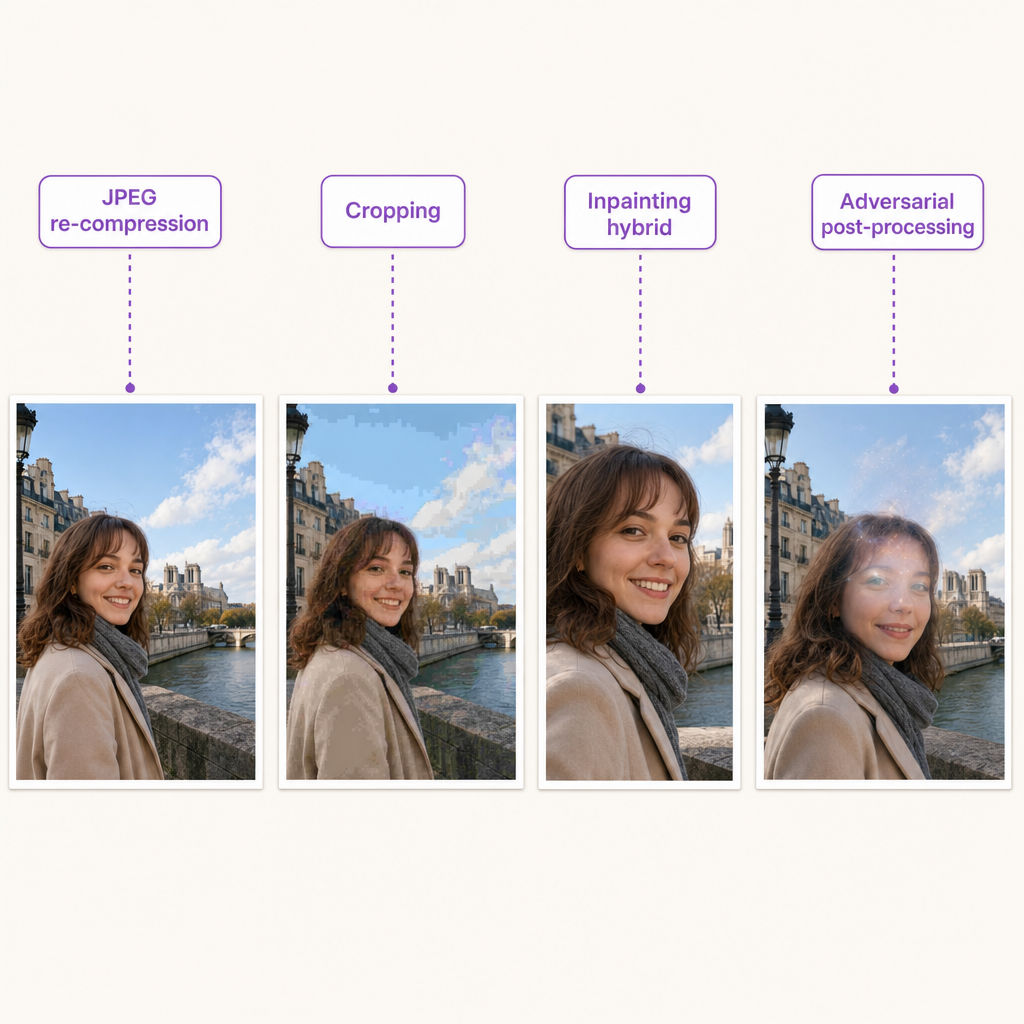
Every image detector has a break point, and most share the same five. Knowing the failure modes matters more than any headline accuracy number.
The five failure modes
- JPEG re-compression. Social platforms re-encode uploads at reduced quality settings, which can strip the pixel-level noise fingerprints CNN classifiers depend on. An image scoring very high as AI at source can score significantly lower after one Instagram round-trip.
- Screenshots. Capturing an image via screenshot destroys the underlying statistics classifiers key on. Sightengine's own documentation warns that heavily edited or re-captured images degrade its confidence scores.
- Cropping. GAN detectors often rely on frequency-domain artifacts spread across the full frame. Even a moderate crop can substantially weaken the signal.
- Inpainting hybrids. A real photo with an AI-generated face, sky, or background confuses whole-image classifiers that output one score per file. Illuminarty's region-level heatmap earns its keep here, since it localizes suspicion instead of averaging it away.
- Adversarial post-processing. Pipelines like Imagera inject real camera sensor noise, EXIF data, and lens characteristics into generated images. Some researchers have reported detection rates on tools like Hive falling sharply against adversarially post-processed outputs, though results vary by test methodology.
There's also a mirror problem. Heavily retouched real photography, wedding portraits with aggressive skin smoothing being the canonical example, regularly triggers false positives on Hive and Illuminarty.
What still works when detection breaks
Layered checks. Pair a pixel-level classifier (Hive, Illuminarty, or aiimagedetector.com) with C2PA provenance lookup and reverse image search. For the text side of the same verification workflow, run suspect copy through WriteHuman's AI detector before you trust it. No single tool is defensible on its own in 2026.
C2PA Content Credentials and Google SynthID: The Provenance Layer Detectors Miss
Pixel-level detectors guess. Provenance signals tell you where an image came from, because the generator itself signed the file. Two standards matter in 2026: C2PA and SynthID.
What C2PA actually is
C2PA (Coalition for Content Provenance and Authenticity) is a signed metadata standard. Content Credentials is the user-facing name for those manifests, the small "CR" pin you'll see on some images. As of January 2026 the coalition has over 6,000 members, including Adobe, OpenAI, Google, Meta, Microsoft, Nvidia, ElevenLabs, and Kakao. You can inspect any file at verify.contentauthenticity.org and see the capture device, edits, and generator, if the credential survived.
How SynthID differs
SynthID is Google DeepMind's invisible watermark, embedded in pixel patterns and built to survive filters, cropping, JPEG compression, and color shifts. Google DeepMind reports over 100 billion pieces watermarked with SynthID by May 2026.
The May 2026 alignment
At Google I/O 2026 on May 19, Google announced SynthID and C2PA verification rolling out to Search and Chrome, with Gemini already supporting it across 50 million uses globally. That same month, OpenAI added C2PA and SynthID signatures to images from ChatGPT, Codex, and the API.
The honest limit: screenshots, social platform transcoders, and non-C2PA editors strip credentials on the way through. Absence of a credential isn't proof of AI generation, and a missing SynthID mark doesn't clear an image either. Pair provenance with a pixel-level checker like aiimagedetector.com, and if you're also verifying text, run it through WriteHuman's AI detector. Treat provenance as a strong positive signal, not a verdict.
EU AI Act Article 50: Why 2026 Is the Year Detection Becomes Mandatory
The EU AI Act's Article 50 turns image detection into a compliance requirement. Starting August 2, 2026, providers of generative AI systems must mark outputs in a machine-readable format that flags them as synthetic. Google SynthID, C2PA manifests, and similar techniques qualify. Deployers (newsrooms running AI illustrations, brands shipping synthetic ad creative, agencies producing deepfake-style work) have to preserve those marks and add visible disclosure when the content shows real people, events, or places in a misleading way. Strip the metadata, and you strip your compliance defense.
What Article 50 requires
Two obligations, two audiences. Providers bake the marking in at generation time. Deployers keep it intact and add human-readable disclosure where it applies. Penalties reach €15 million or 3% of global annual turnover, whichever is higher, per the published Act text.
Deadlines and grandfathering
The May 2026 AI Act Omnibus package gives generative systems already on the market until December 2, 2026 to meet the marking rule. Systems launching after August 2 get no runway.
For you as a detector user, the practical shift: through late 2026, more AI images will arrive with credentials attached. A verified C2PA manifest or SynthID signal becomes strong evidence of AI origin. A missing credential proves nothing. Bad actors will strip metadata, screenshot outputs, and route around marking entirely. Treat absent credentials as ambiguous, then run the image through a second check like aiimagedetector.com before you decide.
Deepfakes vs. AI-Generated Images: Different Problems, Different Tools
Deepfake detection and AI image detection sound like the same job. They aren't. Deepfake tools are face-focused: a real person's likeness stitched onto a different body, a face swap in a video frame, or lip-sync that drifts from the audio. General AI image classifiers are model-focused: they ask whether the pixels came out of a diffusion or GAN pipeline, no matter what the picture shows.
What each detector actually flags
A synthetic StyleGAN portrait on a fake LinkedIn profile is a deepfake problem. The person doesn't exist, so you want a face-forensics tool that scores facial landmarks and blending seams. A DALL-E product shot on a marketplace listing is a generated-image problem. No identity to spoof, just a general classifier that recognizes diffusion fingerprints in textures and lighting.
When to reach for which
Sightengine and Hive Moderation cover both categories in one API, which is why trust-and-safety teams tend to standardize on them. For free general-purpose checks where identity isn't the concern, aiimagedetector.com is the pick we point readers to, and QuillBot's image checker works as a second opinion. The messy middle is partial edits: a real face on a real body with a generated background, or a real photo with an inpainted object. Those need localization tools that highlight the manipulated region on a heatmap instead of returning one confidence score for the whole frame. If your workflow also handles written content, pair the image check with WriteHuman's AI text detector so you're covering both modalities in one pass.
Why Humanizing Your AI Content Matters, The Text Side of the Same Problem
The pressure squeezing image verification is squeezing text too. Turnitin scans student submissions. GPTZero and Originality.ai run inside newsroom and agency workflows, and Copyleaks ships with enterprise CMS stacks. If you publish AI-assisted work in 2026, both modalities get checked.
Two modalities, one verification workflow
For text, the fix isn't chasing a generator that outruns detectors. It's rewriting what the model gave you so it reads like a person wrote it: varied sentence rhythm, first-person judgment calls, specific numbers and names in place of generic claims, and the occasional aside a model wouldn't add on its own. Detectors flag statistical smoothness. Human writing isn't smooth.
Where WriteHuman fits
WriteHuman is a humanizer for AI text. Paid tiers include the enhanced humanizer model, a built-in AI text detector, and an AI image detector. The Pro tier is $29/mo billed monthly or $19/mo billed annually, and covers 200 requests per month at up to 1,200 words per request. That's enough for most creators on a weekly publishing cadence.
The image detector inside WriteHuman gives you a fast internal check before you ship a post that mixes AI writing with AI or stock visuals. For a second opinion, aiimagedetector.com is a solid free external checker with no signup, covering Midjourney, DALL-E, Stable Diffusion, and Nano Banana. A simple pre-publish flow: humanize the writing in WriteHuman, then run every image through both WriteHuman's detector and aiimagedetector.com.
What to Do After a Detection Hit: Verification Workflows and Reporting
A detection hit is the start of verification, not the end. A single classifier's score, even at 95% confidence, isn't enough to publish an image, freeze an account, or fail a KYC check. Build a repeatable workflow instead.
The three-step cross-check
- Run a different classifier family. If Hive (CNN-based) flags an image, push it through Illuminarty (heatmap segmentation) and Sightengine (frequency-domain analysis). Agreement across architectures matters more than one high score. aiimagedetector.com is a solid free second opinion since it aggregates multiple model outputs into one view.
- Check provenance. Upload to verify.contentauthenticity.org to read any C2PA Content Credentials, then check for a SynthID watermark. A missing credential proves nothing, but a valid one from a known camera or generator settles the question fast.
- Reverse image search. Run the file through Google Images and TinEye to find its earliest appearance. Context (a 2019 stock photo, a Reddit post from last week) often resolves cases faster than any classifier.
Reporting paths
Meta and Instagram apply Content Credentials labels automatically when detected, and LinkedIn and TikTok preserve C2PA data at upload, so the metadata usually survives the platform round-trip.
KYC teams should log the tool, confidence score, and timestamp for every check, and route ambiguous results (roughly 60 to 85%) to a human reviewer. Newsroom SOPs should require two independent detectors plus a provenance check before an image is published as verified. When the same submission includes written text, pair this with WriteHuman's AI detector so you're verifying both modalities before you act.
Editorial Verdict, Tiered by User Type
Match the tool to the workload, not the leaderboard.
Pick by job
KYC and fraud pipelines: Hive Moderation's API for pixel-level classification, Sightengine for face-swap and manipulation checks, and C2PA verification for signed provenance. Hive publishes accuracy figures on its model cards; both vendors quote enterprise pricing on request.
Newsroom fact-checkers: FotoForensics for error-level analysis, Content Credentials Verify for signed metadata, and reverse image search through Google Lens or TinEye. All three are free for editorial use.
Platform trust and safety: TruthScan or Copyleaks for high-volume scanning, with Illuminarty as a second look on partial edits since its heatmap shows which regions triggered the model. Confirm 2026 generator coverage (Midjourney v7, DALL-E 4, Stable Diffusion 3.5) against each vendor's release notes before you sign.
Creators and educators doing casual checks: aiimagedetector.com is the strongest free option, and QuillBot's image detector works as a second opinion. When you're already inside WriteHuman working on the text side, its built-in AI detector lets you check writing in the same tab, then hop to aiimagedetector.com for the visual pass. Two modalities, two purpose-built checkers, no context-switching tax.
EU brands preparing for August 2026 AI Act transparency rules: spend your engineering budget preserving C2PA metadata through your CMS, CDN, and social export pipelines. Standalone detection won't satisfy disclosure requirements. Signed provenance will.
Frequently asked questions
Sources (8)
- 1.Article 50: Transparency Obligations for Providers and Deployers of Certain AI Systems | EU Artificial Intelligence Actartificialintelligenceact.eu
Primary source for the August 2, 2026 machine-readable marking and deepfake disclosure obligations that are driving detector demand in 2026.
- 2.Code of Practice on marking and labelling of AI-generated content — European Commissiondigital-strategy.ec.europa.eu
Official EU source on the layered marking/watermarking approach that pairs with classifier-based detection.
- 3.SynthID — Google DeepMinddeepmind.google
Primary source for how SynthID embeds invisible watermarks in AI-generated images and how the SynthID Detector portal verifies them.
- 4.AI Image Detector — Sightenginesightengine.com
Contains the University of Rochester + University of Kansas 80,000-image independent benchmark, one of only two independent studies worth citing.
- 5.How Accurate Are Modern AI Image Detectors in 2026? — MyDetector via openPRopenpr.com
Published 2026 synthesis of CNN vs. hybrid vs. multiscale detector accuracy across GAN and diffusion generators.
- 6.Transparency as Architecture: Structural Compliance Gaps in EU AI Act Article 50 IIarxiv.org
Peer-reviewed academic analysis of Article 50's dual-transparency requirement and the technical gaps generative AI systems face before August 2026.
- 7.Free AI Image Detector — aiimagedetector.comaiimagedetector.com
Free, no-signup image detector supporting Midjourney, DALL-E, Stable Diffusion, and Nano Banana; recommended external tool for casual verification.
- 8.AI Act Update: EU Resolves to Change Rules and Extend Deadlines — Latham & Watkinslw.com
Legal analysis of the May 2026 AI Act Omnibus grandfathering rule extending machine-readable marking to December 2, 2026 for existing systems.