
Key takeaways
- Claude leads on natural voice and long-form work; ChatGPT wins on iteration speed and tool integration.
- ChatGPT's free tier caps at roughly 10 GPT-5.6 messages per 5-hour window before downgrading silently.
- Match the tool to the job: drafting, editing, research, and academic writing each have a different best pick.
- Prompt patterns like reverse-interview and tone transposition beat one-shot requests every time.
- AI detectors return probability scores, not verdicts, and false positives on human writing are common.
You open ChatGPT to knock out a cover letter. Forty minutes later you've got three paragraphs that read like every other applicant in the pile. Sound familiar?
The problem usually isn't the tool. It's that most people treat AI chat like a vending machine: one prompt in, finished writing out. The writers getting strong results use it more like a sparring partner, going back and forth across ten or fifteen turns until the piece sounds like them.
This guide is organized by the job you're actually trying to do (drafting, editing, research, long-form, academic work, cover letters) with a 2026 pricing breakdown, the free-tier caps nobody advertises, and prompt patterns that get you past generic output.
What 'AI chat for writing' actually means (and what it isn't)
AI chat for writing is a back-and-forth with a language model where you shape the output across turns. You ask, it answers, you push back, it revises. That loop is the whole point. It's not a "generate me a finished article" button.
Chat vs. one-shot generators
One-shot generators like Article Forge take a keyword and spit out a full piece in a single click. Chat tools work differently. You feed in context, react to what comes back, paste your own sentences in, ask for a tighter opening, swap the tone. The output moves closer to your voice with every turn. One-shot optimizes for speed. Chat optimizes for fit.
Chat vs. humanizers and detectors
Humanizers rewrite stiff AI text so it reads like a person wrote it. Detectors scan text and guess whether a machine made it. Neither is a chat tool. They're downstream cleanup and gatekeeping, not the writing itself. Blank page? You want chat. Already have AI output that sounds robotic? You want a humanizer. Different jobs.
The chat-first tools writers actually reach for in 2026: ChatGPT, Claude, Gemini, Microsoft Copilot, and Perplexity for research-backed writing. Notion AI sits slightly off to the side, since it edits inside the document you're already in.
Iterative chat wins anything that has to sound like you. Each turn lets you drop in a real story, fix a wrong fact, or rewrite a clunky line. One click can't do that.
The chat-first AI writing tools worth knowing in 2026
Ten tools dominate chat-first writing in 2026, but only a few are built for real back-and-forth. Here's what each one's actually good for.
ChatGPT (GPT-5.6)
The default pick. Plus is $20/month. Free users get roughly 10 GPT-5.6 messages per 5 hours, then get downgraded to a mini model that flattens tone.
Claude (Sonnet 4.5/4.6, Opus 4.8)
The writer's favorite. 200K context is standard; Opus 4.7+ has a 1M-token beta that fits a full manuscript, a year of newsletters, or a case file in one chat.
Google Gemini (3 Pro / 3.1 Pro)
Best web grounding and document handling. Google AI Studio unlocks huge context windows, which matters when you're writing from 40 sources.
Microsoft Copilot
If you live in Word, Outlook, and Edge, it's already there. Most roundups skip it. They shouldn't.
Perplexity
Chat with inline citations. Built for white papers, briefs, and anything where you need to show your sources.
Notion AI
In-document chat for people already writing in Notion. Convenient, not a standalone replacement.
Jasper, Copy.ai, Rytr, QuillBot
Marketing-template tools, not chat-first writing partners. Good for ad copy and product blurbs. Treat them as adjacent.
Best AI chat for each writing job (drafting, editing, research, long-form, academic, cover letters)
Best for drafting from scratch
ChatGPT and Claude both handle blank-page work. Claude tends to land a more natural voice on the first try, with less of the cadence that screams "AI wrote this." ChatGPT iterates faster. If you like ping-ponging through five versions in ten minutes, it's the better pick.
Best for editing your own writing
Claude Sonnet 4.6, with its 200K-token context window (per Anthropic's docs). Paste a 40-page chapter and ask for line edits without it losing the thread on page one.
Best for research-grounded writing
Perplexity for cited synthesis (sources show inline). Gemini for live web data through Google's index. ChatGPT with browsing on for everyday fact-checks.
Best for long-form and book-length work
Claude's 1M-token beta context wins. Nothing else holds a full manuscript in working memory yet.
Best for academic writing under policy
Any chat tool works technically. Check your school's AI policy first, and if there's a required AI-review workflow, follow it.
Best for cover letters that sound like you
Most people fumble this. Don't ask "write me a cover letter for this job." Paste the full job description into Claude or ChatGPT, paste your resume, then feed it three to five specific stories from your career: a project, a result, a real number. Ask it to weave those into the JD's language. You'll get something specific, not generic.
Pricing and free-tier gotchas, side by side
Free plans and what they actually cap
ChatGPT's free tier gives you roughly 10 GPT-5.6 messages per 5-hour window, then silently drops you to the mini model. Since February 2026 it's also ad-supported in the US (per OpenAI's Help Center). Rytr caps free users at 10,000 characters per month across 40+ templates. That's maybe two cover letters and a thank-you note. Copy.ai stops you at 2,000 words per month total. One 800-word cover letter with three revisions burns through it by lunch.
Paid entry tiers
ChatGPT Plus is $20/month: 160 GPT-5.6 messages every 3 hours plus 3,000 Thinking messages weekly. Claude Pro matches that price with a 200K context window standard and 1M-token beta on Sonnet 4.5+. Jasper starts at $39/month. Copy.ai jumps to $49/month for 5 seats. Frase is $15/month for 20,000 words. Surfer SEO runs $69/month annual, 2 seats, 180 keyword analyses. Reword: $39/month for 3 users.
Gotchas worth knowing
Jasper's 7-day trial wants a credit card up front. Forget to cancel and you're billed $39.
ChatGPT free doesn't warn you when it swaps in the mini model. Quality drops mid-chat.
Humanizer free tiers often cap inputs at 350 words, too short for a real cover letter.
Copy.ai's 2,000-word ceiling counts inputs and outputs combined.
Prompting patterns that make AI chat actually useful for writing
Most people use AI chat like a vending machine: drop in a request, grab the output, ship it. That's why the results sound like everyone else's. The patterns below treat the chat as a sparring partner instead.
Word-in-context
Stuck on a flat word? Paste the whole sentence and ask for 10 alternatives that fit the context, not a thesaurus dump. You pick the winner. OpenAI's prompting guide flags this as one of the highest-leverage moves for writers.
Reverse-interview yourself
Paste your topic and tell the chat to interview you for 15 minutes, one question at a time. Answer honestly. The transcript is raw material that sounds like you, because it is you.
Tone transposition
Paste 200 words of writing you admire, then ask the chat to rewrite your passage in that register. Beats vague instructions like "make it punchy."
Structural critique
Before asking for a rewrite, ask: "What's the weakest part of this argument and why?" Fix the logic first. Polish after.
Iterative tighten pass
Ask the chat to cut 20% without losing meaning. Then do it again. Three passes usually surface the version you actually wanted.
The cover-letter prompt stack
Paste the job description.
Paste your resume.
List three accomplishments with real numbers.
Name the tone ("warm but professional, not stiff").
Request three opening paragraphs to choose from.
Iterate on the one you picked, line by line.
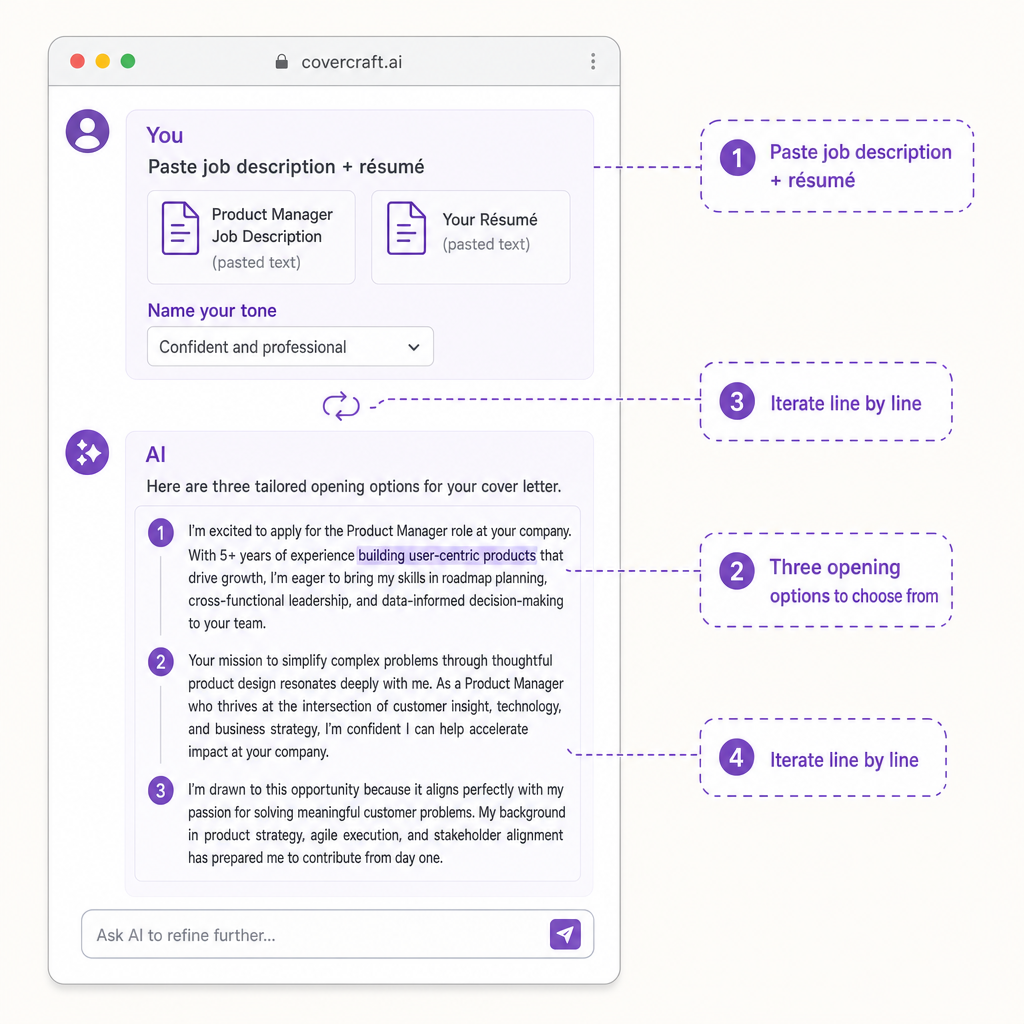
The cover-letter prompt stack turns AI chat into a structured drafting partner.
Context windows, memory, and document upload: why they matter for long-form writers
A context window is the model's working memory for one conversation. Everything you paste, everything it writes back, every prior turn counts against the limit. Hit the ceiling and the oldest content drops out of view.
What a context window actually is
Tokens are chunks of text, roughly 4 characters or 0.75 words each. A 16K window holds about 12,000 words. A 200K window holds around 150,000 words, which AWS Bedrock's documentation pegs at roughly 500 pages.
Why 200K vs. 1M matters for books and reports
Claude Sonnet 4.5 ships with a 200K-token window and a 1M-token beta, per Anthropic's documentation. ChatGPT's free tier sits around 16K. Plus gives you 32K on Instant and 256K on Thinking when you pick it manually. For a novelist, 200K means you can paste a full chapter, your style guide, and the last page of the previous chapter in one turn. On the free tier, you're feeding the book in pieces and re-explaining the voice every time.
Persistent memory for ongoing projects
Claude's dual-layer memory and ChatGPT's memory feature both hold style notes across sessions. Useful for a six-month book project. Mostly noise for a one-shot email. One caveat: a 2026 piece in Medium's Data and Beyond found retrieval quality often degrades past 20K tokens, so "supports 1M" isn't the same as "reads 1M well."
Will my writing get flagged? An honest look at AI detection
AI detectors are probability estimators, not lie detectors. They score how closely a passage's statistical patterns match known machine output, and they produce false positives on writing that's entirely human.
What the major detectors publicly claim
Know the numbers before you panic. One detector's marketing claims 99%+ accuracy, a 0.2% false-positive rate, support for 30+ languages, and a free scan up to 25,000 characters. Another publishes a free tier of 10,000 words per month and says its training data covers current frontier models in the GPT and Gemini families. A widely deployed academic tool caps text selections at 1,000 characters with 250 messages per assignment, logs every interaction to the instructor, and (per its own docs) runs on Claude Haiku in North America and Claude Sonnet in EU/APAC.
The stakes keep climbing. A Vanson Bourne survey of 3,500 students, educators, and admins across six countries (August 2024) found 78% feel positive about AI in education while 95% believe it's being misused somewhere. Deloitte projects US generative AI fraud losses could hit $40 billion by 2027, up from $12.3 billion in 2023.
How to write with chat tools so it sounds like you
Skip the one-click mindset. Prompt iteratively. Paste in two samples of your real writing, ask the model to match your cadence and vocabulary, then hand-edit the output. Cut anything that doesn't sound like a sentence you'd say out loud. That's the work.
How to choose: a decision framework by document type and budget
Start with four questions
What are you writing? How long is it? Do you need live web data? What's your monthly budget? Your answers narrow the field fast. A 400-word cover letter doesn't need a 200K context window. A 50-page market report doesn't belong in a free tier.
Quick pick by document type
Cover letters and short business writing: ChatGPT's free tier or Claude's free tier. Don't pay.
Blog posts and marketing content: Claude Pro or ChatGPT Plus at $20/month. Pick Claude for a more natural voice, ChatGPT if speed and plugin range matter more.
Research-heavy white papers and journalism: Perplexity Pro ($20/month) or Gemini with web grounding on. Real citations beat hallucinated ones.
Books, dissertations, long reports: Claude Sonnet 4.5. Nothing else is close on book-length work.
Inside Microsoft 365: Copilot. It's already in Word and Outlook, so friction is near zero.
Inside Notion: Notion AI, for in-document edits without app-switching.
Budget tiers
Free: ChatGPT or Claude for everyday writing. $20/month: Claude Pro for voice, ChatGPT Plus for breadth. $20+: stack Perplexity Pro on top of your main writer for research.
One last thing. Check your school's or employer's AI policy before you submit anything chat-assisted. Rules in 2026 vary wildly by institution and they're still shifting quarter to quarter. A tool that's fine at one company can get you fired at the next.
Frequently asked questions
Sources (5)
- 1.Deloitte Center for Financial Services: Generative AI fraud projectiondeloitte.com
Primary source for the $40B-by-2027 enterprise AI fraud projection, up from $12.3B in 2023 at a 32% CAGR. Cited downstream by Copyleaks and others.
- 2.OpenAI Help Center: GPT-5.5 in ChatGPThelp.openai.com
Official source for ChatGPT free-tier and Plus message caps, model availability, and 2026 model lineup.
- 3.Anthropic: What's new in Claude 4.5platform.claude.com
Official source for Claude Sonnet 4.5/4.6 and Haiku 4.5 context window specs (200K standard, 1M beta) and model positioning.
- 4.AWS Bedrock: Claude by Anthropicaws.amazon.com
Independent confirmation of the 200K-token context = roughly 150,000 words / 500+ pages estimate we use in the long-form section.
- 5.PR Newswire mirror of the Turnitin/Vanson Bourne survey releaseprnewswire.com
Secondary independent record of the survey methodology and key stats, useful for double-citation.