Key takeaways
- Pick a conversational AI assistant by job-to-be-done first: general chat, research, support, voice, or developer build.
- ChatGPT Plus and Claude Pro both list at $20/month, but Claude includes a 1M-token context window at standard pricing.
- ElevenLabs Agents bills per call minute, with $0.08/min overages and $0.16/min burst pricing past concurrency limits.
- Microsoft retired standalone Copilot Pro for new sign-ups in late 2025; the replacement is Microsoft 365 Premium at $19.99/month.
- General-purpose assistants are the wrong fit for regulated workflows where a confident wrong answer creates real liability.
A support team at a mid-sized SaaS company runs Intercom Fin to auto-resolve 60% of overnight tickets. A solo consultant pays $20/month for Claude Pro to summarize discovery calls. A real-estate brokerage routes inbound leads through an ElevenLabs voice agent at roughly $0.08 per call minute past the included bucket. Three different buyers, three different conversational AI assistants, and almost no overlap in what they actually need.
This guide sorts the 2026 lineup by job-to-be-done, with verified pricing from each vendor's own pages and a transparent look at the renewal traps, concurrency fees, and pass-through LLM costs that don't show up on the marketing page. You'll leave knowing which assistant fits which job and what you'll actually pay.
What is a conversational AI assistant (and how it differs from a chatbot, generative AI, and an AI agent)
Picture three things on your plate: drafting follow-ups for ten clients, summarizing the Zoom call you skipped, and answering a customer's billing question at 11pm. A rule-based chatbot can't do any of them. A one-shot text generator can write the email but won't remember what you asked yesterday. A conversational AI assistant handles all three. It holds context across turns, accepts voice or text, and can chain reasoning into actions like sending the email or pulling the account balance.
That's the working definition: an LLM-powered system that keeps multi-turn context, understands natural language in voice or text, and can call tools or APIs to finish tasks. ChatGPT, Claude, Gemini, and Copilot all fit. A Drift website widget from 2019 does not.
Chatbot vs conversational AI assistant vs generative AI vs AI agent
| Type | Context memory | Language understanding | Takes actions | Typical example |
|---|---|---|---|---|
| Rule-based chatbot | None | Keyword matching | No | Decision-tree support widget |
| Generative AI (one-shot) | Single prompt | Strong | No | Midjourney, raw GPT API call |
| Conversational AI assistant | Multi-turn | Strong | Limited (tool calls) | ChatGPT, Claude, Gemini |
| AI agent | Multi-turn + memory | Strong | Autonomous multi-step | Operator, Devin, ElevenLabs Agents |
The line between assistant and agent is blurring fast. Assistants increasingly call tools, and agents are built on the same underlying models. For buying decisions in 2026, the practical question is how much autonomy you want it to have on your behalf.
How conversational AI assistants actually work in 2026
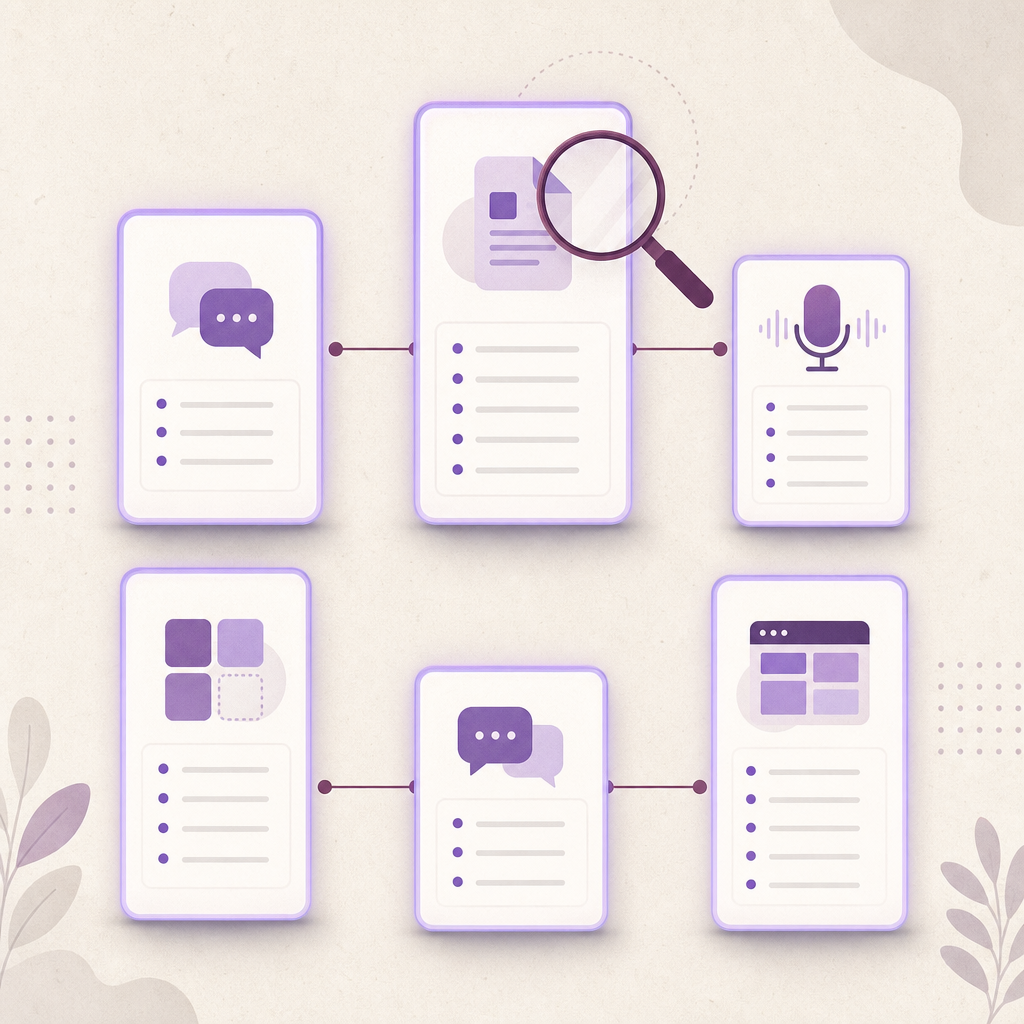
A conversational AI assistant is a pipeline, not a single model. Speak to one and automatic speech recognition (ASR) turns your audio into text, a natural language understanding layer pulls out intent, the LLM reasons through a reply, retrieval-augmented generation (RAG) grounds it in your documents, function calls hit external tools (CRM, calendar, payments), and text-to-speech (TTS) sends the answer back as audio. Break any link and the whole experience falls apart.
The LLM core
The reasoning layer in 2026 runs on a short list of frontier models: OpenAI's GPT-5.5, Anthropic's Claude Sonnet 4.6 and Opus 4.7, and Google's Gemini 3.1 Pro and 3.5 Flash. For support and research jobs, context window matters more than benchmark scores. Claude Sonnet 4.6, Opus 4.7, and Opus 4.8 ship with a 1M-token window at standard pricing, so you can drop entire product manuals or months of chat history into a single turn without chunking.
Voice layer: ASR and TTS
Voice is where most assistants break. ElevenLabs supports 70+ languages with low-latency synthesis built for real-time agents. Google Speech-to-Text recognizes 85+ languages and variants, and Google Text-to-Speech offers 380+ voices across 75+ languages, which is why most enterprise IVR builds default to it.
Retrieval, memory, and tool use
Retrieval keeps answers tied to your documents so the model doesn't hallucinate policy. Memory holds facts about the user across sessions. Tool use is what turns a chatbot into an agent that actually books the appointment, refunds the order, or updates the ticket.
The best conversational AI assistants in 2026, by job-to-be-done
Match the assistant to the job, not the logo on the login screen. Here's how the 2026 lineup sorts out.
General-purpose chat
ChatGPT Plus ($20/mo) is the default. Claude Pro ($20/mo) wins on long context and steadier writing for briefs past 20 pages. Gemini fits if you live in Google Workspace; Copilot fits if you live in Microsoft 365. If your employer already pays for one inside a suite license, skip the standalone subscription.
Research with citations
Perplexity Pro ($20/mo) is the pick. Every answer links to source URLs you can open and verify. Runner-up: ChatGPT with browsing. Skip both if you only need creative writing.
Customer support
Intercom Fin, Zendesk AI, and Salesforce Einstein lead. Your existing helpdesk decides: Fin on Intercom, Zendesk AI on Zendesk, Einstein if Service Cloud is already in the contract. Marketers use these to deflect inbound chat and run post-purchase follow-up sequences.
Voice and telephony
ElevenLabs Conversational AI is the strongest voice-agent layer, billed per call minute with separate LLM pass-through fees. Use it for outbound touchpoints and IVR replacement.
Developer-built
Amazon Lex, Google Dialogflow CX, and Microsoft Copilot Studio if you need to own the agent stack on your existing cloud.
Companion
Pi from Inflection is the empathetic-conversation reference point, a category the productivity tools intentionally avoid.
Side-by-side comparison: pricing, free tiers, integrations, voice, privacy
Here's an apples-to-apples view of major consumer and prosumer assistants at 2026 list prices, pulled from each vendor's pricing page.
Reading the table
- ChatGPT: Free, Go $8/mo, Plus $20/mo, Pro $200/mo. OpenAI added a separate Pro tier at $100/mo on April 9, 2026. Plus has no annual billing option, per OpenAI's help center. Best for general chat and multimodal work; voice mode included.
- Claude: Pro at $20/mo unlocks Opus 4.7, Sonnet 4.6, and Haiku 4.5. Sonnet 4.6 and Opus 4.7 both ship with a 1M-token context window at standard rates. Best for long-document research and writing.
- Google Gemini: AI Plus $7.99/mo, AI Pro $19.99/mo (Gemini 3.1 Pro), AI Ultra cut from $250 to $200/mo at I/O 2026, plus a new entry-Ultra tier at $100/mo. Strongest Workspace integration.
- Microsoft Copilot: standalone Copilot Pro at $20/mo closed to new sign-ups in late 2025 (existing users keep access through August 1, 2026). Microsoft 365 Premium replaced it at $19.99/mo for consumers. Business runs $21/user/mo annual (promo $18), Enterprise add-on $30/user/mo.
- Perplexity: Pro at $20/mo, Enterprise tier published. Best for cited research.
- ElevenLabs Agents: Free 15 min, Starter $6 (75 min), Creator $22 (275 min), Pro $99 (1,238 min), Scale $299 (3,738 min), Business $990 (12,375 min). Overage is $0.08/min. Best for voice/IVR.
Where free tiers genuinely work
ChatGPT Free, Claude's free tier, and Perplexity's free search cover most personal use. ElevenLabs' 15 free minutes are demo-only.
Where annual billing changes the math
Microsoft 365 Copilot Business at $18/user (annual promo) beats month-to-month by 14%. ChatGPT Plus offers no annual discount, so the sticker price is the real price.
Pricing gotchas and hidden costs no vendor advertises
Headline rates rarely match the invoice. Every major conversational AI assistant has at least one billing mechanic the marketing page downplays, and a few cost categories don't show up on the pricing page at all.
Burst rates and silent overages
ElevenLabs Conversational AI lists $0.08 per minute as the standard rate, but the same page notes burst pricing of $0.16 per minute the moment you exceed your concurrency limit. Billing runs on connection duration, not active speech, so a silent caller or a long hold still meters. ElevenLabs applies a 95% discount for silence longer than 10 seconds on multimodal calls, but LLM and telephony charges are billed separately on top of the per-minute rate.
Pass-through LLM costs
Claude Opus 4.7's per-token rate matches Opus 4.6, yet Anthropic's documentation flags a new tokenizer that can emit up to 35% more tokens per request, raising the real bill without a sticker change. On Google's Gemini API, input pricing roughly doubles once a prompt crosses 200,000 tokens on 3.1 Pro and 2.5 Pro, which punishes research workflows that pack long context windows.
Annual-billing traps and ad-supported free tiers
OpenAI's Help Center confirms there's no annual billing for Go, Plus, or Pro, and Free and Go tiers have shown ads in the US since February 9, 2026. Microsoft Copilot Business advertises $18 promotional pricing that reverts to $21 in the SMB lane through the end of 2026, with month-to-month at $25.20. The $30 enterprise add-on still requires a qualifying base license.
Privacy, data retention, and compliance, what each assistant actually does with your data
Data handling is the number-one reason enterprise buyers walk away from an assistant after a successful pilot. Here's what the major vendors' published policies actually say.
Training data opt-outs
ChatGPT Plus conversations can be used to train OpenAI models unless you toggle off "Improve the model for everyone" in settings (per OpenAI's data controls documentation). ChatGPT Business and Enterprise exclude customer data from training by default, add SAML SSO, and carry SOC 2 Type II. Claude's consumer plans follow Anthropic's published usage policy; API traffic isn't used for training. Microsoft 365 Copilot Business and Enterprise keep tenant data inside the Microsoft 365 boundary and inherit SharePoint permissions. That becomes a real failure mode when your file ACLs are messy: users can surface documents they technically had access to but were never meant to open.
Region and residency
Claude's Opus 4.6 and Sonnet 4.6 expose an inference_geo parameter. US-only routing carries a 1.1x pricing multiplier, with global routing as the default. ChatGPT Enterprise offers multi-region residency. Gemini's API exposes four inference tiers as of April 1, 2026 (Standard, Priority, Batch, and model-specific), with pricing that varies by tier.
Compliance posture
ChatGPT Enterprise adds ISO 27017, 27018, 27701, CSA STAR, and GDPR SCCs. Verizon's Google Cloud deployment shows how residency gets negotiated in practice. A Verizon executive told Reuters, "the data does not go back to Google at all. It generates all responses here in Verizon." Read each vendor's trust page before signing. Defaults differ sharply between consumer and enterprise SKUs.
How to choose: a decision framework by JTBD, ecosystem, and budget
Pick on three axes, in order: the job, the ecosystem you already pay for, and the budget you actually have.
Job, ecosystem, budget
Job-to-be-done sets the shortlist. Research with citations points to Perplexity. Voice automation and outbound calling points to ElevenLabs Agents. Long-document reasoning and careful writing points to Claude. General chat and image work points to ChatGPT. Ecosystem-bound productivity points to Copilot or Gemini.
Ecosystem usually decides the default. If your team lives in Microsoft 365, Copilot has the shortest path to deployed value because it reads your Outlook, SharePoint, and Teams content with no extra plumbing. On Google Workspace, Gemini plays the same role. Mixed or web-first teams tend to land on ChatGPT or Claude.
Budget falls into three bands: free tiers (capped and usually trained-on by default), the $8 to $25/mo personal band (ChatGPT Go and Plus, Claude Pro, Gemini AI Pro, Copilot Pro), and enterprise seats at $30 to $200+ per user per month.
Questions to ask before you sign
- Is training-data opt-out the default, or do you have to toggle it?
- Are data residency options available on your tier?
- Is the free trial actually free, or a metered credit pool?
- Are headline prices annual-only? What's the true month-to-month rate?
- What are overage, burst, and per-minute telephony rates?
- Are there seat minimums and auto-renewal clauses?
Marketing teams automating customer touchpoints should stop shopping for one chat tool. Pair voice (ElevenLabs Agents), a reasoning model (GPT-5 or Gemini), and a support layer (Zendesk AI or Intercom Fin).
When a conversational AI assistant is the wrong tool
An assistant that confidently writes a plausible answer is the wrong shape for any workflow where a wrong answer triggers a regulator, a lawsuit, or a wire transfer you can't claw back. Match the tool to the failure mode you can tolerate.
Regulated and irreversible actions
Medical dosing, legal filings, and financial trades share one trait: a single fabricated citation or transposed number is a compliance event, not a typo. Keep a licensed human in the decision path. The same logic applies to sending money, deleting records, or pushing code to production. Even if the agent can technically execute, route those steps through a confirmation a person clicks.
Low-data domains
If your knowledge base is thin, outdated, or unstructured, you're asking the model to invent answers rather than retrieve them. Knowmax's analysis of Gartner's projected $80 billion in contact-center labor savings makes the point bluntly: those savings assume the AI works, and the AI only works when the knowledge behind it is structured and current. Forrester's 2026 outlook, cited in the same piece, frames the year as one of "gritty, foundational work" on knowledge structuring rather than headline transformations.
When a single source of truth beats fluency
For deterministic tasks like password resets, order-status lookups, and refund-eligibility checks, a rules-based chatbot or a workflow tool is cheaper, faster, and auditable. Reserve the probabilistic assistant for open-ended reasoning, and ground every external-facing response in retrieval so the model cites your data instead of guessing at it.
Frequently asked questions
Sources (8)
- 1.Gartner Predicts Conversational AI Will Reduce Contact Center Agent Labor Costs by $80 Billion in 2026gartner.com
Primary source for the $80B 2026 contact-center savings figure and the 1-in-10 automated interactions projection. Anchors the marketing/customer-touchpoint angle.
- 2.Google Cloud and Verizon Drive Customer Experience Improvements with Gemini Integrationgooglecloudpresscorner.com
Primary source for the Verizon Personal Research Assistant deployment: 28,000 reps, 95% comprehensive answerability, powered by Vertex AI / Gemini / Agent Assist Panel.
- 3.ChatGPT Pricing — OpenAIopenai.com
Primary source for ChatGPT tier structure, security and encryption posture, and educator/Edu pricing programs.
- 4.About ChatGPT Pro tiers — OpenAI Help Centerhelp.openai.com
Confirms Pro $100 vs Pro $200 usage differences and confirms OpenAI does not offer annual billing for ChatGPT Go, Plus, or Pro.
- 5.Pricing — Claude Platform Docsplatform.claude.com
Primary source for Sonnet 4.6 / Opus 4.7 / Opus 4.8 token rates, 1M-token context window inclusion at standard pricing, US inference_geo 1.1x multiplier, and Batch API discount.
- 6.ElevenAgents Pricing — ElevenLabselevenlabs.io
Primary source for included minutes, concurrency limits, $0.08/min standard rate, $0.16/min burst, and separate LLM/telephony billing.
- 7.Everything new in our Google AI subscriptions, fresh from I/O 2026blog.google
Primary source for Google AI Ultra repricing ($250 → $200, new $100 tier) and the 2026 Gemini subscription restructure.
- 8.Microsoft 365 Copilot Plans and Pricingmicrosoft.com
Primary source for Microsoft 365 Copilot Business and Enterprise pricing, base-license prerequisites, and the July 1 – September 30, 2026 promotional window.