Key takeaways
- Grammarly's standalone web AI Detector is free with a 1,000-word cap per scan.
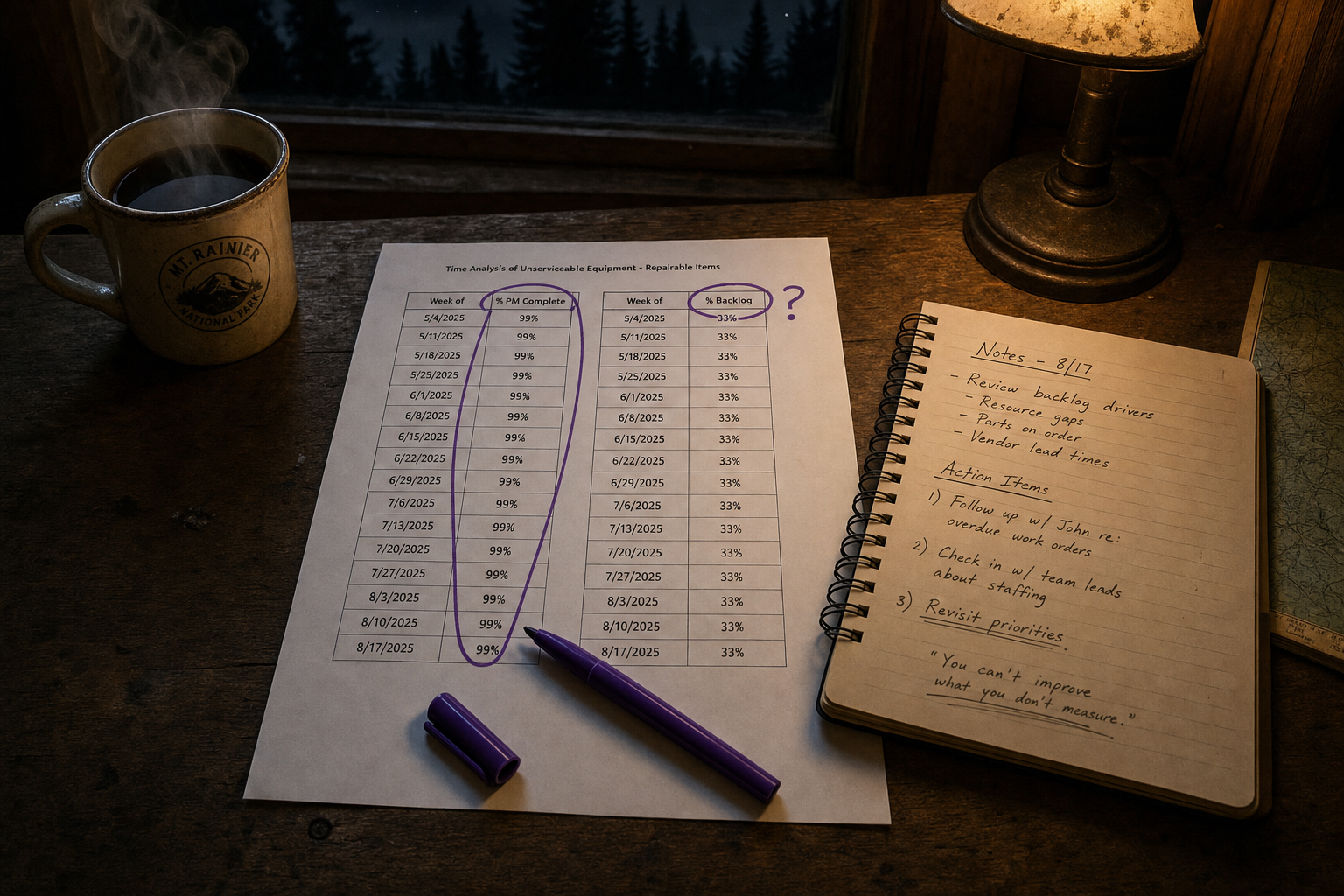
- Accuracy claims range from 99% (Grammarly) to 33% (a competitor test), and both are real.
- Detection collapses to 12-16% once text is paraphrased, per 2026 third-party tests.
- Authorship, not the checker, is Grammarly's real differentiator: it logs the writing process.
- A 2023 Stanford study found GPT detectors flagged 61% of TOEFL essays as AI-written.
Grammarly's AI Checker page claims 99% accuracy and the #1 slot on the RAID benchmark as of June 2026. A competing humanizer's test put the same checker at 33%. Both numbers are real. Neither tells you what your essay will score on Monday morning.
This is a neutral read on the Grammarly AI Checker for the four people who actually search for it: the student worried about a false flag, the educator deciding whether to act on a score, the marketer auditing freelance work, and the HR screener reviewing a cover letter. Pricing, tiers, accuracy claims, conflicts of interest, and what to do when the number is wrong.
Grammarly AI Checker at a glance: what it is, what it costs, who it's for
Grammarly's AI Checker lives at grammarly.com/ai-detector. You paste in a few thousand characters, hit scan, and get back one number: the percentage of text it thinks is AI-generated. No account needed for a basic check. That's the whole tool.
Grammarly launched the standalone detector in August 2024, then layered on an Authorship feature that tracks writing as you type. For 2026, it advertises coverage of the current model generation (GPT-5.5, Claude Sonnet 4.6, Gemini 3 Pro) on top of older ChatGPT and Gemini outputs.
Scale is why this matters. Grammarly integrates with 500,000+ apps and websites and serves 30M+ users (per Grammarly's own corporate page). When a tool that big flags your writing, real consequences follow.
Who's actually pasting text into it
Four readers land on this page. The student checking an essay before submission. The educator scanning a suspicious assignment. The marketer auditing a freelancer's deliverable. The HR screener gut-checking a cover letter that reads too polished. Each needs a different answer.
And here's the tension this piece untangles. Grammarly claims 99% accuracy. One competitor humanizer's review pegs it at 91%. A competing detector's testing puts it at 33%. Proofademic clocked it at 95% on raw AI text but only 16% once that text was lightly paraphrased. Every one of those numbers has a stake attached. We'll name them.
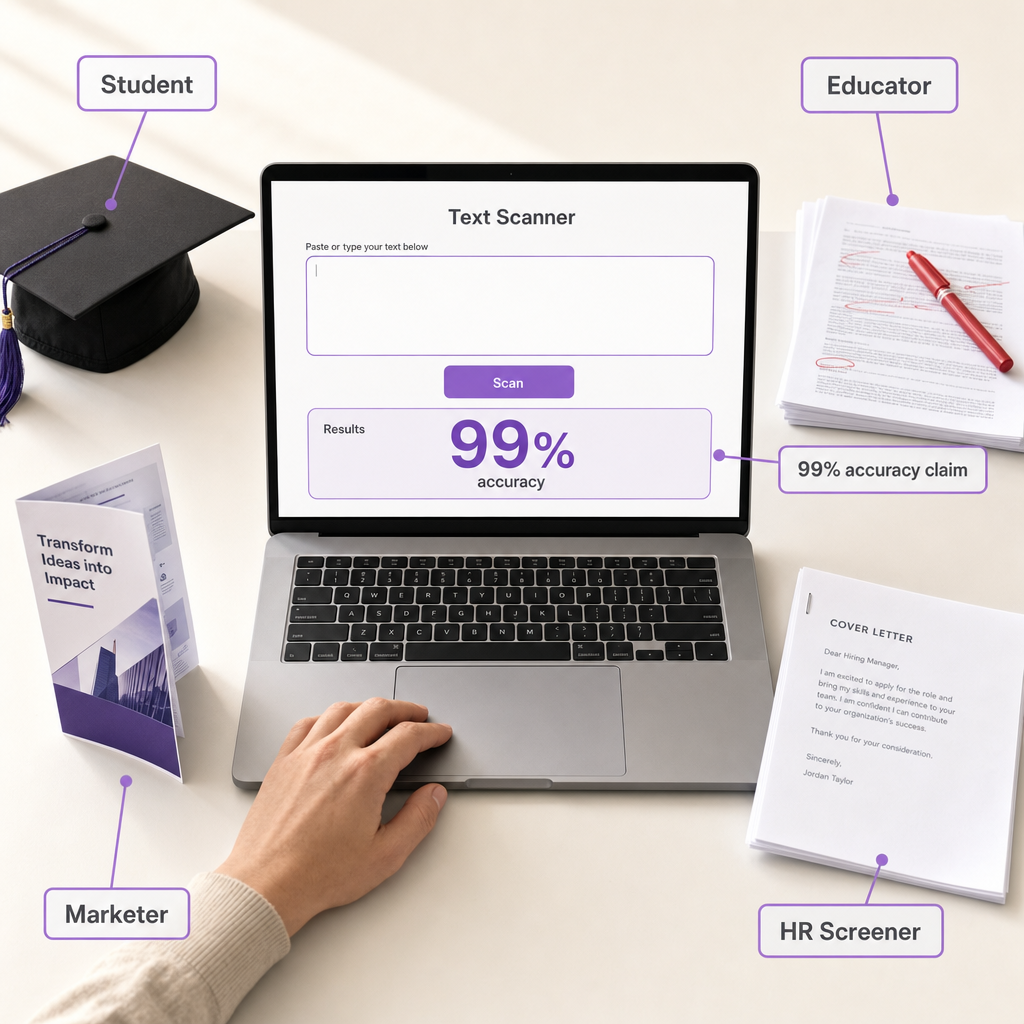
Four very different readers rely on the same single-number AI detection result.
The accuracy controversy: why Grammarly claims 99% and competitor tests say 33%
Grammarly's June 2026 product page claims the #1 spot on RAID with 99% accuracy. Competitor tests put the same checker at 33%. Both numbers are real. Neither predicts what your essay will score.
What RAID actually measures
RAID (Robust AI Detection) is the benchmark published by Dugan et al. at ACL 2024, covering 6M+ generations across 11 models, 8 domains, and 11 adversarial attacks. The paper's headline finding wasn't that detectors work. It was the opposite. Most commercial detectors fall apart the second text gets paraphrased, translated, or lightly edited. A 99% score on raw output and a 16% score after one paraphrase pass can come from the same tool on the same afternoon.
Who's saying what (and what they sell)
Grammarly (sells the checker): 99% on RAID, June 2026 product page.
A humanizer vendor benchmark, April 2026: 95% on raw AI text, 16% after paraphrasing.
A second humanizer vendor, 2026: 91% raw, ~12% after rewriting, under 3 seconds per 1,000 words.
A third humanizer vendor, 6-content-type test: 33% overall, 100% on human writing, 50% on a ChatGPT sample.
A competing detector: cited a Reddit case where the same 2,300-word text scored 0% one day and 35% two days later.
Every party here has a stake. The honest read: accuracy depends almost entirely on whether the text has been touched after generation.
Free vs Pro vs Enterprise: what AI detection you actually get at each tier
The free-vs-paid story gets muddled across search results, so here's the resolution: the standalone web AI Detector at grammarly.com is free, with a per-submission cap around 1,000 words. AI detection scores inside Authorship reports, the document-history feature educators and HR screeners actually want, sit behind Pro.
Free tier: the standalone AI Detector
Paste text, get a percentage, done. No login gate on the basic scan. But you can't pull an Authorship report, there's no plagiarism layer, and the word cap forces you to chunk longer pieces. Fine for a quick gut check on one paragraph. Not enough for a 5,000-word thesis.
Pro at $12/month: detection inside Authorship
Pro runs $12/month on annual billing and $30/month month-to-month (per grammarly.com/plans). That's a 2.5x penalty for paying monthly. Grammarly folded the old Premium and Business labels into Pro in 2026, and the plan scales to 149 seats. Watch the trial window: grammar.blackfriday flagged in January 2026 that Grammarly is "currently not offering any free trials," so the 7-day offer is intermittent.
Enterprise: the API and admin layer
Pricing is quote-based. You get the AI Detection API (still in beta per developer.grammarly.com), SAML SSO, and BYOK/DLP controls. This is the only tier that lets an HR or compliance team script detection into an applicant pipeline.
Where the Grammarly AI Checker holds up , and where it collapses
The Grammarly AI Checker works in exactly one scenario: raw, untouched model output dropped into standard academic register. Outside that, the numbers get weird.
Raw AI text: the 91-99% zone
On unedited GPT-5 or Claude writing, detection clusters high. Walter Writes' own testing put Grammarly at 91% on raw AI. Proofademic's April 2026 writeup logged 95% on a fully AI-generated essay. Grammarly markets a 99% figure. The ceiling is real. It only applies to text no human has touched.
Paraphrased and humanized text: the cliff
Rewrite the wording and accuracy falls off a ledge. Proofademic's headline result: 95% AI dropped to 16% after basic paraphrasing. Walter Writes saw the same pattern, 91% on raw collapsing to roughly 12% on humanized writing. Reddit users report the same passage scoring 0% one day and 35% the next, which suggests the underlying model is unstable on mixed-source text.
ESL writing: the false-positive problem
The 2023 Stanford study by Liang, Zou and colleagues in Patterns found that seven leading GPT detectors flagged 61.22% of TOEFL essays as AI-generated, and 97% were flagged by at least one. Professor James Zou explicitly warned against using detectors in evaluative settings. The University of San Diego's law library guidance echoes this for neurodivergent and ESL writers.
Practical read: a high Grammarly score on raw AI means something. A low score on edited writing, or a high score on an ESL student, means almost nothing.
Grammarly Authorship: the feature that's actually Grammarly's differentiator
Authorship is the one Grammarly feature that does something competing detectors can't. It's not a classifier. It records the writing process.
What Authorship tracks
While you write in Google Docs or Microsoft Word, Authorship logs every keystroke, paste, and AI-rephrase event. The output sorts each chunk of text into one of four buckets: Typed by Human, AI-generated, AI-revised, or Copied from a known or unknown source. Grammarly rolled it out to Free, Pro, and Grammarly for Education users in late 2024, added Word support in April 2025, and bundled fast citations plus embedded plagiarism checks for Pro and Education tiers around the same time.
Authorship vs. after-the-fact detection
Detectors analyze a single moment in time, per Grammarly's own product page. Authorship preserves version history. That's a different category of evidence: a replay, not a guess. For a student walking into a "did you use AI?" hearing, handing over the replay alongside the essay can end the meeting before it starts. No detector verdict required.
Where it works, and where it doesn't
Read the fine print. Data stores per device, so opening the same file on your laptop after drafting on your desktop turns earlier text into Unknown. It's still beta on desktop, opt-in only, and per Grammarly's institutional FAQ, faculty can't force-enable it on student accounts. It won't retroactively protect anything you wrote before switching it on. And it only helps if your school or employer accepts the report format in the first place.
Grammarly AI Checker vs the dedicated detectors: short verdicts on each matchup
Five detectors keep coming up. Here's how Grammarly's AI checker holds up against each.
vs. GPTZero
GPTZero advertises 99% accuracy and a #1 G2 ranking. Both tools do fine on raw AI output and wobble once a human rewrites it. If Grammarly's already in your subscription, stay put. Pick GPTZero if you want sentence-level highlighting.
vs. Originality.ai
Originality publishes the most aggressive numbers: RAID F1 of 0.918, precision of 1.0, recall of 0.848, and 84.84% accuracy across 11 models. It's paid, built for publishers vetting freelance work. Use it commercially. Use Grammarly for a quick free pass.
vs. Copyleaks
Copyleaks pitches a "won't false-flag Grammarly-edited writing" angle, claims 99%+ accuracy with a 0.03% false-positive rate, covers 30+ languages, and holds SOC 2/3 plus GDPR. That's your enterprise compliance pick.
vs. QuillBot AI Detector
QuillBot needs 80 words minimum, caps free checks around 1,200 words, supports 20+ languages, and runs $8/month for Premium. Cheaper and more multilingual than Grammarly. One catch: its parent company also owns a major paraphrasing tool. Built-in conflict.
vs. Turnitin
Turnitin claims 98% accuracy and under 1% false positives. The Washington Post's Geoffrey Fowler reported 50% false positives in a 2023 limited test. A 2026 third-party number put it at 78% on humanized writing. Students don't pick Turnitin. Their school does.
Winston AI and Pangram Labs (both cited near 97% in recent third-party tests) round out the names worth knowing.
Which AI checker fits your use case
Students protecting their own work
Turn on Grammarly Authorship before you type a single word. It logs keystrokes and paste events so you can show a professor exactly how the document came together. For a one-off check on something you already wrote, the free Grammarly AI Detector is fine. If your school runs Turnitin, run a second scan through QuillBot's free detector. It tends to catch the patterns Turnitin flags.
Educators grading
Grammarly's own institutional FAQ says Authorship isn't built for policing. Use it to teach process, not to convict. A detector score should open a conversation, never close one. Stanford researchers found ESL writing gets flagged at much higher rates than native English writing, which alone is reason to never grade off a percentage.
Content marketers auditing freelancers
For freelancer audits, a detector that publishes its RAID benchmark methodology and targets publisher workflows is the sharper pick. For in-house writers already living inside the Grammarly editor, Grammarly's checker is the lower-friction call since it's already in their sidebar.
HR teams screening applications
Don't run cover letters through any AI detector. The Stanford study and the TRAILS Institute at the University of Maryland have both documented that non-native English speakers get disproportionately flagged. The legal exposure from a discrimination claim outweighs whatever signal you'd get. Score the writing, not the probability a model wrote it.
What to do if you're falsely flagged , and how to make AI writing sound human when you do use AI
A false flag isn't the end of the conversation. It's the start of one. The second you see a score you'd contest, screenshot it with the date and time visible, then request a re-scan. Reddit users have documented the same text swinging from 0% to 35% across two days on Grammarly's checker. A second pass alone can shift the outcome.
Recourse if Grammarly flags your real writing
Pull your version history from Google Docs or Word. Export an Authorship report if you had it running. Per the University of San Diego law library guide on AI detection, the Modern Language Association has tracked student cases where false positives delayed or withheld diplomas. The stakes justify a formal appeal, not quiet acceptance.
Protect future work with Authorship-style timestamping
Turn on Authorship before you start anything high-stakes. Keep a parallel trail in Apple Notes or a separate Google Doc. Don't paste from sources you can't attribute later, even your own old writing. Pasted blocks read as suspicious to most detectors.
When you do use AI: rewrite for a natural tone
If you used AI for brainstorming or a first pass, run the output through a humanizer like WriteHuman so the final version reads the way you actually write. Your falsely-flagged response kit, then, is five items: dated screenshot, version history export, Authorship report, formal appeal letter, and a humanized rewrite of any AI-assisted sections you submit going forward.
Frequently asked questions
Sources (8)
- 1.AI-Detectors Biased Against Non-Native English Writers (Stanford HAI)hai.stanford.edu
Primary source for the 61% TOEFL false-positive finding and Professor James Zou's caution against using detectors in evaluative settings. Anchors the ESL false-positive section.
- 2.GPT detectors are biased against non-native English writers (Liang, Yuksekgonul, Mao, Wu, Zou — Patterns)arxiv.org
The underlying peer-reviewed paper behind the Stanford bias finding; gives the article a citable primary research source rather than a press release.
- 3.RAID: A Shared Benchmark for Robust Evaluation of Machine-Generated Text Detectors (Dugan et al., ACL 2024)arxiv.org
The actual RAID paper Grammarly cites for its #1 ranking. We need to explain what RAID measures so the 99% claim has context — 6M+ generations across 11 models with 11 adversarial attacks.
- 4.AI Detection Tools Falsely Accuse International Students of Cheating (The Markup)themarkup.org
Established journalism documenting real student harm from AI-detector false positives. Adds non-academic-press credibility to the ESL section.
- 5.Detecting AI May Be Impossible (TRAILS Institute, University of Maryland)trails.umd.edu
NSF-funded institute's coverage of Geoffrey Fowler's Washington Post investigation and Soheil Feizi's research; provides the Turnitin 4% sentence-level false-positive figure and the case against acceptable error rates.
- 6.The Problems with AI Detectors: False Positives and False Negatives (University of San Diego Legal Research Center)lawlibguides.sandiego.edu
Academic library guide synthesizing the false-positive evidence and naming the neurodivergent-student bias finding. Useful authoritative voice for the recourse section.
- 7.Grammarly Authorship product pagegrammarly.com
Primary source for what Authorship actually does, how it differs from after-the-fact detection, and current device/platform constraints.
- 8.About Authorship (Grammarly Support)support.grammarly.com
Primary source for Authorship feature gating across Free, Pro, and Enterprise tiers and the specific AI/plagiarism detection access inside reports.