Key takeaways
- No universal acceptable AI percentage exists. Contracts and platform policies govern, and nearly all specify disclosure or quality rules, not numbers.
- Detection scores are probability estimates, not measurements, and two tools can disagree on the same text by 50 points or more.
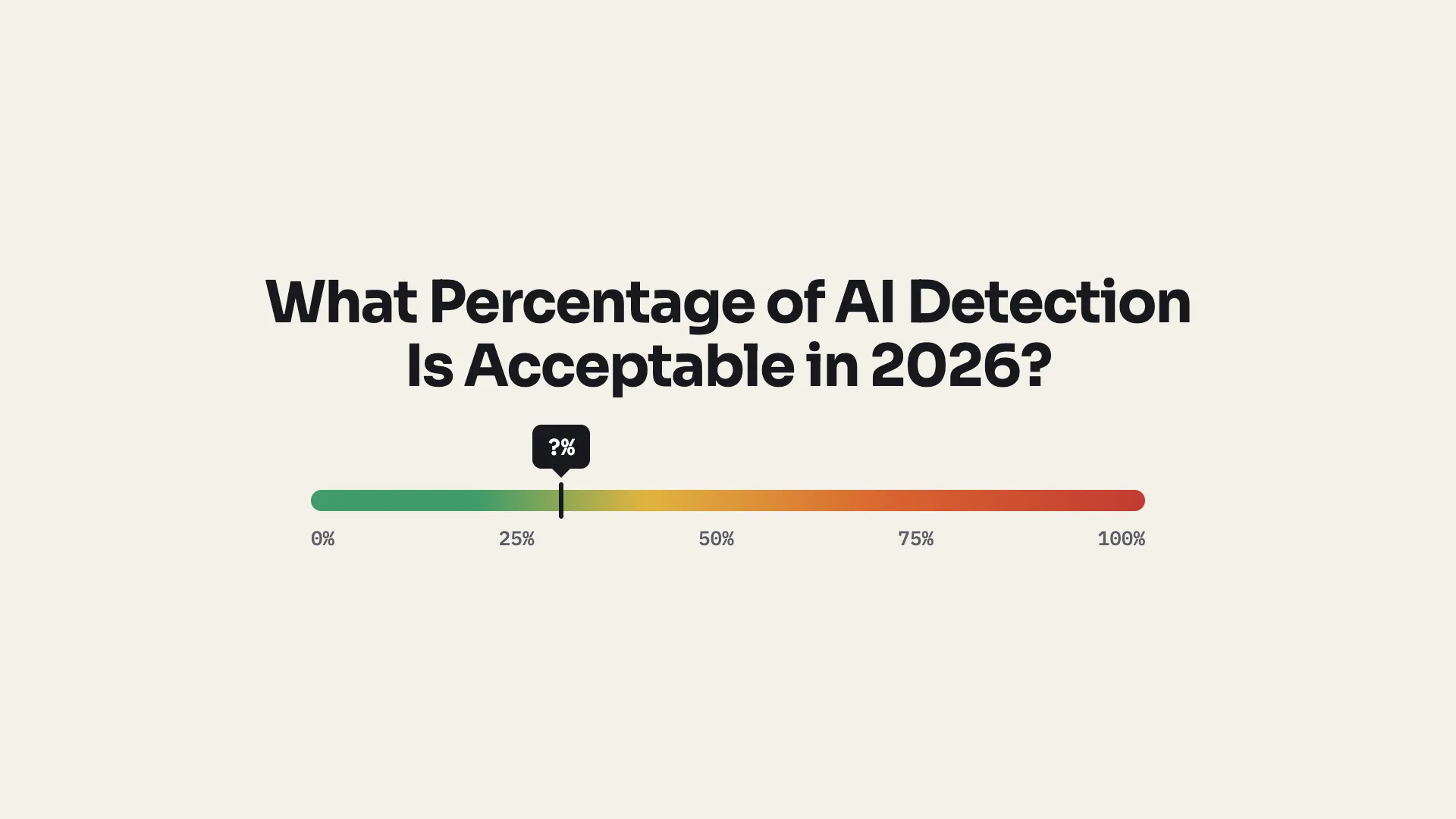
- A workable bar for professional work treats under 20% as noise. At 20 to 40%, reread the flagged passages, and a sustained 60%+ across multiple detectors means rewrite.
- Process documentation (briefs, drafts, version history) settles disputes better than any score.
No client contract template, platform policy, or search engine document anywhere publishes an acceptable AI detection percentage. Not Google's spam policies, not Upwork's terms of service, not Amazon's publishing rules. The cutoffs traded in freelancer forums (keep it under 10, under 25, under a third) are folklore. So here is the honest answer to what percentage of AI is acceptable. It is the number your client, editor, or platform actually wrote down, and almost none of them ever wrote one down.
That answer changes how you should operate. Chasing 0% on every checker burns hours you could bill. The smarter play is knowing what each context actually enforces, what a detection percentage really measures, and how to protect yourself the day a score gets waved at you.
Why no universal threshold exists
A detection percentage looks like a measurement, the way a blood test is a measurement. It is nothing of the kind. It is a statistical model's confidence estimate, produced by software with a known error rate, and the companies that build these tools say so themselves. OpenAI launched its own AI text classifier in January 2023 and shut it down that July, noting its low rate of accuracy. The tool correctly identified only 26% of AI-written text while mislabeling human writing as AI 9% of the time.
A threshold only makes sense when the instrument is reliable and everyone agrees what it measures. Neither condition holds here. That is why no serious institution has committed a number to paper, and why anyone who quotes you a hard cutoff is repeating a rumor.
What different contexts actually expect
The rules that do exist are about disclosure and honesty, not percentages. The table below shows what governs in the places professionals actually work.
Context | Who sets the bar | What actually governs |
|---|---|---|
Freelance client work | The individual contract | Upwork's updated terms (effective September 10, 2025) prohibit passing off AI-generated content as your own original work when the contract rules out AI use. The contract is the standard, not a score. |
Publishing marketplaces | Platform disclosure rules | Amazon KDP has required disclosure of AI-generated text since September 2023. It is a checkbox at upload, distinguishes AI-generated from AI-assisted, and involves no percentage at all. |
Editorial and publications | Each masthead's policy | Policies range from full bans on AI drafting to accepting AI-assisted work with human revision. Some editors spot-check with detectors. None publish a cutoff. |
Employers | Internal AI policy | Corporate policies mostly govern confidentiality, accuracy, and approved tools. Detection scores rarely appear anywhere in them. |
SEO and web content | Google's spam policies | Google says it rewards quality content "however it is produced." Automation aimed primarily at manipulating rankings is spam. No detector threshold is involved. |
Two of those rows deserve a closer look. Upwork's terms of service revision, documented by Eurofound, tells freelancers to use AI ethically and transparently but stops well short of banning the tools. The violation is misrepresentation, not usage. And Amazon's KDP disclosure rule, which the Authors Guild pushed for and welcomed, draws its line between content AI created and content AI merely helped polish. Both policies care about honesty. Neither one mentions a number.
Google is the same story. Its official guidance on AI-generated content has been consistent since February 2023. Production method does not decide rankings, quality and intent do. If your content is accurate, original, and made for readers, Google's published position gives no reason to care what a third-party checker scores it.
How detection percentages are computed, and why tools disagree
Before you react to any score, know what the number claims to be. Detectors report percentages in two different ways, and the interfaces rarely make the distinction obvious.
Document probability. "This text is 40% likely to be AI-generated." A confidence estimate about the whole document.
Flagged proportion. "40% of these sentences look machine-written." A share of the text, which tells you which passages triggered the model.
Those are different claims wearing the same outfit. A 40% probability on a fully human draft is a shrug, while 40% of sentences flagged tells you exactly which paragraphs read generic.
Under the hood, modern detectors are classifiers trained to separate human and machine text. Earlier generations leaned on two signals. One was perplexity, which measures how predictable each next word is, and the other was burstiness, which measures how much sentence rhythm varies. Machine text tends to be smooth and even. Human text lurches. Current tools layer deep-learning models on top, but the output is still a probability, and each vendor trains on different data with different tuning. The same article scoring 8% on one tool and 65% on another is normal, not a glitch.
The failure modes are well documented. Beyond OpenAI's own retired classifier, Stanford researchers reported in the journal Patterns that popular GPT detectors flagged more than half of writing samples from non-native English speakers as AI-generated, while scoring native speakers' writing almost perfectly. Predictable phrasing gets punished, and that lands hardest on ESL professionals who write clean, careful, conservative English. If that is you, a mid-range score says more about the detector's training data than about your integrity.
Sensible personal thresholds for professional work
Since nobody hands you an official number, set your own service bar and apply it consistently. Here is a defensible one, built around the error rates above rather than wishful thinking.
Is 20% AI detection bad?
No. Twenty percent sits inside the noise floor for edited human writing. OpenAI's own tool mislabeled human text 9% of the time, and independent tools misfire far more often on certain writing styles. Treat a sub-20 reading on work you actually wrote or heavily revised as background static. If a client raises it, respond with your draft history, not a panicked rewrite.
Is 30% AI detection bad?
It depends on which kind of 30 it is. A 30% document probability is still weak evidence of anything. But if 30% of sentences are flagged, open the flagged passages and read them cold. Listy structure, hedged claims, and template phrasing usually cluster right there, and those are worth revising for quality reasons that have nothing to do with detectors. Fix the writing, and the score tends to follow.
How much AI detection is too much?
The practical red line is agreement. When two or three different detectors independently place a piece above roughly 60 to 70%, the prose almost always reads templated to human editors too, and that costs you assignments regardless of anyone's AI policy. One tool shouting 80% while two others read 15% is a tuning artifact. Three tools agreeing is feedback. For a detailed walkthrough of one specific mid-range score and what to do about it, see our companion piece on whether 40% AI detection is bad.
Documenting your process is the insurance almost nobody buys
A detection score is an accusation only when you have nothing to answer it with. The professionals who never lose these arguments keep receipts.
Version history. Draft in a tool that timestamps revisions. A document that grew over four sessions across three days is its own defense.
The paper trail around the work. Briefs, outlines, source notes, interview recordings. Deliverables with visible scaffolding do not look conjured.
An AI clause in your own contract. State which tools you use, what AI-assisted means in your workflow, and that a human (you) approves every line. Most clients have never seen a freelancer address it first, and it reframes the entire conversation from suspicion to process.
This is the part that actually scales. Policies will keep shifting through 2026 and beyond, but a documented process is portable across all of them.
Check the score before your client does
The last sensible habit is to know your number before anyone else does. Run deliverables through a free AI detector to see roughly what a cautious client or editor would see, then deal with whatever it flags on your terms. Some passages just need your voice put back in by hand. For machine-flavored drafting, a tool like WriteHuman rewrites stiff, over-even phrasing toward natural human cadence, and you can try it on the homepage without an account (the free plan covers 3 humanizations a month at 250 words each). On HumanizerBench, the public monthly benchmark WriteHuman publishes, WriteHuman finished first of 14 humanizers in the October 2026 cycle with a composite score of 74.89, its fourth straight month at the top.
No tool guarantees any particular score, because the detectors themselves cannot agree on one. What you can control is the writing. The acceptable percentage, in the end, is the one you can defend. Know the policy that actually applies to you, keep your drafts, and deliver work that sounds like a person because a person stands behind it.
Frequently asked questions
Sources (5)
- 1.Google Search's guidance about AI-generated content (Google Search Central Blog)developers.google.com
- 2.
- 3.
- 4.
- 5.Upwork rolls out AI agent and updates its global ToS (Eurofound Platform Economy Database)apps.eurofound.europa.eu