Key takeaways
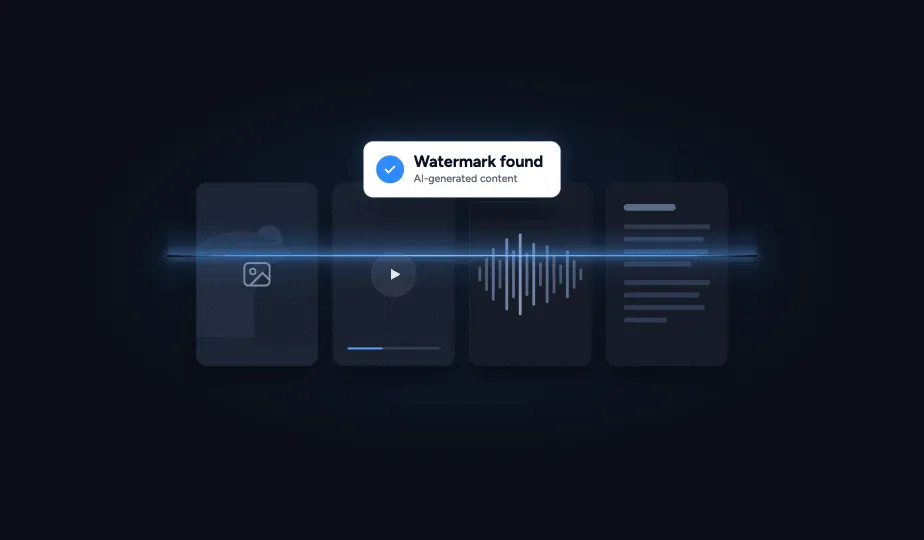
- SynthID is an invisible watermark Google embeds in AI-generated images, video, audio, and text; over 100 billion images and videos already carry it.
- I/O 2026 brought verification to consumers: check content through Google Search (Lens, AI Mode, Circle to Search) and a right-click check in Chrome.
- OpenAI, Kakao, ElevenLabs, and NVIDIA adopted SynthID, Apple support is coming later this year, and Claude's new text watermark is a SynthID-Text variant, making it a de facto industry standard.
- Coverage has gaps: non-partner models embed nothing, the text watermark is the most fragile, and a missing watermark proves nothing either way.
SynthID began in 2023 as a Google DeepMind project that stamped an invisible watermark into images from Google's own Imagen model. Three years on, it is closing in on something much bigger: the default provenance label for AI-generated content across the tools working professionals actually touch. At Google I/O in May 2026, Google announced that SynthID verification is now built into Search and rolling into Chrome, that OpenAI, Kakao, ElevenLabs, and NVIDIA are adopting the watermark, and that more than 100 billion images and videos already carry it. Anthropic went the same way: the invisible watermark Claude now embeds in its text is, in Anthropic's own words, a version of Google DeepMind's SynthID-Text approach.
Here is what SynthID is, where you will run into it, what it can and cannot reveal, and what it means if you publish AI-assisted work for a living.
What is SynthID?
SynthID is Google DeepMind's family of watermarking techniques that embed a machine-readable signal directly into AI-generated content at the moment of creation. For images and video, the watermark lives in the pixels, imperceptible to the eye. For audio, it is woven into the waveform. For text, it is a statistical pattern in which words the model picks, not hidden characters or metadata.
That last point matters because it separates SynthID from the other big provenance standard, C2PA Content Credentials. C2PA attaches a signed metadata record to a file, a kind of nutrition label describing how the content was made. Metadata is easy to strip: screenshot an image or run it through the wrong export pipeline and the label is gone. SynthID is baked into the content itself, so it survives a fair amount of cropping, compression, and re-encoding. Google is now using both together, checking C2PA credentials where they exist and falling back on the SynthID watermark when metadata has been lost.
The scale is striking. At I/O 2025, Google said more than 10 billion pieces of media had been watermarked since 2023. A year later the count for images and video alone had passed 100 billion. If you use Gemini, Imagen, or Veo, everything they generate is watermarked by default.
What changed at I/O 2026
Until this year, SynthID was mostly plumbing: the watermark went in, but ordinary people had no easy way to check for it. Google's May 2026 announcements were about the checking side.
Verification in Search. Starting May 19, 2026, you can ask whether an image, video, or audio file was made with AI through Google Lens, AI Mode, and Circle to Search. Point the tool at the content and Google reports whether it finds a SynthID watermark or C2PA credentials.
A right-click check in Chrome. Gemini in Chrome now lets you right-click content on any page and check it for the watermark. Provenance checking becomes a two-click habit.
The Gemini app got there first. Google said people had already run about 50 million verification checks by asking the Gemini app whether an image was AI-generated.
An enterprise API. Google Cloud launched an AI Content Detection API on its Gemini Enterprise platform so businesses can scan content for watermarks from Google's models and partner models at scale. Newsrooms, marketplaces, and ad platforms are the obvious customers.
Which companies use SynthID?
The partner list from I/O 2026 turns SynthID from a Google feature into a would-be standard.
Company | Where SynthID shows up |
|---|---|
Gemini, Imagen, Veo, and Google's audio models watermark output by default | |
OpenAI | Adopting SynthID in its image generation systems |
ElevenLabs | Watermarking AI-generated voice and audio |
Kakao | The Korean tech giant is adding SynthID to its AI content |
NVIDIA | Embedding SynthID in output from its Cosmos world models |
Anthropic | Claude's text watermark is a version of the SynthID-Text approach |
OpenAI joining is the headline. The two companies compete on nearly everything. Provenance is now the exception. Anthropic's case is subtler. It did not join Google's program, but when it needed a text watermark to satisfy European transparency rules, it built on the SynthID-Text method Google had published openly. Either way, the technique is spreading faster than any rival scheme. Apple has also said SynthID support is coming to its platforms in a software update later this year.
Does SynthID work on text?
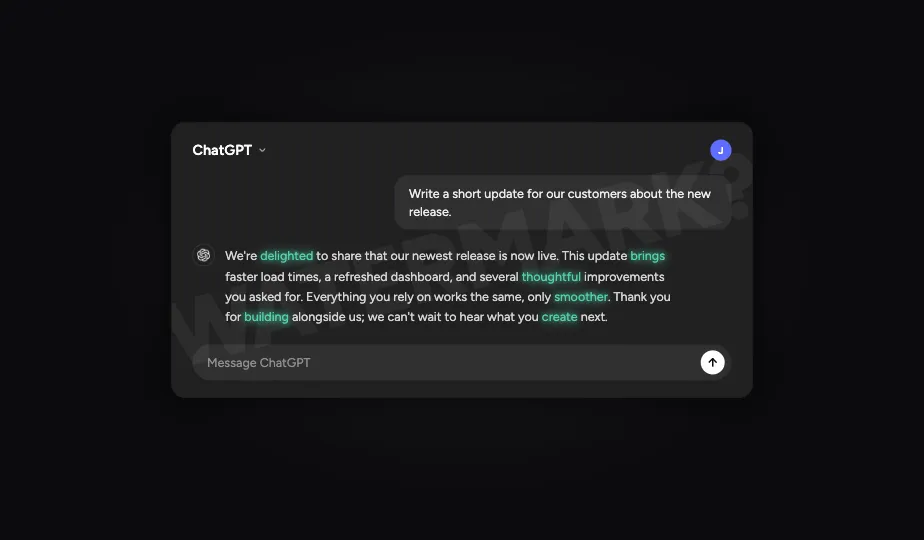
Yes, and text is where the story gets most interesting for anyone who writes with AI assistance. SynthID-Text works by nudging the model's word choices. When a model generates text, it constantly picks among several plausible next words. SynthID-Text uses a cryptographic key, combined with the preceding words, to steer some of those coin flips. No single sentence looks different, but across a long enough passage the choices form a statistical pattern that the key holder can test for. Google DeepMind published the method in Nature in October 2024 and open-sourced an implementation through Hugging Face, which is why other labs can build on it.
Google applies it to Gemini's text output. And since August 2, 2026, Anthropic embeds a SynthID-Text variant in text from newly launched Claude models, a move driven by the EU AI Act's transparency code. We covered that change in detail in our breakdown of Claude's invisible watermark.
But text is also where the watermark is weakest, and the companies say so themselves. Detection only returns a likelihood, not a verdict. It needs a reasonable amount of text to say anything at all. Light editing usually leaves the pattern partly intact, while a thorough rewrite that replaces the wording removes it, because the watermark is nothing more than a pattern in the wording. Anthropic is explicit that its detector cannot confirm a text was human-written and cannot identify output from any other company's model. The biggest name in AI writing sits this out entirely. OpenAI built a text watermark of its own and has never shipped it, a story we unpack in whether ChatGPT watermarks text.
How do I check for SynthID?
Your options depend on the content type and on who you are.
Ask Gemini. Upload an image to the Gemini app and ask whether it was AI-generated. This is live now and is the fastest route for images.
Use Google Search. Lens, AI Mode, and Circle to Search can check images, video, and audio for SynthID watermarks and C2PA credentials.
Right-click in Chrome. Gemini in Chrome adds a context-menu check, now available.
The SynthID Detector portal. Google's dedicated portal accepts images, audio, video, and text, and highlights which parts carry the watermark. Access is still gated behind a waitlist that prioritizes journalists, media professionals, and researchers.
Notice what is missing: a public, everyone-welcome checker for text. Anthropic says a detection API for Claude's watermark is coming but has not shipped a public tool. In practice, the way most editors, clients, and platforms evaluate text today is not watermark lookup but statistical classification: tools that judge whether the writing pattern itself looks machine-generated. It works on any text, regardless of which model produced it. You can see how that looks from the receiving end by running a draft through a free AI detector. The same distinction applies to images: a classifier-based AI image detector estimates whether an image is synthetic even when no watermark is present.
What SynthID does not cover
The gaps are as important as the coverage.
Non-partner models embed nothing. Open-weight models you run yourself, and the many image and video generators outside the partner list, produce content with no SynthID watermark at all.
Absence proves nothing. A clean scan means only that no watermark was found. The content could still be AI-generated by a non-participating model, or the watermark could have been degraded.
Presence is not a fraud verdict. A watermark says a participating model helped make the content, not that the content is misleading. Plenty of watermarked content is ordinary, legitimate work.
Text is the fragile modality. Image and audio watermarks survive heavy transformation reasonably well. A text watermark, being a pattern in word choice, does not survive a genuine rewrite.
Detection access is uneven. Consumer checks cover images, video, and audio. Text checking remains gated to key holders and waitlist members.
What this means if you publish AI-assisted work
The practical shift is that provenance checking is moving into the browser. A prospect can right-click your landing page hero image. An editor can run your submitted draft through detection tools. A hiring manager can check the portfolio images on your site. Checking now barely requires effort.
For marketers, freelancers, and creators, three habits follow. First, know your toolchain: if your images come from Imagen, your voiceovers from ElevenLabs, or your drafts from Gemini or a post-August Claude model, that content is watermarked whether or not you thought about it. Second, check your own work the way others will, with a watermark check where available and a classifier-based detector for everything else. Third, and most durable: make the final wording genuinely yours. A SynthID-Text watermark lives entirely in the model's word choices, so work that you have substantially rewritten reflects your choices instead. That is the layer WriteHuman operates on. It rewrites AI-assisted drafts into natural, human-sounding prose, free to try on the homepage, 250 words per pass. On HumanizerBench, the public monthly benchmark WriteHuman publishes, WriteHuman's rewrites scored a composite 78.29 in the September 2026 cycle, first among 14 humanizers for the second month running.
SynthID is not yet universal, and it may never be. But with Google, OpenAI, NVIDIA, ElevenLabs, and Kakao embedding it, and Anthropic borrowing its text method, it is the standard everyone else now has to position against. If your work involves AI-generated anything, 2026 is the year to know what your tools are stamping into it.
Frequently asked questions
Sources (5)
- 1.
- 2.
- 3.Anthropic: How Claude's text watermarking worksanthropic.com
- 4.
- 5.