Key takeaways
- As of September 2026, ChatGPT adds no watermark to text; OpenAI confirmed in 2024 that it built one and chose not to release it.
- OpenAI's stated reasons: the mark degrades under translation and rewriting, and it could disproportionately flag people writing with AI in a second language.
- The EU AI Act's Article 50 transparency rules began applying on August 2, 2026 and cover machine-readable marking of AI-generated text.
- Gemini and Claude already watermark text in production, so ChatGPT is now the exception, not the rule.
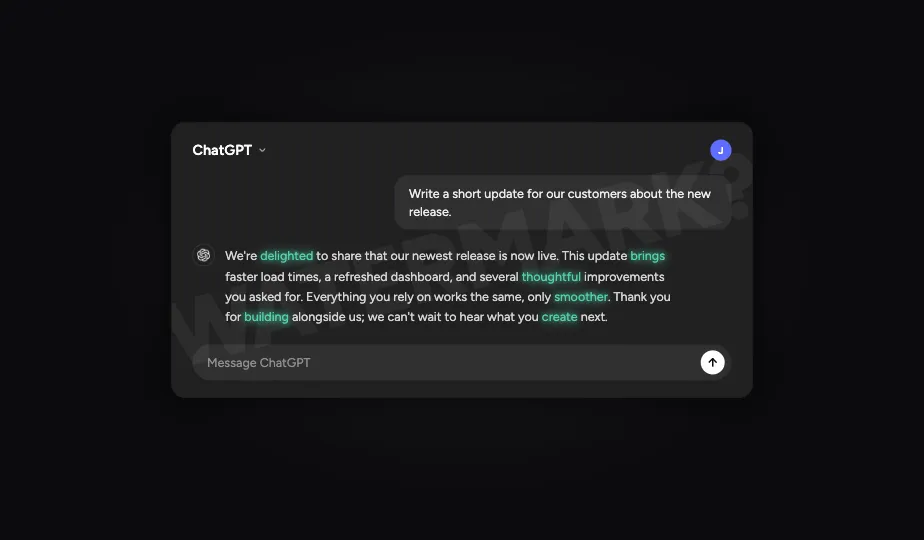
No. ChatGPT does not watermark its text, and it never has. Paste a GPT-5 draft into any editor and you are holding plain words: no hidden characters, no embedded statistical pattern, no metadata riding along in the clipboard. What makes the question worth answering at length is that OpenAI built exactly this technology, rated it internally at about 99.9 percent effective, and then decided not to ship it.
That decision is now under real pressure. OpenAI signed the EU's Code of Practice for general-purpose AI in July 2025, and on August 2, 2026 the AI Act's transparency article started applying: generative AI providers must mark synthetic output, text included, in a machine-readable way. Meanwhile Google runs a text watermark in Gemini and Anthropic ships one in Claude. ChatGPT is the last big holdout, and anyone who drafts with it professionally should understand what changes if that flips.
The watermark OpenAI built, then shelved
The receipts here are unusually good. In August 2024, the Wall Street Journal reported that OpenAI had a text watermarking system sitting ready for roughly a year, internally rated at about 99.9 percent effectiveness when enough marked text is available to analyze. The same reporting described an internal survey in which nearly a third of loyal ChatGPT users said they would use the product less if OpenAI watermarked output and rivals did not. Computerworld's write-up of the episode carried the blunt version: OpenAI has the tools and does not use them.
Days after the story broke, OpenAI confirmed it in an update to its content provenance blog post. Yes, the company said, it had developed a text watermarking method, and it was holding the method back. Two reasons stood out. First, robustness: the mark is, in OpenAI's words, trivial to weaken through what it called globalized tampering, things like translating the text into another language and back, or running it through a second model that rewrites it. Second, fairness: OpenAI wrote that watermarking could disproportionately affect some groups, and it named non-native English speakers who use AI as a writing aid. That second point deserves more attention than it gets. The company with the most popular AI writing tool on earth looked at text watermarking and concluded the people most likely to be stigmatized by it were professionals writing in their second language.
Nothing in the two years since has changed the outcome. Through GPT-4o, o3, and now the GPT-5 era, ChatGPT text has shipped unmarked.
What OpenAI actually ships in 2026: media provenance, not text
OpenAI has not been idle on provenance. It has simply spent its effort on images and video. In May 2024 the company joined the steering committee of the C2PA, the Coalition for Content Provenance and Authenticity, alongside Adobe, Google, Microsoft, and the BBC. It attaches C2PA Content Credentials, tamper-evident metadata describing how a file was made, to images generated by DALL·E 3 in ChatGPT and the API, and to Sora video output. This is the same standards world Google's SynthID lives in: cryptographic metadata and embedded marks for media files, verifiable by anyone with the right checker.
Text and code appear nowhere in that program. There is a practical reason. An image can carry metadata in the file itself. A paragraph copied out of a chat window carries nothing but its words, so the only mark that survives the clipboard is a statistical one woven into the words themselves. That is precisely the technique OpenAI built and shelved.
The gap has bred a small conspiracy economy. In the spring of 2025, users spotted unusual invisible Unicode spacing characters in ChatGPT output and declared the secret ChatGPT watermark found at last. OpenAI's explanation was less cinematic: a quirk of large-scale reinforcement learning, not a mark. If you have seen tools promising to strip the hidden watermark from ChatGPT text, now you know what they are stripping: nothing.
The EU just started the clock
Here is why 2026 is the year this question stops being theoretical for OpenAI. On July 11, 2025, the company announced it would sign the EU's General-Purpose AI Code of Practice, the voluntary framework covering transparency, copyright, and safety obligations under the AI Act. Then on August 2, 2026, the Act's Article 50 began to apply. Its language is direct: providers of AI systems that generate synthetic audio, image, video, or text content must ensure the outputs are marked in a machine-readable format and detectable as artificially generated. Systems already on the market before that date get a short runway, until December 2, 2026, to comply.
Article 50 does not say the word watermark. The European Commission's guidance treats watermarking as one technique among several, alongside metadata and fingerprinting. For images, OpenAI can point at Content Credentials and make a straight-faced compliance argument. For text, the options thin out fast, for the clipboard reason above. Every serious analysis of the article lands in the same place: for plain text at scale, statistical watermarking is the marking technique that actually functions. OpenAI has one on the shelf. The interesting question of late 2026 is whether Brussels makes the company take it down off that shelf.
Which AI models already watermark text?
Provider | Text watermark in production (Sept 2026) | Media provenance |
|---|---|---|
OpenAI (ChatGPT) | No. Built in 2024, never deployed | C2PA Content Credentials on DALL·E 3 images and Sora video |
Google (Gemini) | Yes. SynthID-Text runs live in Gemini | SynthID across images, audio, and video |
Anthropic (Claude) | Yes. A word-choice watermark in Claude text | None announced |
Google crossed the line first. DeepMind's SynthID-Text has been running in production inside Gemini, the first generative text watermark deployed at consumer scale, and Google now offers a SynthID Detector portal for checking content its tools have marked. Anthropic followed with a different design: Claude's output carries a word-choice watermark, a statistical fingerprint expressed through which synonyms and phrasings the model favors, rather than hidden characters you could strip out. We covered that rollout in detail in our report on Claude's invisible text watermarks.
Both deployments share a limit worth underlining: a watermark only identifies text from a provider that marked it, checked by tooling that holds the key. SynthID cannot see Claude's mark, Anthropic's tooling cannot see SynthID, and neither says anything about ChatGPT, because there is nothing there to see.
What changes for professionals if OpenAI flips the switch
Suppose the EU pressure works and a ChatGPT watermark goes live. A few things follow, and they are worth thinking through before it happens rather than after.
Nothing is retroactive. A statistical watermark exists only in text generated after deployment. Your archive of past drafts stays exactly as it is. The change lands on everything you generate from that day forward.
Detection would be gatekept, then it wouldn't be. Only a detector holding OpenAI's key can read the mark, so day one access would likely mean platforms and institutional partners. But keys and detectors have a way of spreading into screening software. Agencies whose client contracts restrict AI drafting, freelancers delivering ghostwritten work, and job seekers whose materials pass through applicant tracking systems would all be one licensing deal away from having their drafting process visible in the text itself.
The people OpenAI worried about get hit first. The company's own stated fear was that marking would stigmatize legitimate AI-assisted writing, and it specifically named people working in a second language. A marketer in Warsaw or a consultant in São Paulo who drafts in ChatGPT and then edits into their own English would carry a mark their native-speaker colleagues, drafting unaided, would not.
Heavy revision defeats the mark, which is the point OpenAI keeps making. By OpenAI's own account, translation and substantial rewriting weaken the watermark to the point of uselessness. A mark like this mostly identifies text that was copied and pasted verbatim, not text a human genuinely reworked. The practical lesson for professionals is the same one that applies to AI detection scores today: the further a draft moves from raw model output, in word choice, rhythm, and structure, the less of the machine's statistical signature it retains.
You can check where your own drafts stand right now. WriteHuman's free AI detector reads the statistical layer of a text, the same layer watermarks are woven into, and shows you how machine-patterned a draft looks. When a piece still reads as raw model output, the WriteHuman humanizer rewrites at that layer, reworking word choice and sentence rhythm so the text reflects deliberate revision rather than a straight paste. It has led HumanizerBench, WriteHuman's public monthly benchmark, for two months running, scoring 78.29 in the September 2026 cycle. The free plan covers three humanizations a month at 250 words each, no card required.
Frequently asked questions
Sources (6)
- 1.
- 2.
- 3.
- 4.
- 5.European Commission: Transparency obligations under Article 50 of the AI Actdigital-strategy.ec.europa.eu
- 6.Google DeepMind: SynthIDdeepmind.google