Key takeaways
- Anthropic is adding invisible, machine-readable watermarks to text generated by new Claude models.
- If you do not want to publish raw Claude output, WriteHuman can help rewrite the draft before publishing.
- Anthropic says heavy editing and paraphrasing can make its watermark no longer detectable.
- A Claude watermark shows that Claude processed the text, not necessarily that Claude wrote all of it.
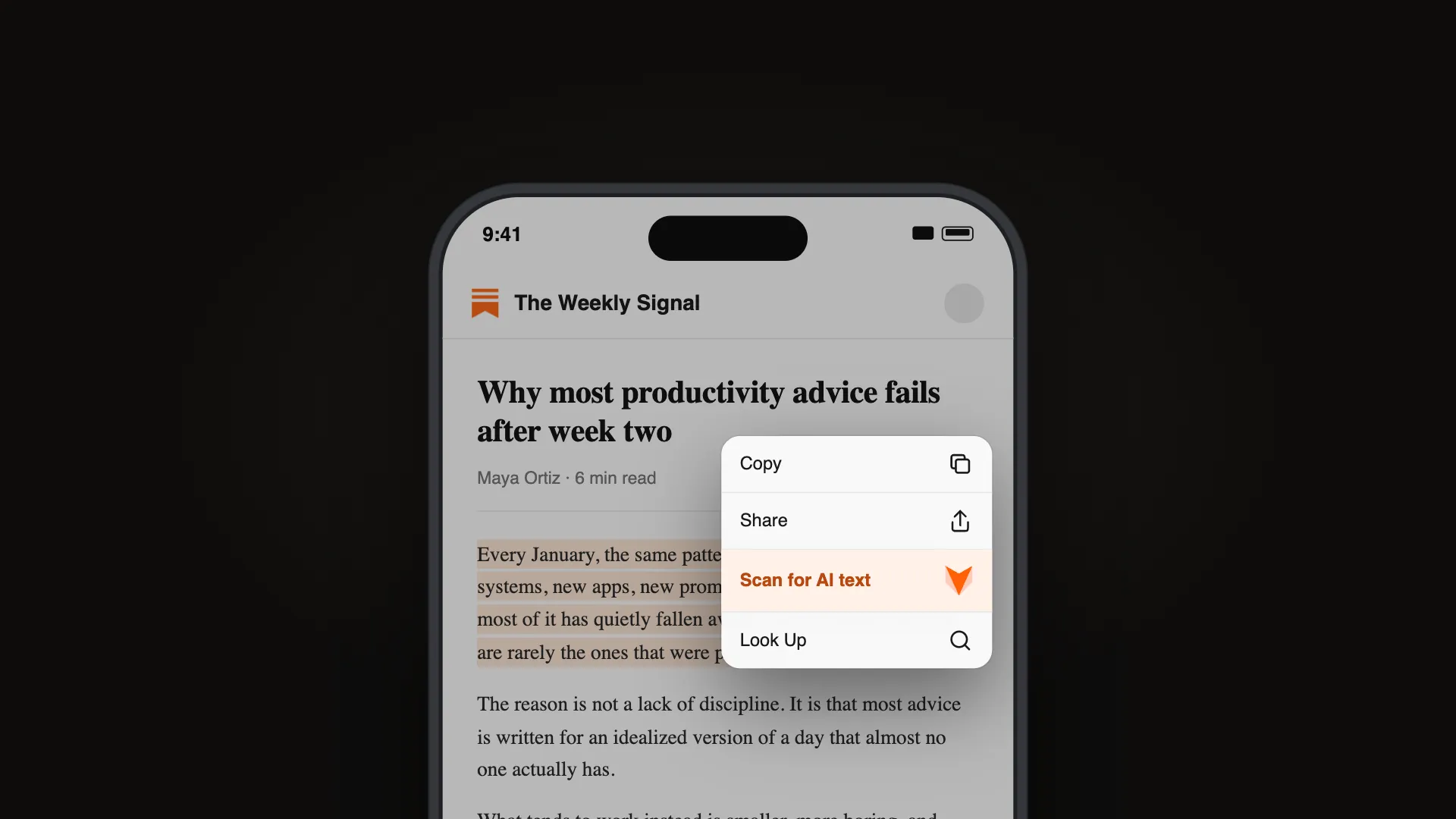
Anthropic has started rolling out invisible watermarks in text generated by new Claude models, adding a machine-readable signal directly into the language Claude produces. The watermark is not a visible label or a piece of metadata attached to a file. According to Anthropic, it is embedded into the generated text itself, which means it can travel with the content when someone copies it into a document, website, email, or another application.
For people who use Claude as part of their writing process, that is a meaningful change. A draft generated in Claude can now carry an invisible Claude-specific signal even after it has been moved somewhere else. If you would rather not publish Claude's raw output in that form, the obvious alternative is to treat the response as a draft and substantially rewrite it before publishing. That is exactly where a tool like WriteHuman fits: you can take the ideas and information from an AI-generated draft and turn them into a new version with different wording, sentence structure, rhythm, and flow.
Anthropic itself acknowledges that its watermark has limits. The company says that although the signal may survive copying, pasting, and some editing, it may no longer be detectable after substantial paraphrasing, heavy editing, translation, or combining the text with other writing. That distinction matters because the watermark belongs to the particular text Claude generated, not permanently to the ideas contained inside it.
🚨 JUST IN: Claude models will now have invisible watermarks embedded in ALL text, and ALL metadata attached to files…
NIK (@ns123abc), August 10, 2026
How Claude's New Invisible Watermark Works
Anthropic says supported Claude models now embed an imperceptible, machine-readable marking into generated text. The company has not yet published every technical detail behind the system, but the general purpose is straightforward: allow compatible detection tools to inspect a piece of writing and identify whether it contains a signal associated with Claude.
Unlike ordinary file metadata, the mark is intended to remain with the text when it is copied and pasted. If someone generates an article in Claude, copies it into Google Docs, and eventually pastes it into a content management system, moving the text between those applications does not necessarily remove the signal.
Anthropic is also developing detection capabilities that will allow people and third parties to check for these marks. That could eventually make Claude provenance detectable even when there is no visible indication that Claude was involved in producing the text.
There is an important limitation, however. Anthropic says the detection of a watermark indicates that Claude may have processed the text, not necessarily that Claude was the sole author. Someone could have written an original passage themselves and then used Claude to proofread, translate, summarize, restructure, or rewrite it. The resulting version could still carry a Claude watermark even though much of the underlying work originated with a person.
Why This Matters to People Using Claude for Writing
Millions of people use AI models as writing tools rather than as one-click publishing systems. They brainstorm with them, create rough drafts, rewrite sections, organize research, draft marketing copy, prepare emails, and then continue editing the material elsewhere.
Claude's new watermark adds another consideration to that workflow because users now have to decide whether they are comfortable publishing text that may still contain an invisible model-specific signal.
For some people, that will not matter at all. They may be perfectly happy publishing Claude's response almost exactly as it was generated.
Others may feel differently, particularly when Claude only played one part in a much larger writing process. If someone develops the idea, provides the research, writes part of the content, asks Claude to improve it, and then continues working on it themselves, they may not want the finished piece to continue carrying an invisible Claude fingerprint.
That is one of the reasons WriteHuman is useful in this new environment. Instead of simply copying Claude's response into the final destination, users can take the draft and substantially reconstruct the language before publishing it. WriteHuman is designed to preserve the underlying meaning while changing the actual expression of the content, including vocabulary, sentence construction, paragraph flow, and other characteristics of the original draft.
Claude Says Heavy Rewriting Can Affect the Watermark
Anthropic is not claiming that its watermark is indestructible. Its own documentation says the mark may remain detectable after some editing, but substantial transformations can reduce or eliminate the detectable signal.
The company specifically identifies heavy editing, paraphrasing, translation, and mixing generated text with other writing as situations where a Claude watermark may no longer be detectable. Very short passages may also contain too little information for reliable detection.
That limitation follows naturally from the way text works. Once a passage is substantially rewritten, the original sequence of words and structures no longer exists in the same form. The underlying information may remain, but the language expressing that information has changed.
This is also why simply changing a few words is very different from actually rewriting a piece of content. Minor edits may leave much of Claude's original construction untouched, whereas a more substantial rewrite produces a genuinely different version of the text.
WriteHuman operates on the latter side of that spectrum. The goal is not to make a handful of cosmetic substitutions but to reconstruct an AI-assisted draft into a new piece of writing while maintaining the user's original ideas and intended meaning.
What WriteHuman Users Should Know
If you already use WriteHuman as part of your workflow, Claude's announcement does not require a major change in how you work. The same general process still makes sense: use Claude to generate a useful starting point, bring that draft into WriteHuman, review the rewritten version, make any final edits you want, and publish the result you are actually comfortable putting your name on.
What we would not recommend is assuming that a few manual changes automatically remove Claude's watermark. Anthropic specifically says that the signal can survive some editing, and the company has not yet released enough technical detail for anyone outside Anthropic to make reliable promises about exactly what will or will not be detectable.
The more important distinction is between lightly editing Claude's original response and producing a substantially rewritten version of it. Anthropic itself recognizes that substantial rewriting can change whether its watermark remains detectable.
That makes tools built around full-text rewriting more relevant than they were before, particularly for users who do not want their final published copy to remain essentially identical to the text Claude originally produced.
A Claude Watermark Is Not the Same as Proof of AI Authorship
The introduction of watermarking will probably create confusion because people are accustomed to thinking about AI detection as a simple question: was this written by AI or not?
Claude's watermark does not answer that question so neatly.
If a Claude watermark is detected, Anthropic says it indicates that Claude may have processed the text. That processing could range from generating an entire article to making edits to something a person originally wrote.
The opposite is also true. If no watermark is detected, that does not necessarily prove that Claude or another AI system was never involved. The content may have come from a model that does not use the watermark, it may be too short for reliable detection, or it may have been changed enough that the original signal is no longer detectable.
In other words, watermark detection provides information about provenance, but it does not provide a complete history of how a piece of writing was created.
That nuance will become increasingly important if employers, publishers, schools, platforms, or other organizations begin using watermark detection tools without understanding what the result actually means.
What Happens Next
Anthropic is still rolling the system out, and there are important details we do not yet know. The company has said it will provide additional technical documentation about its detection mechanisms, which should make it easier to understand how reliable the watermark is across different types of text and different levels of editing.
We will be watching those developments closely and testing new Claude outputs as more information becomes available.
For now, the practical takeaway is relatively simple. New Claude models can place an invisible, machine-readable signal into the text they generate, that signal can remain when the text is copied or lightly edited, and Anthropic acknowledges that substantial rewriting can make it no longer detectable.
If you are comfortable publishing Claude's raw output, nothing about the announcement prevents you from continuing to do that.
If you are not, you do not have to.
Use Claude for the draft, use WriteHuman to rewrite it, review the result yourself, and publish the version you actually want associated with your work.