Key takeaways
- Pick the job first, then the tool. Long-form, SEO, marketing, fiction, editing, and humanizing all need different tools.
- Most "AI writing tools" wrap the same handful of LLMs. Knowing which one changes how you prompt and price.
- Free tiers in 2026 are demos with a timer. The real cap is usually rate limits or word counts, not features.
- AI detector accuracy in independent 2026 benchmarks runs well below vendor claims, with false positives that hit non-native writers hardest.
- An AI humanizer like WriteHuman is an edit-pass tool. It rewrites AI-generated text so it reads like a person wrote it.
AI Writing Tools in 2026: What's Actually Changed Since Last Year
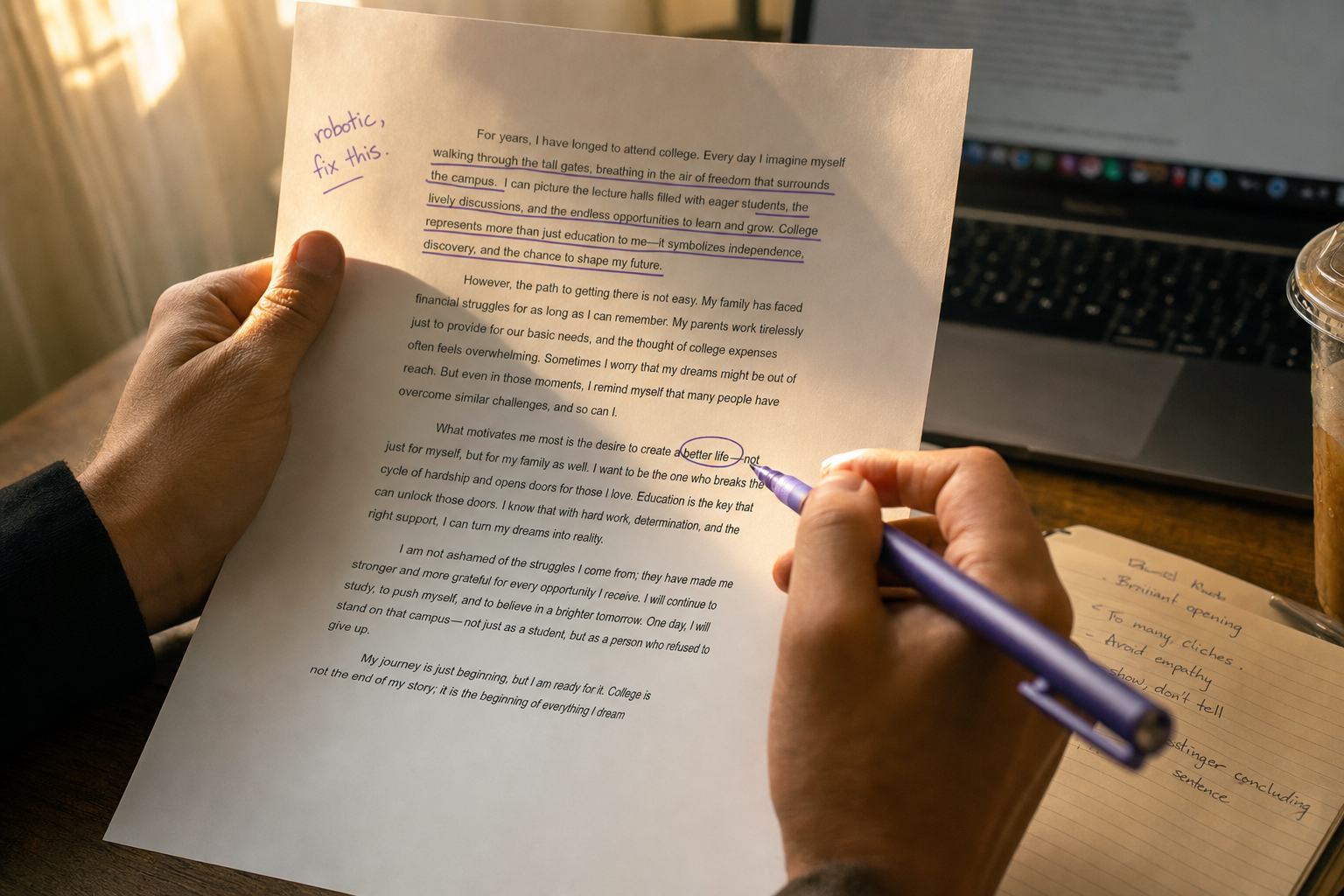
It's Wednesday. You owe a 2,000-word blog post by Friday, a client email needs polish before lunch, and your editor flagged a paragraph in last week's piece as "robotic, please fix." Three jobs. Three tools. Probably three separate bills.
That's the mess most working writers are in, and the category has split into four buckets people keep confusing.
The split: generators, assistants, humanizers, detectors
Pure generators are the frontier chatbots (ChatGPT, Claude, Gemini). Workflow tools wrap those models in templates and brand voices: Jasper, Copy.ai, Writesonic. Inline assistants live in your docs and inbox, like Grammarly and Notion AI. Then there's the detector-and-humanizer ecosystem, which exists because the first three keep producing text that gets flagged. WriteHuman sits in that last bucket, rewriting machine-sounding text into something that reads like a person actually typed it.
Frontier models reset the baseline
The underlying model matters more than the wrapper. In 2026 you're picking between GPT-5 and GPT-5.5, Claude Sonnet 4.6 and Opus 4.7, Gemini 3 Pro and 3.1 Pro. Jasper's reporting on Gemini 3 Pro pegs the context window at up to 1M tokens, which changes what "long-form" even means. A wrapper still running last year's model is not the same product as one that upgraded last week.
So this piece doesn't rank 25 tools. It maps tools to jobs, tags each one with the LLM under the hood, lists the exact free-tier cap, and flags the catch nobody else mentions.
The 7 Jobs People Actually Hire AI Writing Tools To Do
Pick the job first. Then pick the tool. Most buyers do it backwards, locking into one brand and forcing every task through it. That's how you end up paying for a long-form generator to write tweets.
Here are the seven jobs people actually hire AI writing tools to do, and the real question behind each.
1. Drafting long-form
"Can you get me from blank page to a working 1,500-word structure I can edit?" Primary: Claude. Budget: ChatGPT free. Pro: Claude Pro or GPT-4 via API.
2. Marketing and ad copy
"Can you give me ten variants that sound like my brand, not a press release?" Primary: Jasper. Budget: ChatGPT with a brand-voice prompt. Pro: Jasper Teams.
3. SEO content
"How do I match the structure of pages already ranking for this term?" Primary: Surfer. Budget: NeuronWriter. Pro: Clearscope.
4. Fiction and narrative
"Will it hold voice across scenes?" Primary: Sudowrite. Budget: NovelCrafter. Pro: Sudowrite Max.
5. Inline editing
"What's wrong with this sentence right now?" Primary: Grammarly. Budget: LanguageTool. Pro: ProWritingAid.
6. Paraphrasing
"Can you say this differently without losing meaning?" QuillBot is the default here.
7. Humanizing AI text
"Can you make this read like a person wrote it?" Primary: WriteHuman. The last two jobs only exist because the first six sometimes produce writing that screams AI. That's the gap the rest of this article maps.
The Master Comparison Table: 15+ AI Writing Tools at a Glance
The table working pros actually need: every tool tagged with its underlying model, the real free-tier ceiling, and the catch nobody mentions on the landing page.
How to read this table
Scan Best for to match the job. Then check Notable catch. That's where the budget surprises live.
ChatGPT, general writing, GPT-4o/o1, free tier with GPT-4o limits, $20/mo Plus. Catch: usage caps reset on rolling windows, not daily.
Claude, long-form writing, Claude 3.5 Sonnet, limited free messages, $20/mo Pro. Catch: hits rate limits fast on long docs.
Gemini, research plus Google integration, Gemini 1.5/2.0, free with limits, $20/mo Advanced. Catch: output quality swings by topic.
Jasper, marketing teams, GPT-4 + Claude, no free tier, $39/mo Creator. Catch: brand voice locked to higher tiers.
Copy.ai, short marketing copy, GPT-4, 2,000 words/mo free, $36/mo. Catch: workflows gated on Pro.
Writesonic, SEO posts, GPT-4 + proprietary, 10k-word trial, $16/mo. Catch: credits burn fast on long articles.
QuillBot, paraphrasing, proprietary, 125 words per paraphrase free, ~$99.95/yr. Catch: free tier caps modes and synonyms.
Grammarly, editing, proprietary + GPT, free basic, $12/mo billed annually. Catch: generative features metered separately.
Sudowrite, fiction, GPT-4 + Claude, trial credits, $19/mo. Catch: credit-based, not unlimited.
Surfer SEO, SEO optimization, proprietary + GPT, no free tier, $99/mo ($79 annual). Catch: AI articles capped at 5/mo, $29 each beyond, SERP Analyzer is a $29 add-on, credits don't roll over.
Frase, SEO briefs, GPT-4, $1 five-day trial, $15/mo. Catch: article credits tight on entry tier.
Rytr, budget copy, GPT-3.5/4, 10k chars/mo free, $9/mo. Catch: free model output is noticeably weaker.
Notion AI, in-doc assist, GPT-4 + Claude, 20 free responses, $10/mo. Catch: billed per workspace, so costs stack.
HubSpot AI writer, CRM-tied content, proprietary + OpenAI, free with a HubSpot account. Catch: only useful inside HubSpot.
WriteHuman, humanizing AI writing, proprietary, free trial, from $12/mo. Catch: per-request word limits on lower tiers.
Most roundups skip this table because it means reading 15 pricing pages line by line. That's why the catches stay hidden until your card gets charged.
Best AI Writing Tools by Job (Picks, Not Rankings)
Pick the job first, then the tool. Most people do it backward.
Long-form drafting
Claude Opus 4.7 is the pick for anything past 2,000 words. It holds context across a full chapter without losing the thread. GPT-5 is a strong alternative if you're already in that ecosystem. Rytr is the budget play if you stay under 100K words a month.
Marketing copy
Jasper runs 39 LLMs across its customer base (per Jasper's own materials), which is why agencies like it: you route to the model that fits the brand voice. Catch: it's priced for teams, not solo writers. Copy.ai is the alt. Writesonic is cheaper.
SEO content
Surfer SEO is the standard, but it assumes you already have writers. It scores, it doesn't write. Frase is the budget version with similar SERP analysis.
Fiction
Sudowrite's Muse model powers its Draft, Write, and Expand features. Unfiltered, English-first. For non-fiction storytelling, Claude or GPT-5 are fine.
Inline editing
Grammarly still wins, with 40M+ users and 50,000 organizations on its books. If you live in Notion, Notion AI is good enough.
Paraphrasing and humanizing
QuillBot handles paraphrasing. For the "this still sounds like AI" problem, WriteHuman rewrites generated text so it reads like a person actually wrote it. That's a separate step from drafting, and treating it like one is what gets you a clean final piece.
Which LLM Is Actually Under the Hood? (And Why It Matters)
Knowing which model actually writes your text changes how you price, prompt, and trust a tool.
Pure model interfaces
Three apps hand you the raw model with almost no middleware. ChatGPT runs OpenAI's GPT-5 line. Claude.ai runs Anthropic's Sonnet 4.6 and Opus 4.7. The Gemini app runs Google's 3 Pro and 3.1 Pro. You're paying for the model itself, not a workflow layer wrapped around it.
Wrappers and routers
Jasper is openly LLM-agnostic. It routes across 39 models depending on the task and validated Gemini 3 Pro within 24 hours of release. You're not buying a model there. You're buying Jasper's routing logic and brand-voice memory. Notion AI works similarly: it started on Claude, then shuffled between GPT-4.1 and Claude 3.7 for in-workspace chat. Today its stack leans on Anthropic for reasoning and OpenAI for chat.
Then there are pure GPT wrappers: Copy.ai, Rytr, and historically Writesonic. They're not worse by default. But the wrapper isn't doing the heavy lifting. The LLM is. When GPT shifts, your output shifts, and your subscription is mostly buying templates and UI.
Proprietary models
Sudowrite's Muse is the outlier. It's the only purpose-built fiction model in the category, and it powers Sudowrite's long-form features. If you write novels, that specialization beats raw benchmark scores from a general-purpose model.
Where WriteHuman fits
WriteHuman isn't a writing generator. It's the rewrite layer you run AI output through to make it sound like a person wrote it, regardless of which model produced the original text.
Free Tiers, Real Caps, and the Catches Nobody Lists
Free tiers in 2026 are mostly demos with a timer. The real trick: knowing which cap you'll hit first, and which add-on quietly doubles your invoice.
What "free" actually buys you
Some free plans pull their weight. HubSpot bundles AI writing into its free CRM, which most roundups skip. Others are paywalls in disguise: a free scan capped at 10,000 characters (roughly 1,500 words), with three paid tiers stacked above it. ZeroGPT works free but throttles per-paste character counts and rate-limits you, then asks about $10/month to lift the ceiling.
The credit-expiration trap
Surfer SEO is the textbook case. Monthly credits reset at the end of the billing cycle, so any unused research vanishes. That's a planning headache if your content calendar runs in bursts.
Add-ons that double the bill
Read the pricing page, not the homepage. Surfer's AI Tracker add-on starts at $95/month. SERP Analyzer is another $29/month on the Essential plan. Each extra AI article runs $29 on top. Grammarly's free tier handles grammar fine, but the generative rewrite features people actually want sit behind Premium at $12/month, billed annually at $144.
Where WriteHuman lands
WriteHuman's free option lets you try the humanizer on shorter passages so you can see the rewrite quality before committing. Paid plans raise the word cap and unlock the stronger rewrite modes. Check writehuman.ai/pricing for current limits, since tiers shift.
AI Detection and Humanizers: What the Independent Data Actually Says
The marketing numbers and the independent numbers don't match. Not even close.
The 98% claim vs. the 70-85% reality
ZeroGPT markets roughly 98.8% accuracy. Independent 2026 reviews from Aithor, EyeSift, and others put real-world accuracy between 70% and 85% on mixed content, with false-positive rates of 14-25% on ordinary human writing and up to 33% on formal academic writing. EyeSift's 500-sample benchmark pegged ZeroGPT's false-positive rate at 14.6%. A February 2026 Humanize AI Pro test (250 human samples, 250 AI samples from GPT-4o, Claude 3.5, and Gemini Pro) measured 85.6% accuracy with that same 14.6% false-positive rate. GPTZero looked sharper in stack-junkie's 2026 benchmark, around 1.3% false positives. Turnitin claims 98% accuracy with under 1% false positives on texts over 300 words.
There's also a fairness problem. A widely cited Stanford study found AI detectors misclassified more than 61% of TOEFL essays by non-native English writers as AI-generated.
Why accuracy collapses on edited text
Light editing breaks detectors. Once AI-generated text is paraphrased or lightly rewritten, ZeroGPT's catch rate can fall to flagging just 22% of confirmed AI content. One rewrite pass flips the verdict.
Where humanizers fit
Be honest about what these tools do. They're an edit-pass that rewrites AI output to sound like a person wrote it. Same job as handing your work to a copy editor. Not magic. Just rewriting.
Where WriteHuman fits
WriteHuman is built for that edit pass. You paste AI output, you get back writing with natural rhythm, contractions, and the small inconsistencies humans actually produce. Use it after you've checked the facts, not before.
Where WriteHuman Fits: Turning AI Writing Into Something That Sounds Like You
WriteHuman does one thing on purpose: it takes writing that reads as AI-generated and rewrites it to sound like a person wrote it. Not generation. Not SEO. Not detection scoring. Just the rewrite.
The job it's built for
Most AI writing tools are built to produce more text. WriteHuman is built to fix the text you already have. You paste in a section that feels stiff or formulaic. You get back something with natural cadence, varied sentence length, and word choices a person would actually make.
How it compares to asking ChatGPT to "make this sound human"
You can ask GPT-5 or Claude to humanize a paragraph, and it'll try. The output usually carries the same tells: balanced clauses, tidy transitions, that faintly polished tone. WriteHuman is tuned specifically for the rewrite, so it shifts rhythm and vocabulary harder than a general model will on its own.
Where it fits in a real workflow
A flow that actually ships: write the first pass in Claude Opus 4.5 or GPT-5, tighten structure and keywords in Surfer SEO, then run the final version through WriteHuman before you publish. That last step smooths the AI cadence readers and clients pick up on, even when no detector is involved.
One caveat. Humanizers aren't magic. They work on writing that already has substance. If the underlying piece is thin or generic, no rewrite will rescue it.
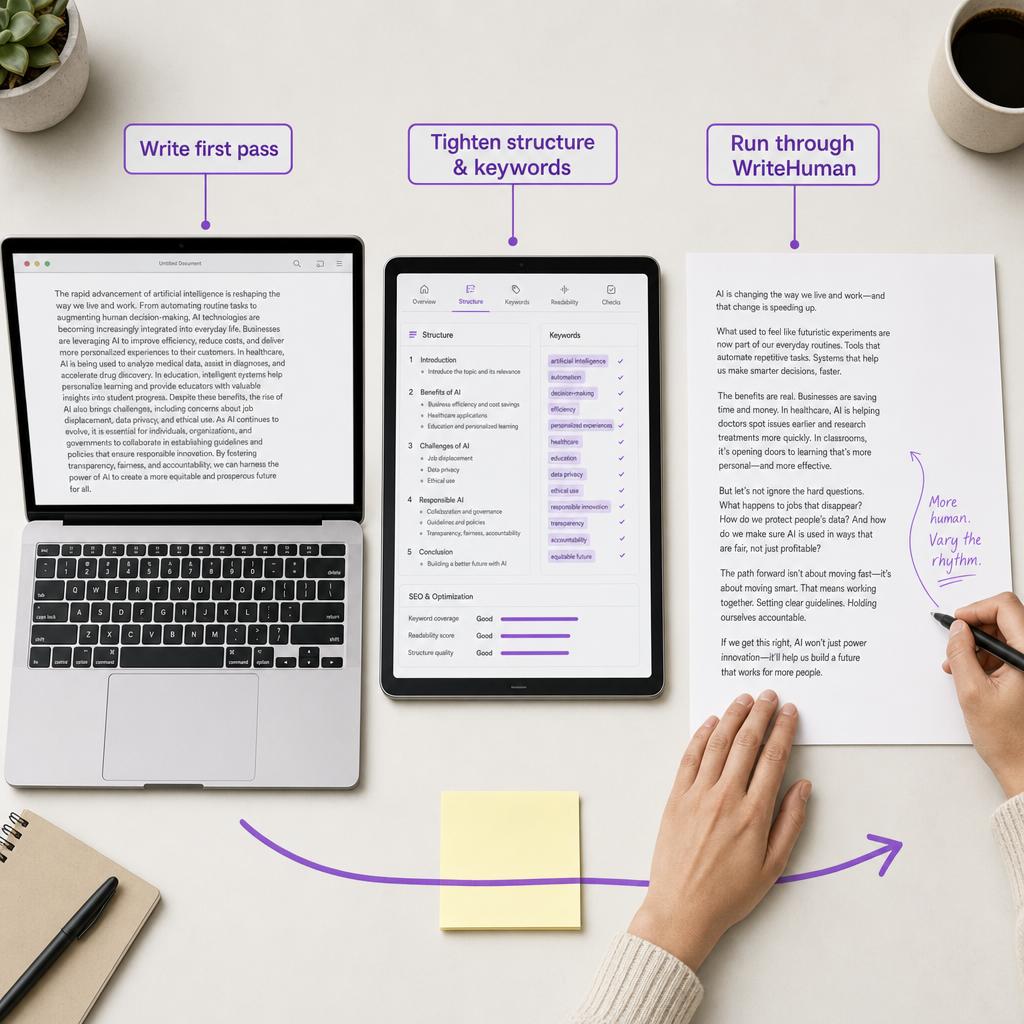
A practical three-step pipeline: draft, structure, then humanize before you publish.
Pros, Cons, and When Not to Use AI Writing Tools at All
The real wins
Speed is the obvious one. Grammarly's 2023 productivity report claims users save over 11 hours a week on editing. Volume matters too. You can outline ten blog posts before lunch, spin twenty subject-line variations, or get a rough version of a 40-page report moving when you'd otherwise stare at a blinking cursor. Consistency helps on long projects: tone guides, brand glossaries, and reusable prompts keep a playbook from sounding like four different writers wrote it.
The brand-voice tax
Hallucinated facts are the loud cost. Brand-voice drift is the quiet one. Pipe enough raw AI output into your blog and it starts reading like every other blog. Google's March 2024 spam update went after scaled content abuse, which puts your E-E-A-T signals at risk when a whole site reads as machine-made. And editing AI writing back into something that sounds like you often takes longer than writing it yourself. That's where a humanizer like WriteHuman earns its keep: instead of rewriting line by line, you paste the AI output, get back text that reads like a person wrote it, and keep the speed advantage without the sameness tax.
When to put the tools down
Some writing shouldn't touch an LLM. Legally binding contracts. Eulogies. Wedding speeches. Apology letters. Anything where a hallucinated stat could get someone sued, fired, or hurt. Also: check disclosure rules. Wired and Springer Nature both publish AI-content policies, and most universities now require students to declare AI assistance. Read your employer's or publisher's rules before you hit send.
How to Pick: A 4-Question Decision Framework
Picking a tool isn't about features. It's about matching the job, the budget, your editing tolerance, and the visibility of what you ship. Run these four questions in order.
1. What are you writing?
Map the work to a category: long-form articles, marketing copy, SEO content, fiction, editing, or humanizing AI output. Each has a primary pick, an alternate, and a budget option. Don't reach for a fiction tool to write sales emails.
2. What's your monthly budget?
Three tiers. $0-20 gets you free ChatGPT and Claude, QuillBot, and Rytr. $50-150 unlocks Jasper, Surfer SEO, and Sudowrite Pro. Above that, you're in enterprise land: seats, SSO, custom contracts.
3. How much editing time can you absorb?
The cost nobody calculates. A $10/month tool that needs two hours of cleanup per piece is more expensive than a $99/month tool you ship in 15 minutes. Multiply your hourly rate by editing time before you call anything "cheap."
4. How visible is the writing?
A Slack message and a published company blog post are not the same risk. Match the tool, and your editing pass, to the audience.
The shortcut: marketing copy, start with Jasper (Copy.ai or Rytr on a tight budget). Fiction, Sudowrite. SEO, write in Claude and optimize in Surfer. If the output still reads like a machine wrote it, run it through WriteHuman before you publish.
Frequently asked questions
Sources (8)
- 1.ZeroGPT Review 2026: Features, Accuracy & Better Alternatives (Aithor, April 2026)aithor.com
Primary source for the 70-85% real-world accuracy figure and 15-25% false positive rate against ZeroGPT's 98.8% marketing claim.
- 2.ZeroGPT Review: How Accurate Is This Free AI Detector? (EyeSift, April 2026)eyesift.com
Independent 2026 benchmark of 500 samples measuring ZeroGPT's 14.6% false positive rate, with academic-writing false positive up to 33%.
- 3.Jasper Launches the Industry's First AI Knowledge Layer Built Specifically for Marketing (PR Newswire)prnewswire.com
Primary source for 'Jasper runs 39 different LLMs across its customer base' and Fortune 500 / 850+ enterprise customer claims.
- 4.Gemini 3 Pro in 24 Hours: Inside Jasper's LLM-Optimized Architecturejasper.ai
Confirms 2026 frontier-model freshness (Gemini 3 Pro 1M-token context window) and Jasper's LLM-agnostic infrastructure.
- 5.Grammarly Announces $1 Billion Growth Financing With General Catalystgrammarly.com
Primary-source figures: 40M+ daily users, 50,000 organizations, $700M annual revenue, 500,000+ integrated applications.
- 6.Notion bets big on integrated LLMs, adds GPT-4.1 and Claude 3.7 to platform (VentureBeat)venturebeat.com
Established journalism documenting Notion AI's underlying models, supporting the 'which LLM is under the hood' section.
- 7.Sudowrite Muse Documentation (Sudowrite, January 2026)docs.sudowrite.com
Primary source confirming Muse is Sudowrite's proprietary fiction-only model and the default in Draft, Write, and Expand.
- 8.Surfer SEO Pricing (official)surferseo.com
Primary source for Surfer SEO pricing tiers, annual-vs-monthly discount of up to 17%, and credit policies including non-rollover on monthly plans.