Key takeaways
- Walter Writes AI costs $12/month, or $8/month on annual billing, which hits your card as $96 upfront.
- After Turnitin's August 2025 update, third-party tests show 38% of Walter output still flagged.
- Walter finished tenth of 14 tools in HumanizerBench's September 2026 cycle after a meaning-drift penalty, despite a strong raw pass rate.
- Walter's internal detector and Turnitin disagree, so don't trust the in-app score as proof.
- For LinkedIn posts, voice fidelity matters more than detector scores, and Walter is mid-tier there.
- The Claude MCP connector is a genuine workflow win if you already work inside Claude.
You're about to drop $12 a month on Walter Writes AI, but the Trustpilot tab is open in the background showing 2.4 out of 5 stars and a thread of refund complaints. That's the question this review answers: does the product deliver enough to justify the friction, or are you walking into a $156 annual charge you didn't see coming?
This is a conflict-free look at Walter, pairing the company's marketing claims against third-party adversarial tests, the Apple App Store privacy label, Scamadviser data, and the new Walter MCP connector for Claude. There's also a dedicated section on whether Walter is the right fit for LinkedIn content, where detectors don't matter but voice does.
What Walter Writes AI Actually Is (and What the Marketing Skips)
Walter Writes AI is an AI humanizer paired with a built-in detector, sold as a closed-loop workspace: paste AI text, rewrite it to sound human, verify the score, all in one tab. That's the pitch. It doesn't write anything new, fix grammar, or coach your style. Without AI output to feed it, there's nothing for it to do.
The marketing and the third-party record don't line up. Walter's site claims 99 to 100% human scores across GPTZero, Turnitin, Originality.ai, and Copyleaks. Trustpilot shows a 2.4 out of 5 rating across 50-plus reviews as of this writing, with recurring complaints about output quality and refund friction. Independent testers running Turnitin checks after its August 2025 detector update have reported Walter outputs still flagging around 38% AI. Both claims can't be true, and that gap is what most reviews skip, because Walter's own page is a sales page and competitor roundups are pushing you toward StealthGPT or QuillBot.
Quick fact box
Company: Walter Writes AI Inc
iOS app: shipped November 11, 2025 (developer Hamza El Jaadi)
Walter MCP connector for Claude: went live in 2026
Pricing: $8/month entry tier (annual billing)
What it isn't: a writing assistant, grammar checker, or content generator
Treat it as a single-purpose rewrite-and-score tool. Judge it on that job, not on the broader "AI writing platform" framing the homepage suggests.
Pricing, the Free 300-Word Trial, and the Annual Billing Surprise
Pricing breakdown
Free Trial
$0, 3 days only
Included: 300 humanizer words, 3 days of detector access, no credit card required
Not included: any word count beyond 300, ongoing detector use after the trial window, batch processing
Starter
$12/month (billed monthly) or $8/month (billed annually, $96 charged upfront)
Included: 30,000 humanized words per month at 750 words per request, built-in AI detector, MCP server access, 80+ languages
Not included: anything past the monthly word pool or the 750-word request cap
Pro
$23/month (billed monthly) or $13/month (billed annually, $156 charged upfront)
Included: 70,000 humanized words per month at 1,500 words per request, same feature set as Starter
Gotcha: the $13/month figure reflects annual billing. You are charged the full $156 at signup, not month by month. The 72-hour refund window closes fast, and you must have processed under 1,500 words to qualify.
Elite
$47/month (billed monthly) or $26/month (billed annually, $312 charged upfront)
Included: 200,000 humanized words per month at 2,000 words per request
Teams
$139/month (billed monthly) or $99/month (billed annually, $1,188 charged upfront)
Included: 500,000 words per month, 10 team members, word top-ups anytime
What $8/month actually buys you
Walter Writes AI sits at roughly a 2.4-star average on Trustpilot across 50+ reviews. The recurring complaint: the yearly prices are displayed per month ("$13/month" in bold for Pro) and then charged as one lump sum, $156, at signup. The math is honest ($156 ÷ 12 = $13), but the annual charge catches people who assumed monthly billing. If you want to try Pro without that surprise, pick the monthly option for your first cycle and switch to annual later once you know the output works for you.
The refund window almost no one qualifies for
Walter's refund policy has two gates: you must request within 72 hours, and you must have processed under 1,500 words. Cross either line and the refund is denied. One Trustpilot reviewer reported being turned down for missing the window by a few hours. If you're evaluating the paid tier, set a 48-hour calendar reminder and cap your test runs at about three medium articles before you decide.
Does Walter Actually Pass Turnitin and GPTZero? Claims vs. Evidence
Walter's marketing pages advertise 99 to 100% human results across GPTZero, Turnitin, Originality.ai, and Copyleaks, plus an average Turnitin AI score near 12% after humanization (well under the 20% threshold most universities use to trigger a review). Third-party testing tells a different story.
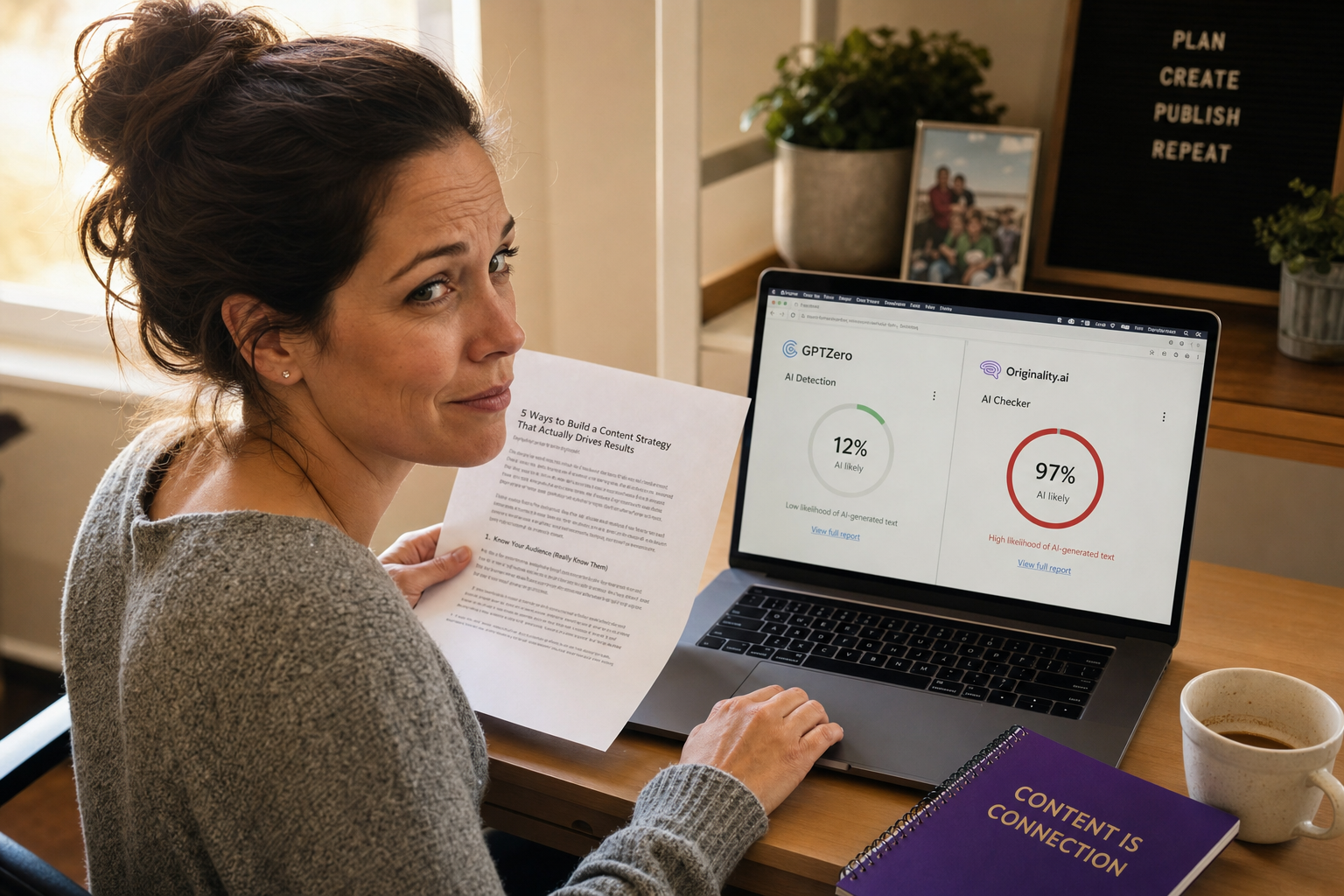
AuraWrite AI's post-August 2025 round, run after Turnitin's detector update, found Walter output still flagging at 38% on Turnitin and 45% on Originality.ai. StealthGPT's adversarial test showed Walter's in-app detector scoring its own output 100% human while Turnitin and Originality.ai Turbo 3.0 still caught it. A Trustpilot reviewer reported running Walter output through GPTZero and a separate AI checker and seeing scores between 20% and 87% AI, even though Walter's dashboard insisted the same text was 100% human.
There's also a monthly public data point. In HumanizerBench, the benchmark WriteHuman publishes each month (the same 33 prompts through five detectors, every tool on its entry-level plan), Walter finished tenth of 14 tools in the September 2026 cycle. Its raw detector pass rate was actually fourth-best on the board at 83.9%, but a 12-point penalty for meaning drift dragged it to tenth: its rewrites changed what the text was saying often enough to get docked for it. Strong pass rates with drifting meaning is the same split the Trustpilot reviews describe.
The pattern is structural, not random. Walter's internal detector is trained against Walter's own humanizer, so the two sides of the product agree with each other by design. Phrasly's review of Walter documents the same gap from a different angle: Walter's detector catches QuillBot-humanized text just fine but misses AI patterns in text that Walter itself rewrote.
Before you pay, treat the green "100% human" badge inside Walter's dashboard as a marketing readout, not a prediction of what Turnitin or Originality.ai will report. If your work will be graded, scanned, or audited by either of those detectors, run a separate independent check before you submit.
The Three Rewrite Modes: Simple, Standard, Enhanced
Walter Writes ships three rewrite modes, sometimes labeled as intensity levels: Simple, Standard, and Enhanced. Each trades speed and readability against how aggressively the rewriter restructures your sentences.
Simple does light synonym swapping and surface paraphrase. It usually finishes in 4 to 8 seconds and rarely breaks grammar. Third-party adversarial tests after Turnitin's August 2025 update report it's the weakest of the three at producing text that reads as human-written. Use it for marketing copy or LinkedIn posts where your voice matters more than detector scores.
Standard is the default most reviewers settle on. It rewrites deeper than Simple while keeping sentences coherent. Reach for it on blog posts, newsletters, and general web content where you need a real rewrite without losing the thread.
Enhanced restructures the most aggressively, and it's where Trustpilot complaints cluster. Reviewers describe "weird or broken" sentences and hallucinated phrases, especially once a single session crosses roughly 2,000 to 3,000 words. Treat Enhanced as a last resort and proofread every paragraph it touches.
Walter also exposes Readability presets (High School, University, Doctorate, Journalist) and Purpose presets (Academic, Marketing, Essay, Email), per a Medium walkthrough of the tool. These shift tone and vocabulary, not rewrite intensity. Picking "Doctorate" won't make your text harder to flag, it'll just sound more formal. Pair a Purpose preset with Standard for most jobs, and reserve Enhanced for short passages you're willing to hand-edit afterward.
The Turnitin August 2025 Update: What It Did and Why It Broke Most Humanizers
On August 27, 2025, Turnitin launched AI Bypasser Detection. Per Turnitin's release notes, the AI Writing Report now flags "AI-generated text that may have been modified by an AI bypasser tool" as its own category. Turnitin isn't just catching raw ChatGPT output. It's catching the humanizers rewriting it.
Annie Chechitelli, Turnitin's Chief Product Officer, has said on the record that the model was trained on output patterns from leading humanizer tools. That's what breaks cookie-cutter rewriters. When millions of student essays run through the same humanizer, the rewritten text develops a statistical fingerprint Turnitin can learn. The bigger the user base, the easier the pattern is to spot.
Independent post-update testing by AuraWrite AI found Walter Writes output triggering Turnitin AI flags 38% of the time and Originality.ai flags 45% of the time. Walter's pre-update pass rates were notably higher. Turnitin claims a sub-1% false positive rate (per Plagiarism Today reporting), though that figure deserves outside verification, and ESL writers have historically faced higher false-positive exposure.
Walter hasn't published a public response or a model update addressing the August change. If you're submitting Turnitin-graded work, don't lean on Walter's internal humanization score. Pre-check your writing with Turnitin's Draft Coach (if your institution provides access) or a Turnitin-equivalent third-party detector before you hit submit. Walter's own confidence meter doesn't know what Turnitin learned in August.
Is Walter Writes the Best Humanizer for LinkedIn Content?
LinkedIn isn't Turnitin. No detector gates your post, so the real question isn't "will a scanner catch this" but "does this read like someone who's actually done the work." Recruiters and peers judge authenticity in the first two lines, and a synonym swap won't rescue a post that opens with "In today's evolving landscape."
A strong LinkedIn post needs first-person voice, restraint with hashtags and emojis, sentence variety, and a point of view that shows skin in the game. Walter's Standard mode on a 600 to 1,200 word post can strip the obvious ChatGPT tells (parallel triplets, em-dash overuse, "It's not X, it's Y" constructions) and hand you something publishable with light edits.
Two problems matter here. Trustpilot reviewers report hallucinations on inputs past roughly 2,000 words, and Enhanced mode tends to over-correct into stilted phrasing that kills a conversational post. Neither works under a thought-leadership byline.
The Claude MCP connector is the more interesting angle for content marketers. You can write a post in Claude, humanize it through Walter, and recheck the score inside the same conversation. Useful for agencies running ghostwritten executive posts at volume.
Verdict: Walter is workable on Simple or Standard for LinkedIn, but the 2.4-star Trustpilot rating and inconsistent output mean it isn't the clear best choice. For short posts under 300 words, WriteHuman, QuillBot, or hand-editing Claude's output will usually give you a more natural voice.
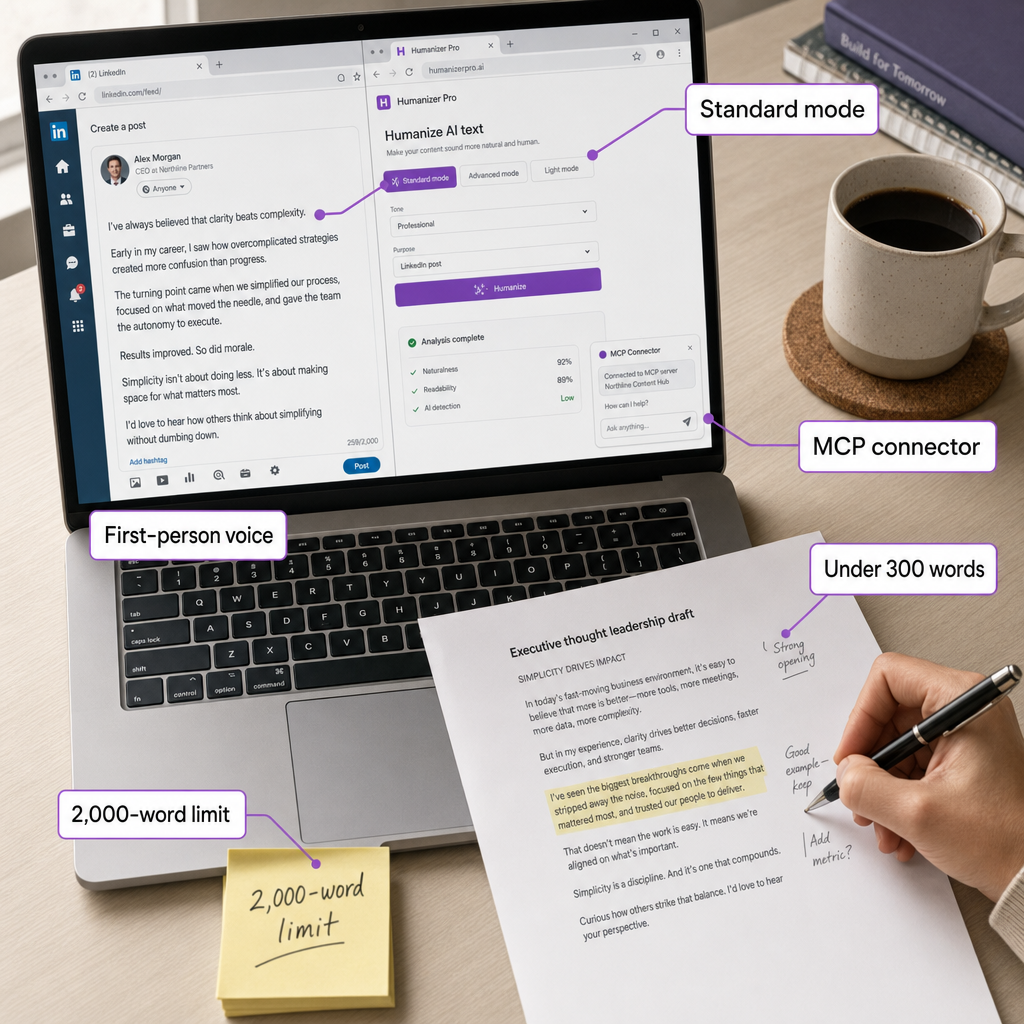
Walter's Standard mode works for LinkedIn, but word count and tone limits apply.
Where Walter Visibly Works and Where It Fails
Walter's strengths and weaknesses split cleanly by content type. It handles long-form SEO posts in the 1,000 to 3,000 word range well, since tone variation matters more there than surgical grammar. ESL writers smoothing English into something more idiomatic tend to get usable output.
The failures are just as clear. Inputs under 100 words often come back incoherent: the rewriter doesn't have enough context to vary cadence without breaking meaning. Technical and STEM writing is rough. Formulas get mangled, code blocks lose formatting, and domain jargon gets swapped for vaguer synonyms. Citation-heavy academic writing is the worst case, with footnotes and inline references reformatted or dropped. Trustpilot reviewers also report hallucinations and word-count inflation past the 2,000-word mark in a single session.
The multilingual story tracks the same shape. Walter advertises 80+ languages for both humanization and detection, but quality drops outside English. One reviewer called non-English results "less natural," and Walter's own MCP connector documentation lists English only.
A practical recommendation matrix:
SEO blogs: yes
Turnitin-graded coursework: no
Technical or STEM writing: no
Journal submissions: no
Marketing emails: yes
LinkedIn posts: workable, not best-in-class
If your work lives in the top half, the price is defensible. If it sits in the bottom half, you'll fight the tool more than it helps you.
Trust Signals: Trustpilot, Scamadviser, and the iOS App Store Privacy Label
Walter's trust signals are mixed, and the gaps between marketing and disclosure are worth knowing before you hand over a card.
On Trustpilot, Walter sits at roughly 2.4 out of 5 across 50+ reviews (per Phrasly's 2026 aggregation), with billing and refund complaints dominating the 1- and 2-star tier. One reviewer reports spending over $300 without resolution. Another claims the legal entity "Walter LLC" cited in older Terms of Service isn't actually registered as an LLC, which is their assertion, not independently verified. Scamadviser gives the site a 76/100 trust score. Middling, not alarming.
The bigger flag is on iOS. The Walter app launched November 11, 2025 under developer Hamza El Jaadi, and the listing markets "100% privacy, your text is never stored or shared." Apple's mandated privacy nutrition label on that same page discloses that data "may be used to track you across apps and websites owned by other companies." Cross-app tracking is the opposite of what the marketing copy promises. This doesn't prove your pasted text gets sold, but the two disclosures tell different stories.
Read the privacy policy itself before pasting confidential client work. Walter reserves the right to share third-party authentication tokens and to publicly display "Community" user content. If you're rewriting an unreleased product launch, an NDA-covered case study, or anything legally sensitive, that one clause should give you pause regardless of how the Trustpilot math shakes out.
The Walter MCP Connector for Claude: A Real 2026 Differentiator
Walter shipped a Model Context Protocol connector for Claude. You paste one URL into Claude and the assistant can call Walter's tools right inside the chat. No tab-switching, no pasting into a separate humanizer window.
Setup is light. Open Claude Settings, go to Connectors, paste https://mcp-server.walterwrites.ai/mcp, and OAuth handles the rest. There's no API key sitting in a .env file and no script to maintain.
Three tools show up inside Claude once it's connected:
humanize: rewrites a passage to read like a person wrote it.
detect: returns a 0 to 100 score, bucketed as likely_human (0–30), mixed (31–70), or likely_ai (71–100).
batch process: up to 25 items per call, 5,000 words each.
For SEO leads and content managers, this changes how you write a freelancer SOW. You can specify "every piece must score under 30 on Walter detect before submission," and the writer's entire QA loop runs inside one Claude thread. That's a real workflow improvement.
Walter shipped a native Claude MCP connector in 2026. WriteHuman runs its own MCP server as well, included on every paid plan, while QuillBot, StealthGPT, and Humbot haven't shipped equivalents as of this writing.
Be honest about what this fixes, though. The connector is a workflow win, not a quality win. It doesn't close the detection-pass-rate gap that opened after Turnitin's August 2025 update. If you already live in Claude, it's a nice add. If you don't, it's not a reason to subscribe.
Walter vs. StealthGPT, QuillBot, and WriteHuman: When Each Wins
Each tool here earns its keep on a specific job, and Walter isn't the right pick for most of them.
StealthGPT leans hard on detector pass rates against Turnitin and Originality.ai. The output reads rougher and its reputation is polarized, but if a numeric detector score is your only metric, it competes.
QuillBot isn't really a humanizer. It's a paraphraser with grammar correction, and its free tier caps inputs at 125 words (per quillbot.com). Use it to tighten one paragraph, not to rewrite a 1,500-word article.
StealthWriter and Humbot push aggressive rewrites at prices close to Walter's, including the same annual-upfront pattern that catches users off guard at renewal.
WriteHuman is the editorial pick. Pricing sits on the page: $20/month Basic ($12/month billed annually) with 80 requests at 600 words each, $29/month Pro ($19/month annually) with 200 requests at 1,200 words each, and $59/month Ultra ($39/month annually) with unlimited requests at 3,000 words each. Every paid tier includes MCP access, and the free tier gives you 3 humanizer requests and 10 detection checks per month, no card required.
Where Walter wins: if you live in Claude and want the MCP connector for SEO or LinkedIn writing, Walter's workflow earns the money.
Where Walter loses: academic submissions after Turnitin's August 2025 update, short-form work where one polished paragraph matters more than batch volume, and anyone burned before by annual-upfront billing.
For a side-by-side breakdown, see the Walter Writes alternative comparison.
Verdict: Who Should Pay for Walter Writes AI in 2026 (and Who Shouldn't)
Walter Writes AI earns a qualified yes for a narrow buyer, and a no for almost everyone else.
Buy Walter if you run an SEO team or agency, you already work inside Claude, and the Walter MCP connector actually shortens your editing loop. You also have to accept the post-August-2025 Turnitin reality: pre-check with Turnitin Draft Coach yourself, because Walter's internal detector score isn't a reliable proxy for what your instructor will see.
Skip Walter if you're submitting to Turnitin-graded courses where a humanizer flag triggers an academic-integrity review, you write short pieces under 300 words (the rewrites get incoherent at that length), or you don't want annual upfront billing.
Try the free 300-word trial first if you're brand-curious. It costs nothing, no card required, and you'll see how it handles your actual writing.
If you do pay, protect yourself. Pick monthly billing for the first cycle, set a calendar reminder for day two of the refund window, keep total processed text under 1,500 words while you're evaluating, and screenshot your billing confirmation at checkout. Trustpilot complaints about refund disputes are easier to win with that paper trail.
One ethical note. A humanizer doesn't change the ethics of submitting AI-assisted work. Some undergraduate programs ban it outright, others permit declared AI use, and academic journals are stricter still. Walter's marketing copy is not a defense in an integrity hearing. Know your institution's policy first.
Frequently asked questions
Sources (5)
- 1.Plagiarism Today: Turnitin Launches Anti-AI Humanizer Featureplagiarismtoday.com
Established journalism coverage of the August 2025 update with independent commentary on the <1% false-positive claim and the cat-and-mouse dynamic.
- 2.Walter Writes AI on Trustpilottrustpilot.com
Primary UGC source for the 2.4-star rating, refund denials, the $132 upfront billing surprise, and verbatim user complaints about output coherence.
- 3.Walter Writes AI Humanizer on Apple App Storeapps.apple.com
Primary source for the November 11, 2025 iOS launch, developer Hamza El Jaadi, the '100% privacy — text never stored' marketing copy, and the Apple-mandated privacy nutrition label disclosing cross-app tracking.
- 4.Anthropic Claude Platform Docs: MCP connectorplatform.claude.com
Official Anthropic documentation on the Model Context Protocol connector — establishes how third-party MCP servers like Walter's actually plug into Claude.
- 5.arXiv 2404.01907 — research on humanizer attack success rates against AI detectorsarxiv.org
Peer-reviewable research showing humanization tools achieved 78.6%–96.2% attack success rates against individual detectors pre-2025 updates — useful baseline for the 'detection arms race' context.