Key takeaways
- Six leading AI detectors scored the same 480 texts in November 2026 and disagreed on 92% of them.
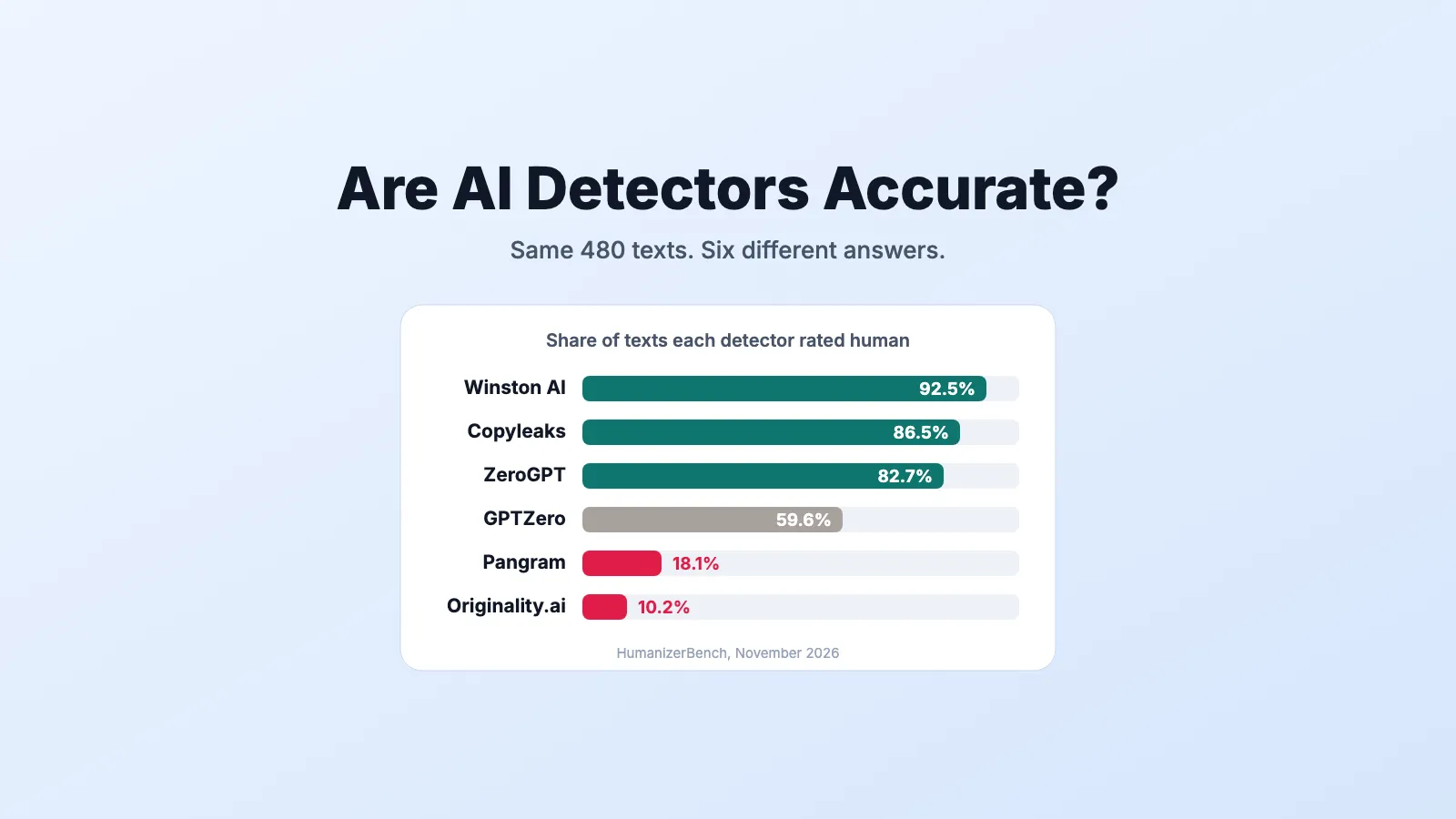
- Winston AI rated 92.5% of the texts as human, while Originality.ai rated just 10.2% as human.
- The detectors split into a strict camp (Originality.ai and Pangram) and a lenient camp (Copyleaks, Winston AI, and ZeroGPT) that reach opposite verdicts on the same text.
- Detectors also shift from month to month. Originality.ai flagged 11.4% of humanized texts in October and 89.8% in November after launching new models.
- A single detector score now says more about the detector than about the writing, so check with more than one tool and keep your drafts.
Take one news article about independent journalism. Run it through Winston AI and Copyleaks, and both say it is human-written with near-total confidence. Run the exact same article through GPTZero, Pangram, and Originality.ai, and all three say it is AI. Same words, same moment, opposite answers.
That article is not an outlier. In November, we scored 480 texts with six of the most widely used AI detectors, and the detectors disagreed with each other on 92% of them. This post walks through what that data shows about where AI detection stands at the end of 2026, using results from HumanizerBench, the public monthly benchmark the WriteHuman team runs. We also make an AI humanizer, so we have a stake in this topic. That is why every verdict behind these charts is published on GitHub for anyone to check.
One text, six opposite verdicts
Each detector gives a text a score for how likely it is to be human-written. Above 50% counts as a human verdict, and below 50% counts as an AI verdict. On this article, three detectors landed at the very top of the scale and three at the very bottom. Nothing in between suggested any of them were unsure.
For anyone whose work gets checked, that is the core problem. The verdict you get depends less on what you wrote than on which tool your client, editor, or platform happens to use.
The same 480 texts, six different answers
Every month, HumanizerBench takes 30 AI-written samples, has each humanizer on the board rewrite them, and sends every rewrite to the same six detectors. In November that meant 16 humanizers, 480 rewritten texts, and 2,880 detector verdicts.
Look at how differently the detectors read that identical set. Winston AI rated 92.5% of the texts as human. Originality.ai rated 10.2% as human. If Winston is your only reference, nearly everything looks human. If Originality is, nearly everything looks like AI. Both are scoring the same 480 texts.
Detectors almost never agree
Only 40 of the 480 texts got the same verdict from all six detectors. Nine were called AI by every detector, and 31 were called human by every detector. The other 440 got split verdicts, and 154 of them split exactly down the middle, three detectors against three.
On a third of these texts, the detectors were as evenly divided as a coin toss. That is what it means in practice when people say AI detection has stopped being useful. It still produces confident numbers. It just no longer produces the same number twice.
Two camps reading the same texts
The disagreement is not random. The six detectors fall into two camps. Originality.ai and Pangram agreed with each other on 86% of texts, and both flag almost everything. Copyleaks, Winston AI, and ZeroGPT agreed with each other most of the time too, and they pass almost everything. GPTZero sits in the middle.
Between the camps, agreement collapses. Originality.ai and Winston AI reached the same verdict on just 17% of texts. On 82% of them, Originality called the text AI while Winston called it human.
The disagreement keeps growing
From July through September, the detectors split on roughly two in three texts. In October that jumped to 83%, and in November it reached 92%. Part of the October jump comes from adding a sixth detector, since more detectors means more chances to disagree. But November used the same six detectors as October, and the split still widened. The reason was one detector changing its model.
How we got here
The shift started in the summer. On July 21, Substack began using Pangram to let readers scan posts and notes for AI writing, which put a strict detector in front of every Substack reader. Pangram joined HumanizerBench in October and immediately flagged 83% of the humanized texts, more than any other detector that month.
Then on October 20, Originality.ai launched two new models, 5.0 and 5.0 Max, and said it built them for writing that has been edited, rewritten, or run through a humanizer. The effect on our data was immediate. Originality flagged 11.4% of humanized texts in October and 89.8% in November. We cover the new models in our Originality.ai review.
Originality is not the only detector that swings. Winston AI flagged between 31% and 36% of texts each month from June through September, then dropped to 7% in October. Copyleaks fell from 43% in August to 14% in October. October also brought new source texts, written by newer AI models, so some of that drop may come from the test itself rather than the detectors. Either way, a score you got from a detector in September tells you little about the score the same detector will give you in December.
What you write changes your score
Detectors also treat different kinds of writing very differently. In November, ZeroGPT flagged 49% of blog posts but only 4% of discussion posts. GPTZero flagged 18% of blog posts and 54% of news articles. Originality and Pangram flagged most of everything, whatever the format.
So the same writer, using the same process, can get a clean report on one project and a flag on the next, purely because of the format.
What about writing no AI ever touched?
One limit of our data is worth saying plainly. HumanizerBench only tests AI-written text that has been rewritten by a humanizer. It does not test purely human writing, so it cannot tell you how often these detectors flag a person who never used AI at all.
Outside research has looked at that question, and the answer is not reassuring. A Stanford study published in Patterns found that seven popular detectors misclassified more than half of the essays written by non-native English speakers as AI-generated. OpenAI shut down its own AI classifier in 2023, citing its low rate of accuracy. If the detectors in our data cannot agree on texts that started as AI, there is little reason to expect them to agree on texts that did not. We cover the bias problem in our post on AI detector bias against ESL writers.
So, are AI detectors accurate?
The honest answer is that "accurate" has stopped being a useful question. Each detector is consistent with its own camp and its own settings, and some are very good at the narrow job they were built for. But a single score now tells you more about which detector produced it than about the text it scored. When six tools look at the same 480 texts and agree on fewer than one in ten, no one score can settle whether something was written by a person.
If your work gets checked, a few habits help. Find out which detector your client or editor actually uses, since the gap between tools is bigger than the gap between most texts. Check your own work with more than one detector, including our free AI detector, and treat a split result as what it is, a sign of uncertainty rather than proof. Keep your drafts and version history, because a record of how a document came together carries more weight than any percentage. And if you want help reading a specific score, our guides on whether a 40% AI detection score is bad and what percentage of AI detection is acceptable go deeper.
We will keep publishing these numbers every month. The full November results are in our November 2026 AI humanizer rankings, and every detector verdict behind this post is public on GitHub.