
Key takeaways
- Conversational AI is a pipeline (NLU, LLM, retrieval, dialogue state, channels), not one model.
- Pick a platform by job-to-be-done first, then by where your data and channels already live.
- Consumption pricing (Lex, Dialogflow) and seat pricing (Zendesk, Intercom) reward very different volumes.
- EU AI Act Article 50 transparency rules take effect August 2, 2026, with mandatory AI disclosure to users.
- Humanized, grounded responses beat robotic accuracy on trust, retention, and containment.
You've got five vendor demos on the calendar this week. Lex on Monday, watsonx Assistant on Tuesday, Agentforce on Wednesday, Fin on Thursday, RingCX on Friday. Every deck calls itself the leader. Every pricing page leaves out the part that matters.
This guide skips the pitch language. You'll get a working definition of conversational AI in 2026, the modern stack underneath it, the platform landscape organized by the job you're actually hiring it for, publicly disclosed pricing with the gotchas attached, and an EU AI Act section your legal team will thank you for.
By the end, you'll know which questions to bring to the next demo and which answers should make you walk.
What Conversational AI Actually Is (And What It Isn't)
Conversational AI is software that understands natural language input, decides what to do with it, and responds in natural language (text or voice). That's it. The "decides what to do" part is where the real engineering lives: intent recognition, dialogue state, tool calls, and grounding in your actual data.
Conversational AI vs. generative AI vs. rule-based chatbots
Sales decks blur these three. They shouldn't.
Rule-based chatbots: decision trees and keyword matching. Cheap, brittle, broken the second a user phrases something off-script.
Generative AI: a language model that produces fluent text. No memory of your business, no grounding in your knowledge base unless you wire it up.
Conversational AI: NLU plus dialogue management plus grounding plus output. The full stack. It's what every vendor in your inbox is actually pitching.
Why care? Because pricing models (per-message, per-resolution, per-minute), accuracy expectations, and compliance scope all shift depending on which category a tool really belongs to. According to Grand View Research, the conversational AI market hit $11.58B in 2024 and is projected to reach $41.39B by 2030, a 23.7% CAGR. This is a real budget line now. The wrong category choice gets expensive fast.
How Conversational AI Works in 2026: The Modern Stack
A 2026 conversational AI system is a pipeline, not one monolithic model. For text, the flow goes: user message to NLU (intent and entity extraction), then to an LLM with retrieval-augmented generation (RAG) pulling from your knowledge base, then to a dialogue manager that tracks state and policy, then to NLG that writes the reply. For voice, bolt ASR on the front and TTS on the back. Same brain, different ears and mouth.
Text channels: NLU → LLM with RAG → dialogue manager → NLG
Most production stacks route to a frontier LLM. OpenAI's GPT-5 and GPT-5.5, Anthropic's Claude Opus 4.7 and Sonnet 4.6, and Google's Gemini 3.1 Pro are the usual picks. RAG is the default grounding pattern now. It controls hallucinations, keeps answers fresh, gives you citation trails for audit, and costs far less than fine-tuning on every doc update.
Voice channels: add ASR on the front, TTS on the back
Voice has a brutal constraint: sub-200ms end-to-end latency, or the call feels broken. That budget dictates model size, streaming setup, and how aggressively you can hit RAG mid-turn. Bigger isn't always better.
NLG is where output stops sounding like a form letter. Contractions, varied sentence length, tone calibration: this is the layer that turns a correct answer into one a customer actually wants to read. Get NLG wrong and your bot sounds robotic even when the facts are right.
What Changed in 2026: Agentic AI, Voice Cloning, and the EU AI Act
Three shifts reshaped conversational AI in 2026, and most vendor decks haven't caught up.
From chatbot to agent
The single-turn chatbot is done. What you're buying now is an agent: a system that uses tools, holds memory across sessions, and plans multi-step work without checking in at every turn. A customer says "return the blue one and reorder it in red." The agent hits your order API, processes the return, places the new order, emails the shipping label, and logs the case. Five tool calls, one turn. If a vendor demo still shows intents and entities matching keywords, you're looking at 2022 tech with a 2026 price tag.
Voice cloning crossed the realism line too. A 30-second sample is enough to impersonate a caller. If your contact center treats voice as identity verification, that's a board-level fraud risk today, not a future one.
The compliance clock
The EU AI Act is the deadline most buyers underestimate. Article 50 transparency rules kick in August 2, 2026: any chatbot talking to EU users must disclose it's AI. Watermarking obligations for AI-generated content follow December 2, 2026. Fines reach €35M or 7% of global turnover for prohibited practices, and €15M or 3% for transparency violations (per the official Act text).
So: any platform you shortlist needs automatic AI disclosure, full conversation logging, and clean human escalation paths out of the box. If those are roadmap items, skip the vendor.
The Conversational AI Platform Landscape, Organized by Job-to-Be-Done
Stop comparing platforms by feature matrix. Name the job first. Where the work actually lives (your CRM, your phone tree, your identity provider, your cloud) usually picks the winner for you.
Customer support and CX
Tickets in Zendesk? Zendesk AI Agents wins by gravity. On Intercom, Fin is the obvious fit. Heavy Salesforce shop with Service Cloud already wired up? Agentforce and Einstein beat any standalone bot, because the case history is already sitting there.
Voice and contact center
Pick by telephony, not chatbot demos. RingCentral RingCX and AI Receptionist fit teams already on RingCentral UCaaS. Amazon Lex paired with Amazon Connect is the strongest fit if you're AWS-native and want deep IVR control. Google Cloud CCAI shines when your warehouse is BigQuery.
Internal helpdesk (HR/IT)
Microsoft Copilot Studio is the default if your identity runs on Entra ID and your knowledge lives in SharePoint and Teams. IBM watsonx Assistant earns its keep when data residency, on-prem options, or regulated-industry guardrails matter more than slick UX.
Developer build-your-own
Twilio AI Virtual Agents fits messaging-first teams. Amazon Lex is the AWS-native pick. Google Dialogflow CX still has the cleanest visual flow builder. Choose by SDK comfort and where your other workloads run.
Agentic workflows
OpenAI's Assistants API and Anthropic's Claude with tool use lead on orchestration. Agentforce wins when agents need to read and write Salesforce records natively. Data gravity decides.
Pricing, Free Tiers, and the Gotchas Vendors Don't Highlight
Pricing pages tell half the story. The rest hides in per-turn math, downstream service charges, and seat counts that outgrow your team.
Free tiers worth knowing
Amazon Lex gives new accounts 10,000 text requests and 5,000 speech requests per month for the first 12 months (per the AWS Lex pricing page). Starting July 15, 2025, new AWS customers also get up to $200 in Free Tier credits. Enough to prototype a support bot. Not enough to run one in production.
How per-turn billing actually scales
After the free tier, Lex charges about $0.00075 per text request and $0.004 per speech request. Sounds cheap. It isn't. A five-turn chat bills as five requests. Streaming mode bills by duration: roughly $0.002 per 15 seconds of text and $0.0065 per 15 seconds of speech. A three-minute voice call can quietly outpace what per-request billing would have cost.
Hidden costs
Lex is rarely the whole bill. You'll also pay for Lambda invocations (your fulfillment logic), Polly for text-to-speech, and CloudWatch for logs. Stack those and the line item can triple.
Then there's seat vs. consumption. Zendesk, Intercom, and Salesforce price by agent seat or resolution. Lex, Dialogflow, and Twilio price by usage. Model both against your projected volume. A 50-agent contact center handling 200,000 conversations a month gets very different answers from each, and the cheaper one isn't obvious until you plug in real numbers.
Real Use Cases Beyond Customer Service
Customer service hogs the spotlight, but it's not where the sharpest buyers are spending in 2026. Zendesk's Benchmark data shows 51% of consumers prefer bots over humans when they want an instant answer. Real signal. But the highest-ROI deployments often sit elsewhere.
IVR deflection
AWS claims Lex deployments reach up to 80% IVR containment in contact centers (per the Amazon Lex product page). Every contained call is a saved agent minute. Do the math on your call volume before you greenlight anything else.
Internal HR/IT helpdesk
This is the sleeper win. Password resets, PTO questions, benefits lookups, laptop provisioning. Employee time has a crisp dollar value, so payback periods are short and defensible. No brand-safe tone police. No CSAT survey. Just close tickets.
Sales and outbound
Voice agents now book meetings, qualify inbound leads, and chase abandoned carts. Conversion lift varies wildly by vertical, so pilot before you scale. Watch compliance: outbound voice triggers TCPA in the US and similar rules across the EU.
Accessibility
Voice-first interfaces open your product to users with motor or vision impairments. Multilingual coverage scales without hiring a single new rep. Moral win, market-expansion play.
One caveat. The same voice tech that warms up your IVR also powers deepfake fraud. If you're deploying voice, insist on consent capture, voice watermarking, and an audit trail. Your security team will thank you in 2027.
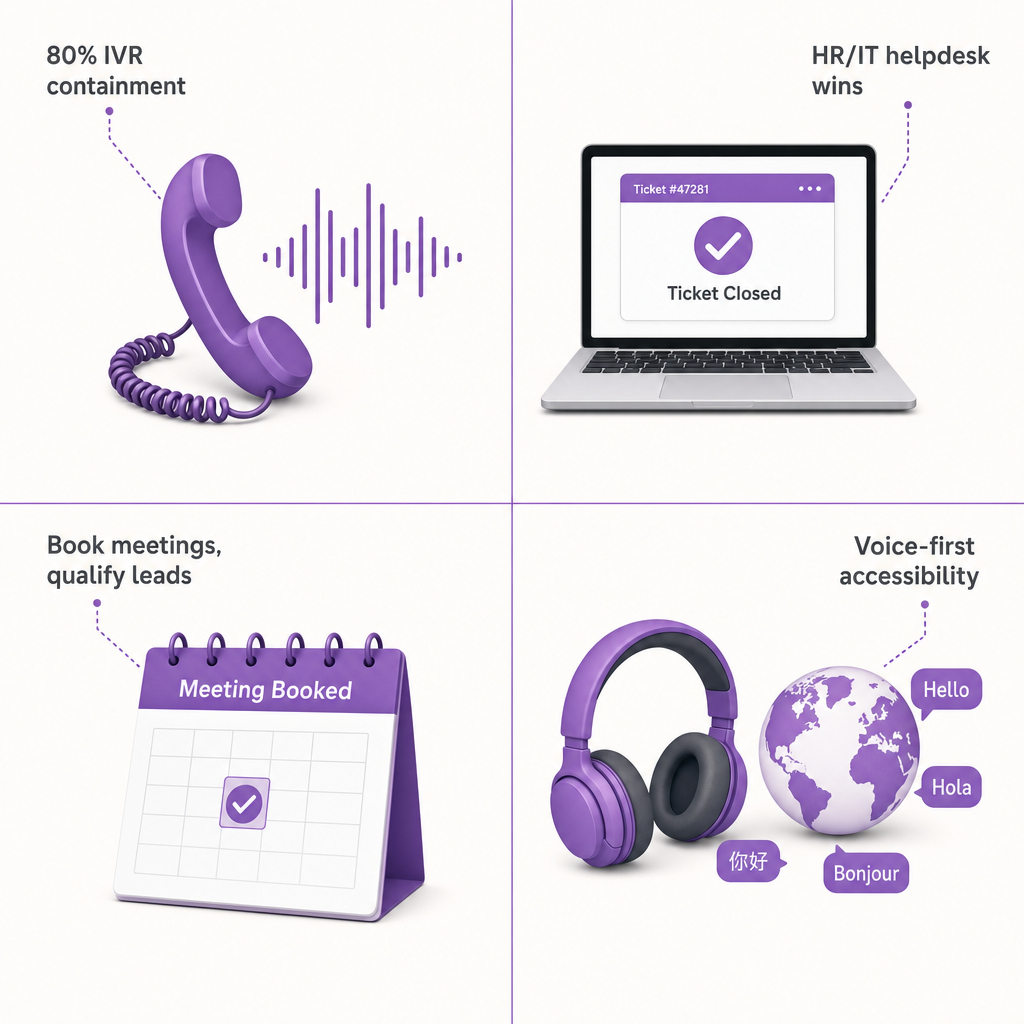
Conversational AI's highest-ROI deployments often live outside customer service.
Why Humanizing Conversational AI Output Matters
The trust gap
A robotic reply kills trust in one exchange. Zendesk's 2025 CX Trends report found 68% of consumers believe chatbots should match the expertise of highly skilled human agents, and 64% are more likely to trust AI that feels friendly and empathetic. Read those together and the message is brutal. Stilted, hedge-everything answers aren't just annoying. They're a churn signal. Your bot can ground every answer perfectly against your knowledge base and still lose the customer because it reads like a form letter.
Tone, length, and contractions
Humanizing your bot's writing comes down to a few concrete moves:
Vary sentence length. Mix short replies with longer explanations.
Use contractions. "You'll" beats "you will" every time.
Mirror the user's words. If they say "refund," don't switch to "reimbursement."
Cut corporate filler ("we value your patience," "rest assured").
Admit uncertainty when grounding fails, then hand off to a human.
One line you can't cross: don't pretend the bot is a person. The EU AI Act requires you to disclose AI interaction (per Article 50). Humanize the writing, not the identity.
This is where WriteHuman fits into a conversational AI stack. Pipe generated replies, knowledge base articles, and email responses through it to rewrite them in natural-sounding language, while your retrieval layer keeps the facts intact.
Limitations, Risks, and Compliance
Every conversational AI deployment ships with a risk surface vendor decks skip. Pressure-test these before you sign.
Hallucination and grounding failures
LLMs invent answers confidently, even with retrieval-augmented generation. There's no silver bullet. Require citation-linked outputs, route low-confidence responses to a human, and log every ungrounded answer for review. If your vendor can't show you the retrieved chunk behind a response, you can't audit it.
Prompt injection and data leakage
Any RAG pipeline that pulls from user-controlled data (tickets, emails, uploaded PDFs) is an attack surface. A malicious instruction buried in a support ticket can hijack your system prompt. Ask vendors two questions: do you sanitize retrieved content, and do you train on tenant data by default? A "yes" to the second is GDPR exposure.
Bias and accent fairness
Stanford researchers (Koenecke et al., 2020, PNAS) found commercial speech recognition had nearly twice the word error rate for Black speakers versus white speakers. That's an access problem, not a rounding error. Test your voice stack on the accents your customers actually have.
GDPR, HIPAA, TCPA, and the EU AI Act
Voice cloning fraud is rising, and consent regimes apply: TCPA in the US, GDPR in the EU. Put these EU AI Act dates on your roadmap:
August 2, 2026: Article 50 chatbot disclosure obligations apply.
December 2, 2026: AI-generated content watermarking requirements.
December 2, 2027: Annex III high-risk system obligations.
How to Evaluate a Conversational AI Platform: A 2026 Buyer's Checklist
Vendors love demoing on their own data. Make them demo on yours. Here's the shortlist to bring to your next call.
Metrics to demand in any vendor demo
Containment rate on your transcripts, not theirs. Healthy ranges: 40-60% for complex service, 60-80% for FAQ and password-reset work. Anything above 85% in a demo means the dataset was rigged.
Intent precision and recall across your top 20 intents. Ask for a confusion matrix. "97% accuracy" without a breakdown is theater.
CSAT lift and deflection measured against your current baseline over 60 days, not a case study from a different industry.
Data residency and tenant isolation: which region, which sub-processors, and who at the vendor can read logs.
Model swap-ability: can you move from GPT-5 to Claude Sonnet 4.6 to Gemini 3.1 Pro without rebuilding flows? If not, you're locked in.
Audit logging and explainability: every decision traceable, exportable, and mapped to EU AI Act Article 13 transparency requirements.
Decision flow: channel × audience × build-vs-buy × budget
Start with the channel. Voice-heavy? Pick a platform with native telephony. Text-only customer service? CX suites win on time-to-value. Internal helpdesk? Copilot Studio if you're Microsoft-shopped, watsonx Assistant if you're not. Developer team that wants control? Lex or Dialogflow. Agentic workflows touching CRM data? Agentforce or Fin.
One last thing. Humanize every generated reply before it ships. AI-flavored phrasing tanks CSAT faster than latency does.
Frequently asked questions
Sources (8)
- 1.AI Act | Shaping Europe's digital future - European Commissiondigital-strategy.ec.europa.eu
Primary source for EU AI Act timeline, Article 50 chatbot transparency obligations effective August 2, 2026, and risk-tier framework.
- 2.AI Act Service Desk FAQ - European Commissionai-act-service-desk.ec.europa.eu
Official Commission guidance on how the AI Act applies to chatbots, AI agents, and GPAI models — useful for the compliance section.
- 3.AI Act Update: EU Resolves to Change Rules and Extend Deadlines - Latham & Watkinslw.com
Legal analysis of the May 2026 AI Act Omnibus, including the August 2, 2026 chatbot transparency effective date and fine structure (€35M / 7% turnover).
- 4.Conversational AI Market Size, Share | Industry Report, 2030 - Grand View Researchgrandviewresearch.com
Primary source for market sizing: $11.58B in 2024, $41.39B by 2030, 23.7% CAGR. Cited by K2view; we'll cite the original.
- 5.Amazon Lex Pricing - AWSaws.amazon.com
Primary source for Lex free tier (10K text, 5K speech requests/month for first year), per-request pricing, and the July 15, 2025 $200 credit policy for new AWS customers.
- 6.AI customer service statistics for 2026 - Zendeskzendesk.com
Source for the 51% prefer-bot-for-immediate-service stat, 68% expect human-quality bots, and 64% trust friendlier AI agents — all attributed to Zendesk Benchmark data and CX Trends.
- 7.Zendesk CX Trends 2026cxtrends.zendesk.com
Current Zendesk research on consumer expectations, memory-rich agents, and the 24/7 availability expectation — used in the humanizing-output and use-cases sections.
- 8.Amazon Lex product page - AWSaws.amazon.com
AWS's own claim of up to 80% IVR containment for Lex deployments in contact centers; used in the use-cases section with attribution.