
2025 can be the year you finally finish that novel you keep swearing you’ll write. After all, the process seems less daunting when you’ve got an AI assistant just a tab away.
Though it’s important to remember AI is a collaborative tool rather than a replacement for the author, that doesn’t mean you can’t still use it as a tool to streamline your writing process.
It’s easier than ever to overcome creative roadblocks, structure compelling stories, and refine prose. Whether you're battling writer’s block or fine-tuning your manuscript, here’s how generative AI can aid your writing journey.
Choosing Your AI Assistant
When getting help with your novel, you’ll want to pick an AI assistant wisely. While ChatGPT, Co-Pilot, and Claude are all go-to tools, it’s also worth taking a look at novel-writing models like Squibler and Novelcrafter. You ought to also consider a humanizer AI tool like WriteHuman to allow your voice to truly shine through!
Or maybe you want to use multiple models in order to compare and contrast. That’s an excellent idea, too! But what’s really vital is not what you use, but how you use it.
Understanding Prompt Engineering for Undetectable AI
Prompts are the primary bridge between a human and a Large Language Model (LLM). Being able to effectively articulate what you’re asking for will produce the most ideal output.
For one, you’ll want to make sure you are being both specific and detailed.
Asking "Give me a story idea” gives little to no direction to your AI. Instead, it’s better to prompt it with something along the lines of: "Give me a sci-fi story idea set in a dystopian future where artificial intelligence controls human memories, featuring a rogue hacker as the protagonist."
It could also be a good idea to start off your prompts with a line assigning the AI a role or perspective, such as telling it "You are an experienced screenwriter." or “From the perspective of a professional novelist…”
Another thing to keep in mind is that prompting is a process. By going step-by-step, you are able to take an AI down a coherent line of reasoning.
Consider breaking prompts into stages rather than asking everything at once. For example:
"Generate a unique fantasy setting with the technological level of 15th century Europe and has three distinct regions."
"Describe the culture, history, and key conflicts of one region."
"Create a protagonist who is deeply connected to this conflict."
And so forth.
This method helps refine AI responses and ensures soundness in complex storytelling.
Lastly, continually provide input in regards to style and tone. If your assistant’s first response isn’t ideal, don’t settle! Instead…
Change phrasing: "Rewrite this in a more poetic style."
Add constraints: "Limit this to 200 words."
Try a different angle: "What if this scene was written from the villain’s POV?"
By treating prompting as a conversation rather than a process of giving commands, you can turn your AI assistant into an effective sandbox for workshopping your ideas.
AI Use Within Your Writing
Title Ideas
Finding the perfect title can be one of the trickiest and most frustrating aspects of writing your novel. Luckily, AI can help generate unlimited fresh ideas based on themes, genre, and tone. Try inputting a brief summary of your book, keywords, or mood to get AI-generated title suggestions.
Generating Writing Prompts
Struggling with writer’s block? AI can produce infinite writing prompts tailored to your genre and themes. You can even be more specific by asking it to provide things like dialogue starters, vivid sensory descriptions, and plot twists based on present storylines and character elements.
With the help of AI, writer’s block could be a thing of the past.
Plain-English Explanations & Text Summaries
Need to digest research quickly or summarize complex ideas? AI can condense articles, historical events, or scientific concepts into accessible language, helping you incorporate complex yet understandable information into your novel. Just make sure to fact check everything yourself!
Planning It Out
Outlining & Pacing
This is a fundamental building block that lots of writers struggle with. How does one best turn a brilliant idea into a well-structured, well-paced story? Again, your AI assistant can help.
For instance, you can ask it to create a chapter-by-chapter outline that follows the Hero’s Journey, the plot bell curve, the narrative arc, the three-act-structure, or other well-established storytelling structures.
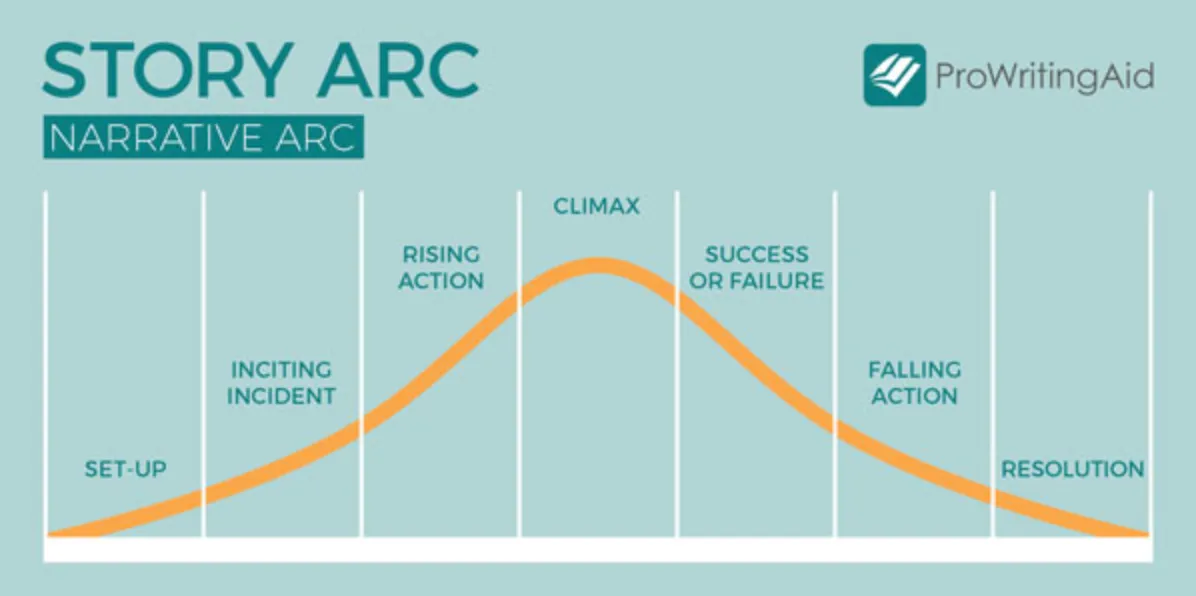
AI can generate scene breakdowns that ensure an engaging pace and optimal character development.
It can even get suggestions for plot twists, including tips for setting it up to deliver maximum payoff, guaranteed to keep readers hooked.
Sometimes, it’s the basics that trip up the greats. But don’t worry—with AI, the execution of your million-dollar idea won’t be derailed by such issues.
Keep your audience turning the pages!
Character Details
This can be a fun way to dip into generative AI—asking it to flesh out the personality and backstory of a particular character or characters. This may bring fresh ideas that you wouldn’t otherwise have considered.
AI can generate detailed character profiles including backstories, quirks, and motivations, helping you explore their past and how it shapes their actions in the story. If you already have your characters and their motivations written down, then AI can verify if they are behaving consistently and with agency.
AI is also incredible at streamlining your cast. Are you too attached to a character that is undeveloped or doesn’t serve the story? AI can analyze your cast and suggest ways to strengthen relationships, eliminate redundancy, or merge characters for a more organized narrative.
Finally, use AI to explore alternative character arcs! Want to see how different motivations or decisions affect your story? AI can simulate numerous paths for your characters, helping you explore different outcomes before committing to a final version.
Authors of the Self-Help Genre
Self-help authors in particular can benefit from using AI.
To start, it can summarize books, articles, and studies to find key insights. It can also analyze trends and common advice to help authors create fresh content.
For example, if writing about productivity, AI can summarize books like Atomic Habits and Deep Work to highlight key points and useful strategies.
When you have your research done, AI can suggest actionable and practical self-improvement tips based on your ideas.
Beyond just brainstorming, an AI assistant can help outline a book by suggesting logical chapter structures. It can even recommend where to include exercises, stories, or case studies.
AI is capable of speeding up the process while allowing authors to focus on their unique insights and experiences, doing its best to improve the author’s writing along the way.
AI for Editing, Improvement, and Refinement
AI can provide feedback on sentence structure, clarity, and tone—great for refining drafts before professional editing. This can help authors pinpoint weak areas.
Prompt Example: "Analyze this excerpt for pacing and suggest improvements."
AI-powered editing tools catch grammatical errors and refine sentence structure, ensuring a polished manuscript before human editors step in. Using humanizer AI tools can further enhance generated text, making it sound more fluid and indistinguishable from human writing.
Prompt Example: "Analyze this excerpt for grammatical mistakes, awkward phrasing, and repetition.”
Writing Style Analysis: AI can analyze your prose for tone consistency, readability, and voice, offering suggestions to match your intended style.
Key Takeaways
AI isn’t here to replace novelists— but it is here to enhance the writing process.
From brainstorming to structuring, character development to editing, AI can act as a valuable creative partner, helping writers spark ideas and confidently bring their stories to life. If you’re still looking for ways to embrace the AI revolution in your writing, check out this neat guide from Forbes.
Also, take a look at what The Author’s Guild has to say about the ethical practices for the aspiring novelist when working with AI. Always keep these considerations and industry standards in mind to avoid finding yourself in hot water later on.
As for our final thoughts on AI for writers, we say it’s crucial to remember that at the end of the day, generative AI is a tool. AI suggestions should always be cross-checked with your own judgement or with trusted human editors for nuance.
In other words, outputs created by generative AI should be considered a first stab – not the final word. Use it wisely, and your story will be uniquely yours.