Key takeaways
- AI slop means mass-produced, low-effort AI content. The defining trait is missing human judgment, not the presence of AI.
- The term went mainstream fast: Merriam-Webster's 2025 Word of the Year, then a literal "Seems like AI slop" report button on LinkedIn that over a million users clicked in three weeks.
- Platforms now punish it with distribution, not warnings: LinkedIn says copy-paste AI posters see about 40 percent fewer views, Substack lets readers scan posts with an AI detector, and Spotify removed more than 75 million spammy tracks.
- AI-assisted work stays out of the bucket through specifics, verification, and a recognizable voice. Editing is the moat.
Between late July and mid-August 2026, more than a million LinkedIn users pressed the same new button: "Seems like AI slop." LinkedIn shipped the report option on July 30, and within three weeks its chief product officer confirmed that accounts caught pasting AI-written posts were seeing roughly 40 percent fewer views. A professional network with over a billion members wrote the phrase "AI slop" directly into its interface, then started throttling whatever earned the label.
So here is the definition worth keeping. AI slop is low-quality, mass-produced content generated by AI and published with little or no human effort, judgment, or accountability. The operative word is slop, not AI. Text, images, video, and music all qualify the moment volume matters more than value. Merriam-Webster picked "slop" as its 2025 Word of the Year, defining it roughly as low-quality digital content produced in quantity by means of artificial intelligence. When a dictionary, a professional network, a newsletter platform, and a music streamer converge on the same word inside eighteen months, the word has stopped being slang. It is now policy language.
Where did the term "AI slop" come from?
The word bounced around image boards and Hacker News threads as early as 2022, mostly aimed at low-effort AI art. It became a movement in May 2024, when developer Simon Willison argued that "slop" should become the standard name for unwanted AI-generated content, the way "spam" became the standard name for unwanted email. The analogy stuck because it was precise. Nobody objects to email, but everybody objects to spam. Opinions split on AI assistance, but almost nobody defends the flood.
By December 2025, Merriam-Webster had made it official, naming "slop" the Word of the Year and noting that a term which once meant soft mud, and later food waste, now describes the low-grade AI output filling social feeds. Seven months after that, the phrase was a button on LinkedIn and a scan feature on Substack. Few slang terms have ever traveled from message board to platform policy that quickly.
What does AI slop look like? The recognizable patterns
Slop is easier to recognize than to define, which is exactly why LinkedIn built a one-click report for it instead of publishing a rubric. The recurring patterns:
Engagement-bait posts. The inspirational story with a suspiciously tidy arc, three-line paragraphs, a lesson in bold, and "Agree?" at the end. Polished surface, nothing underneath.
Articles that summarize other articles. Keyword-shaped posts with no reporting, no first-hand experience, and no claim a reader could not get from the first page of search results.
Automated comments. "Great insight! Thanks for sharing." LinkedIn had already blocked billions of automated comment attempts before the report button even launched.
Batch-uploaded audio. Fake ambient tracks and meditation loops pushed to streaming platforms under invented artist names, at industrial scale. This is the version Spotify spent 2025 deleting.
AI image spam. Feeds of near-identical generated visuals, the flood that pushed Pinterest to label Gen AI content and give users a dial to see less of it.
The prose tells. Hollow symmetry, rule-of-three sentence patterns, "delve" and its cousins, transitions that connect nothing. We cataloged the current list in our breakdown of the AI tells readers actually notice in 2026.
Careful writing that happened to involve AI somewhere in the process appears nowhere on that list. Slop is a judgment about quality, not about which tool you used.
Why is AI slop suddenly everywhere?
Because the economics broke. Producing a passable-looking post, article, image, or track now costs close to nothing, while recommendation feeds still reward volume and posting frequency. When output is free and distribution pays, someone will always flood the zone. It is the same math that buried email under spam two decades ago, replayed across every feed at once.
The scale is not hypothetical. Forbes, covering the LinkedIn crackdown in August 2026, cited research finding that more than 40 percent of long-form LinkedIn posts are fully AI-generated. Spotify said it removed over 75 million spammy tracks in a single twelve-month stretch. LinkedIn reported blocking millions of automation attempts on top of the daily comment flood. Platforms did not develop a sudden aesthetic objection to mediocre writing. They watched the sheer tonnage of it start to erode the thing they actually sell, which is user trust that the feed is worth opening.
Do platforms penalize AI slop?
Yes, and 2026 is the year the penalties became explicit product features rather than quiet ranking tweaks.
LinkedIn added "Seems like AI slop" to its report menu on July 30, 2026, and feeds those reports back into the models that decide how far a post travels beyond your own network. "AI slop is a top priority for all of us," chief product officer Hari Srinivasan said at launch. Three weeks in, over a million members had used the button and copy-paste AI posters were down roughly 40 percent in views. LinkedIn also retired its own "enhance your post" rewriting feature and replaced it with a proofreader, a telling admission about which kind of AI assistance it wants to encourage. We unpack the mechanics and what they mean for your posting strategy in our full report on the LinkedIn AI slop crackdown.
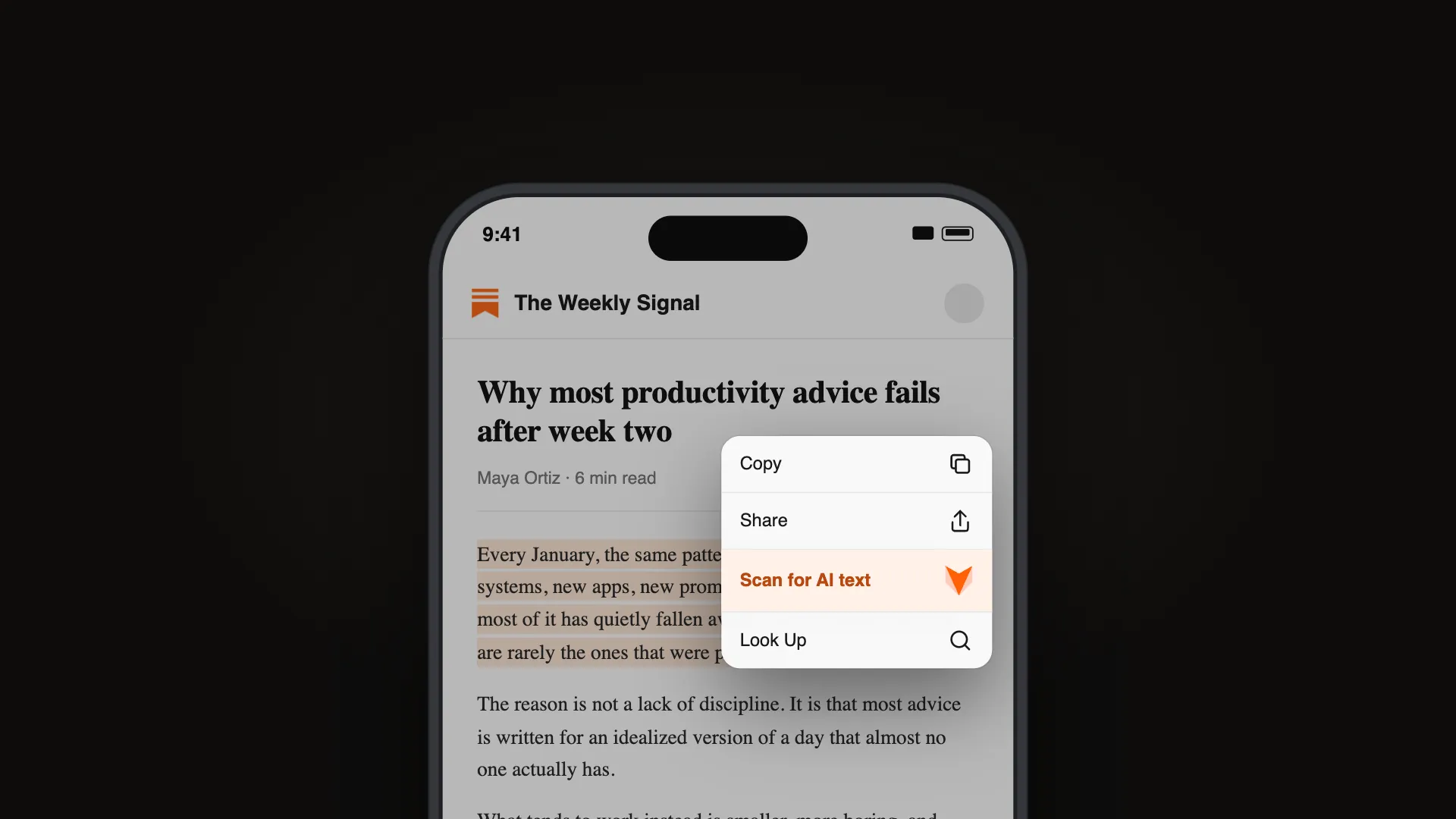
Substack went a different route: transparency instead of suppression. Since July 2026, readers can run a "Scan for AI text" check, powered by the detection company Pangram, on posts, notes, and comments published on or after July 21, and get an estimate of how much of the text was human-written. Writers can pre-scan their own drafts, dispute results, and publish a "How I make this" disclosure. Substack is betting that paying subscribers want humans, and it handed them an instrument.
Spotify announced new anti-spam policies in September 2025 after deleting those 75 million tracks, while stressing that AI-assisted music itself is not banned. Pinterest now applies "AI modified" labels using both metadata and its own classifiers, plus user controls to reduce Gen AI content in certain feeds.
Read the fine print across all four and the same asymmetry appears everywhere. No major platform has banned AI-assisted content. Every one of them is building machinery to detect and demote the unedited, high-volume version of it. The policies target effort, not tooling.
How to keep AI-assisted work out of the slop bucket
The dividing line every platform keeps drawing is human judgment. Content that shows evidence of a person thinking gets treated as authentic. Content that could have been produced by a cron job gets buried. That standard is workable. Here is what it looks like in practice for professionals, marketers, and creators who use AI in their drafting process.
Edit for specifics. Slop is generic by nature, so specificity is the cheapest possible differentiator. Real numbers, named tools, dates, the client project that went sideways, the result you actually measured. One concrete detail per section that only you could supply moves a piece out of the average.
Verify every claim before you publish. A hallucinated statistic is the fastest route from "AI-assisted" to "AI slop," and unlike a clunky sentence it costs credibility you do not get back. If a model gave you a number, find the primary source or cut the number.
Keep your voice in the final pass. Read the draft aloud and delete anything you would never say to a colleague. Sand off the patterns that read as machine output, the ones from the 2026 tells list, because reviewers and report buttons alike key on exactly those.
Check how the draft scores before your audience does. Substack put a detector in readers' hands, and plenty of editors and clients now run one privately. Running your own draft through a free AI detector first shows you the probability score a reader would see. Treat that score as a signal about how the prose reads, not a verdict on your integrity, and revise the sections that trip it.
Use humanizing as polish, not disguise. A tool like WriteHuman's AI humanizer rewrites stiff, AI-flavored phrasing into natural human cadence, which is genuinely useful as a final pass on a draft you have already fact-checked and made your own. You can try it on the homepage without an account, and the free plan covers three humanizations a month at 250 words each. What no rewriting tool can supply is the substance underneath. Polish work you stand behind because nothing rescues work you did not think about, and platforms are getting steadily better at telling the difference.
The bar moved, and that is good news
Here is the part the doom coverage skips. Every reach penalty aimed at slop is reach redistributed toward people with something real to say. LinkedIn throttling copy-paste posts by 40 percent means the marketer with actual campaign data, the freelancer with a genuine point of view, and the job seeker writing in their own voice are all suddenly competing against less noise. "AI slop" became the word of the moment because the flood got undeniable. The response to the flood, from every major platform at once, quietly rebuilt the case for doing the work.
Frequently asked questions
Sources (10)
- 1.
- 2.
- 3.
- 4.LinkedIn offers the option to report AI slop (Social Media Today)socialmediatoday.com
- 5.
- 6.How can I detect AI on Substack? (Substack Support)support.substack.com
- 7.
- 8.
- 9.
- 10.Introducing Gen AI Labels (Pinterest Newsroom)newsroom.pinterest.com